Crime in India 2026: NCRB Report — Key Findings and Policy Implications

Introduction
-
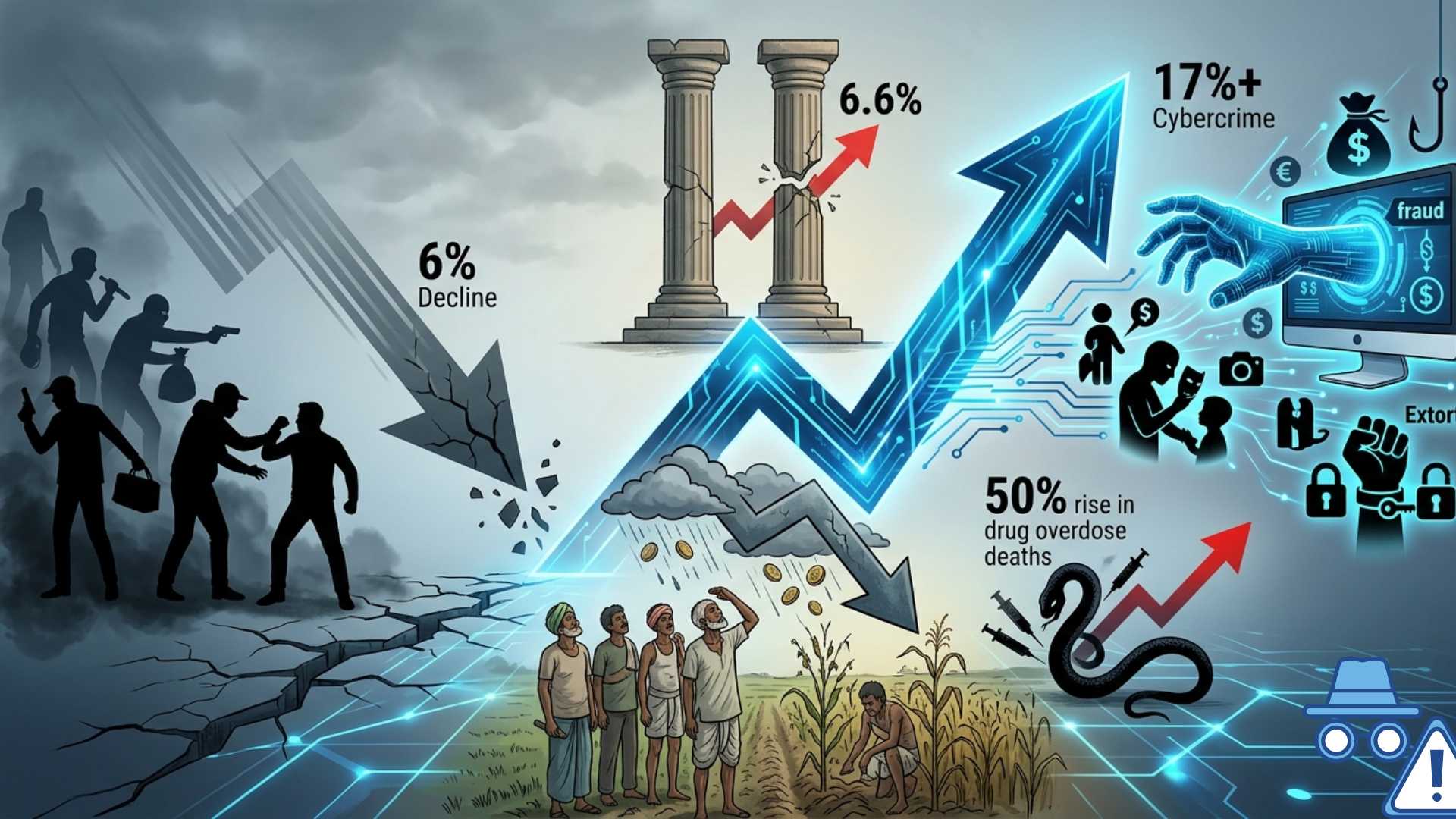
The National Crime Records Bureau's Crime in India 2024 report presents a paradox: overall cognisable crime fell 6% to 58.86 lakh cases, yet cybercrime surged 17.4% — crossing the 1 lakh mark for the first time at 1,01,928 cases.
-
Simultaneously, farmer suicides, drug overdose deaths, and crimes against marginalised communities reveal deep structural fault lines beneath the headline decline.
| Category | 2023 | 2024 | Change |
|---|---|---|---|
| Total cognisable crimes | ~62.6 lakh | 58.86 lakh | ↓ 6% |
| Cybercrime cases | 86,420 | 1,01,928 | ↑ 17.4% |
| Crimes against SCs | 57,789 | 55,698 | ↓ 3.6% |
| Crimes against STs | 12,960 | 9,966 | ↓ 23.1% |
| Offences against State | 4,873 | 5,194 | ↑ 6.6% |
| Total suicides | — | 1,70,746 | — |
| Farmer/cultivator suicides | — | 4,633 | — |
| Drug overdose deaths | 650 | 978 | ↑ 50% |
Cybercrime: The Dominant Emerging Threat
-
Cybercrime has emerged as India's fastest-growing crime category, driven overwhelmingly by financial fraud (72.6% — 73,987 cases), followed by sexual exploitation (3.1%) and extortion (2.5%).
-
The crossing of the 1 lakh threshold is significant — it reflects not merely increased incidence but also improved reporting awareness. However, dark figures remain high; most cyber fraud victims do not register FIRs.
-
The motive profile — fraud-dominant — points to organised cybercriminal networks exploiting India's rapidly expanding digital financial infrastructure, UPI penetration, and digitally semi-literate user base.
-
Policy gaps: India lacks a standalone comprehensive cybersecurity law. The IT Act, 2000 (amended 2008) and BNS provisions remain inadequate against sophisticated transnational cybercrime operations.
Internal Security: Offences Against the State
Of 5,194 cases registered under offences against the State, 84.6% fell under the Prevention of Damage to Public Property Act and 12.5% under the Unlawful Activities (Prevention) Act (UAPA). The 6.6% rise warrants attention in the context of India's internal security architecture and the use of special legislation.
Social Distress: Suicides and Structural Vulnerability
| Suicide Category | Count | Share of Total |
|---|---|---|
| Total suicides | 1,70,746 | 100% |
| Farming sector (total) | 10,546 | 6.2% |
| — Farmers/cultivators | 4,633 | — |
| — of which male | 4,481 | — |
| — of which female | 152 | — |
| — Agricultural labourers | 5,913 | — |
| Daily wage workers | ~52,931 | ~31% |
| Unemployed persons | 14,778 | — |
| Students | 14,488 | — |
| Housewives | 22,113 | — |
The ADSI 2024 report reveals suicides as a mirror of India's unresolved agrarian, economic, and social crises:
Agrarian distress: 10,546 persons from the farming sector died by suicide — 4,633 farmers/cultivators (4,481 male, 152 female) and 5,913 agricultural labourers — accounting for 6.2% of total suicides.
Economic precarity: Daily wage workers accounted for ~31% of total suicides. Unemployed persons: 14,778 deaths. The convergence of agrarian distress and wage precarity points to structural economic exclusion rather than individual vulnerability.
Social categories: Housewives (22,113) and students (14,488) represent significant and underanalysed suicide cohorts requiring targeted mental health and social support policy.
Drug Overdose: A Silent Epidemic
Drug overdose deaths rose 50% — from 650 (2023) to 978 (2024). State-wise distribution:
| State | Deaths |
|---|---|
| Tamil Nadu | 313 |
| Punjab | 106 |
| Madhya Pradesh | 90 |
| Rajasthan | 69 |
| Mizoram | 65 |
Tamil Nadu's disproportionate share warrants investigation into pharmaceutical drug misuse alongside traditional narcotics. Punjab's presence reflects the entrenched drug crisis in the northwest. The 50% single-year spike signals a public health emergency requiring inter-ministerial coordination between Home, Health, and Social Justice ministries.
Conclusion
The NCRB 2024 data demands a disaggregated policy response.
-
The headline decline in overall crime masks three urgent realities: a cybercrime surge that outpaces India's digital governance framework; a suicide crisis rooted in agrarian distress, unemployment, and social precarity; and a drug overdose spike signalling systemic public health failure.
-
Sound governance requires reading crime data not as a performance metric but as a diagnostic tool — one that maps where state policy has failed to reach, protect, and support its most vulnerable citizens.
Attribution
Original content sources and authors


Syllabus classification
How this article maps to GS papers
Main syllabus
GS1Indian SocietyQuick Q&A
What does the NCRB Crime in India 2024 report reveal about the changing nature of crime in India?
The report recorded 1,01,928 cybercrime cases in 2024, compared to 86,420 cases in the previous year. A majority of these crimes were linked to financial fraud, accounting for over 72% of all cybercrime cases. This trend reflects the growing digitisation of India’s economy through online banking, UPI transactions, e-commerce, and social media usage. Criminal networks are exploiting gaps in digital literacy, weak cybersecurity practices, and technological vulnerabilities.
The report also reflects deeper socio-economic challenges. Although crimes against SCs and STs declined statistically, the persistence of such crimes indicates structural inequalities and social discrimination. Similarly, the increase in offences against the state and drug overdose deaths points toward emerging concerns related to internal security and public health.
Another important aspect is the high number of suicides among farmers, unemployed persons, students, and daily wage workers. This demonstrates that crime statistics are not merely law-and-order indicators but also mirrors of economic distress, social pressures, and governance challenges.
Thus, the NCRB report serves as a multidimensional governance document. It provides insights into policing efficiency, socio-economic stress, digital vulnerability, and the changing nature of criminal activity in India.
Why has cybercrime emerged as a major internal security challenge for India?
According to the NCRB report, over 72% of cybercrime cases were related to fraud. These include phishing attacks, OTP scams, identity theft, investment frauds, and online financial manipulation. Criminals often target vulnerable populations such as senior citizens, rural users, and first-time internet users who may lack digital awareness.
The implications extend beyond individual financial loss. Cybercrime can undermine trust in India’s digital economy and governance ecosystem. For example, attacks on banking systems, health databases, or critical infrastructure can disrupt economic activities and compromise national security. Cyber threats are also increasingly transnational, involving international fraud syndicates, cryptocurrency transactions, and dark web operations.
India faces several structural challenges in combating cybercrime:
- Shortage of trained cyber forensic experts
- Low conviction rates due to technical complexity
- Lack of coordination between States and agencies
- Limited digital literacy among citizens
- Rapid technological evolution outpacing legal frameworks
The government has taken measures such as the Indian Cyber Crime Coordination Centre (I4C), cybercrime helplines, and CERT-In initiatives. However, stronger institutional capacity and public awareness remain essential.
In the long run, cybersecurity must be viewed not merely as a technological issue but as a governance and national security priority. India’s digital economy can succeed only if citizens feel secure in using digital platforms.
Critically analyse whether a decline in overall crime rate necessarily indicates improvement in law and order in India.
The NCRB report shows a 6% decline in cognisable crimes in 2024. On the surface, this may suggest improved policing and better governance. However, certain categories such as cybercrime, offences against the state, and drug overdose deaths have increased significantly. This indicates that while traditional crimes may have reduced, new forms of crime are emerging rapidly.
Another limitation is underreporting. Many crimes, particularly those involving women, marginalised communities, or cyber fraud, often go unreported due to fear, social stigma, lack of awareness, or distrust in law enforcement agencies. Therefore, lower crime numbers may sometimes reflect inadequate reporting mechanisms rather than actual reductions in crime.
There are also regional disparities in crime recording and policing standards. States with stronger reporting systems may show higher crime rates simply because victims are more willing to register complaints. Conversely, low crime rates in some areas may conceal administrative inefficiencies or social pressures discouraging complaints.
However, the decline should not be dismissed entirely. Improved surveillance, better policing technologies, community policing initiatives, and stricter legal frameworks may indeed contribute to reductions in certain categories of crimes.
Therefore, crime statistics should be evaluated alongside other indicators such as conviction rates, citizen trust in police, speed of justice delivery, cyber resilience, and social welfare outcomes. A holistic understanding of law and order requires both quantitative and qualitative assessment.
What socio-economic factors contribute to the high suicide rates among farmers, unemployed persons, and daily wage workers in India?
In the agricultural sector, multiple structural problems contribute to distress. Farmers face unpredictable monsoons, rising input costs, debt burdens, crop failures, market volatility, and inadequate access to institutional credit. Small and marginal farmers are especially vulnerable because their incomes remain uncertain despite their dependence on agriculture for survival.
For daily wage workers and unemployed persons, economic insecurity is a major factor. Informal sector workers often lack social protection, stable employment, healthcare access, and savings. Economic disruptions, inflation, automation, and limited job opportunities create psychological stress and social insecurity.
Psychological and social dimensions are equally important. Mental health awareness remains low in India, and many individuals hesitate to seek professional help due to stigma. Social expectations, family responsibilities, educational pressures, and isolation further aggravate emotional distress.
The issue must therefore be approached as both an economic and public health challenge. Government measures such as PM-KISAN, MGNREGA, crop insurance schemes, and employment-generation initiatives provide some support, but implementation gaps remain.
A comprehensive strategy should include:
- Strengthening rural credit systems
- Expanding mental health counselling services
- Creating sustainable employment opportunities
- Improving social security coverage for informal workers
- Enhancing awareness regarding mental health
Ultimately, reducing suicides requires not only economic reforms but also compassionate social support systems and accessible mental healthcare infrastructure.
How can the rise in drug overdose deaths be understood as both a public health and law-and-order issue? Illustrate with examples.
From a public health perspective, drug addiction is a medical and psychological issue. Substance abuse often results from stress, unemployment, peer pressure, mental health disorders, or social alienation. Lack of rehabilitation centres, inadequate counselling services, and poor awareness worsen the situation. Young people are particularly vulnerable due to easy access to synthetic drugs and online narcotics networks.
At the same time, drug abuse is deeply connected to organised crime and illegal trafficking networks. Drug cartels exploit porous borders, digital payment systems, and weak enforcement mechanisms to expand narcotics trade. States like Punjab have long struggled with cross-border drug trafficking, while urban areas increasingly face synthetic drug circulation through online channels.
The issue has serious socio-economic implications:
- Loss of productive workforce
- Increase in healthcare burdens
- Rise in petty crimes and violence linked to addiction
- Weakening of family and community structures
For example, several rehabilitation initiatives in Punjab combine de-addiction programmes with skill development and counselling. Similarly, awareness campaigns in schools and colleges aim to prevent youth addiction.
A balanced response requires both strict enforcement and social rehabilitation. While stronger policing and anti-trafficking operations are necessary, excessive criminalisation of addicts without treatment support may worsen the problem. Therefore, India needs an integrated policy combining healthcare, education, policing, border management, and community participation.
How can India strengthen its institutional capacity to deal with emerging crimes such as cyber fraud and digital exploitation?
First, India must modernise policing infrastructure. Police forces require advanced cyber forensic laboratories, AI-based monitoring systems, and trained cyber specialists capable of investigating digital evidence. Capacity-building programmes should be institutionalised across States to improve investigative competence.
Second, legal and regulatory frameworks must evolve continuously. Existing laws often struggle to address issues such as cryptocurrency fraud, deepfake technology, data breaches, and transnational cybercrime. Faster judicial processes and specialised cybercrime courts can improve conviction rates and deterrence.
Third, inter-agency coordination is essential. Cyber threats frequently involve multiple jurisdictions and international actors. Agencies such as CERT-In, I4C, state cyber cells, banks, telecom operators, and global cybersecurity institutions must work together through real-time information sharing.
Public awareness is equally critical. Many cyber frauds succeed because citizens unknowingly share OTPs, passwords, or personal information. Digital literacy campaigns should target rural populations, students, senior citizens, and small businesses.
India can also learn from global best practices. Countries such as Estonia and Singapore have developed strong cyber resilience through integrated digital governance and cybersecurity education.
Ultimately, emerging crimes require a governance model that combines technology, institutional efficiency, legal adaptability, and citizen participation. Cybersecurity should become an integral part of India’s broader national security and development strategy.
Practice questions
7 questions for mains preparation