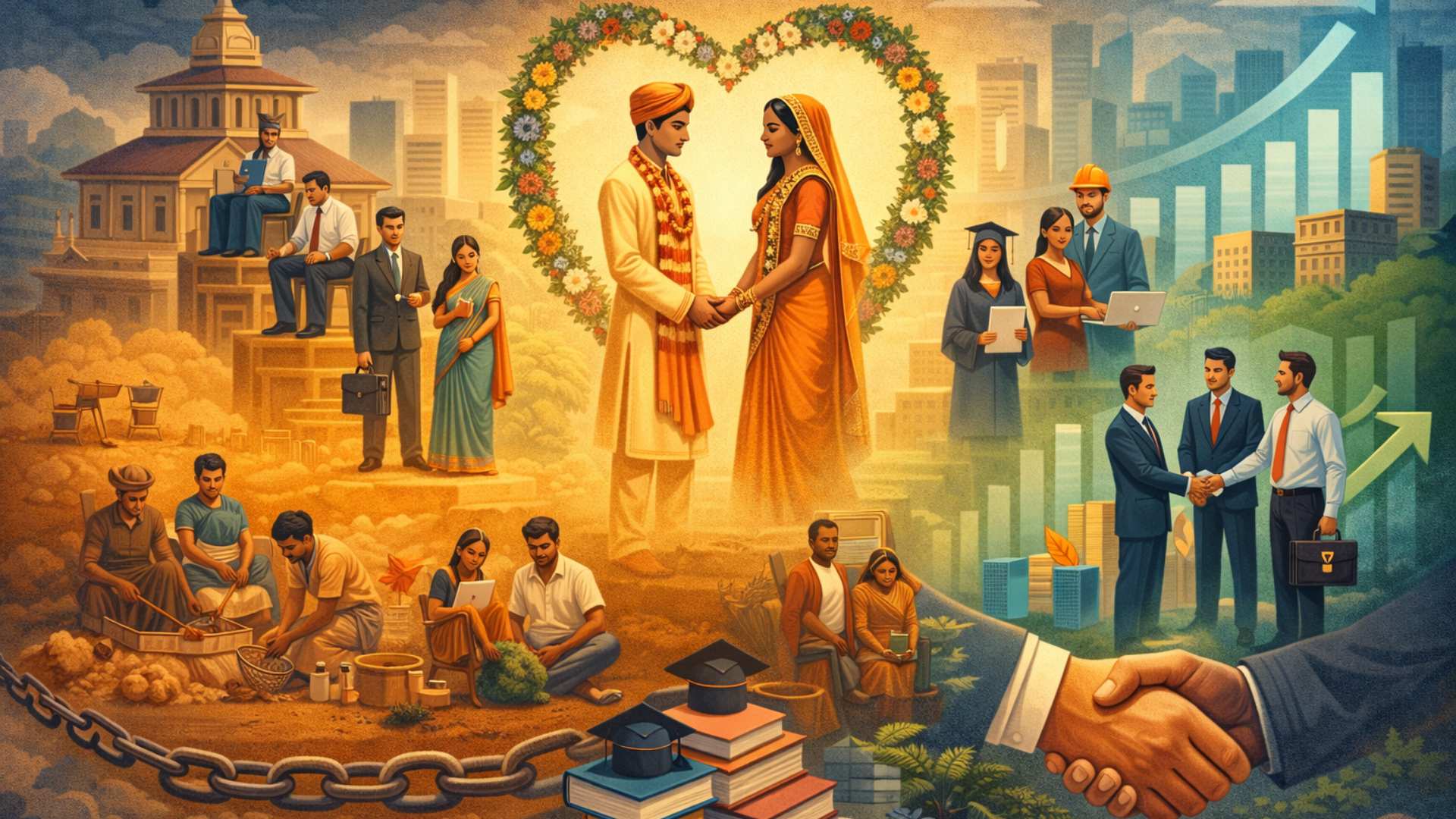
Modernisation of Economy vs Modernisation of Society: Caste, Employment and Social Equality
1. Economic Growth vs Social Modernisation Gap
India has experienced sustained economic growth for nearly four decades. However, social modernisation has not progressed at the same pace. Persistent caste-based discrimination, social isolation, and unequal employment opportunities continue to hinder inclusive development.
The deepest structural root of inequality in India remains the hierarchical caste system, reinforced historically through endogamy and caste-based division of labour. Dalits and Adivasis, constituting nearly 25% of the population, remain at the bottom of this hierarchy.
While economic modernisation expands markets and incomes, social stratification limits equal participation. If unresolved, this divergence between economic growth and social transformation may weaken long-term developmental outcomes and social cohesion.
“Political democracy cannot last unless there lies at the base of it social democracy.” — B.R. Ambedkar
Economic growth without social equality produces segmented development. If caste-based exclusion persists, India’s demographic and economic potential will remain partially unrealised.
2. Historical Institutionalisation of Caste Hierarchy
Caste hierarchy became structurally embedded during colonial rule through Census classification and judicial enforcement of within-caste marriage under Hindu law. Inter-caste marriage required renouncing Hinduism, reinforcing social separation.
Post-independence reforms, including the Hindu Marriage Act, 1955, modernised marriage laws. Earlier attempts such as Vithalbhai Patel’s Bill and Arya Samaj reforms indicated the push toward social reform during the freedom movement.
Despite legal reform, social practice continues to favour endogamy. Surveys from the decade beginning 2010 indicate that only 5–6% of marriages are inter-caste, showing that inherited caste identities still shape family formation and social networks.
“Caste is not merely a division of labour. It is also a division of labourers.” — B.R. Ambedkar, Annihilation of Caste
Legal reform alone cannot dismantle deep-rooted social norms. Without changes in marriage patterns and social interaction, caste boundaries remain institutionally reproduced.
3. Inter-Caste Marriage and Social Integration
Inter-caste marriages are a critical indicator of social integration. The Dr Ambedkar Scheme for Social Integration through Inter-Caste Marriages has had limited impact.
Current inter-caste marriages are largely confined to non-Scheduled Castes, particularly among upper castes. This reflects social connectivity based on comparable economic status rather than genuine cross-hierarchy integration.
True integration of Scheduled Castes (SCs) and Adivasis into socially connected networks depends on economic mobility that narrows status differences.
“Turn in any direction you like, caste is the monster that crosses your path.” — B.R. Ambedkar
Inter-caste marriage reflects deeper social equality. Without economic equalisation, caste boundaries continue to shape social capital and opportunity structures.
4. Persistent Economic Inequalities Across Castes
Economic data reveals continued disparities in income, consumption, and employment outcomes.
- Statistics:
- SC/ST monthly consumption is 7–20% lower than the national average (Household Consumption Expenditure Survey 2022-23).
- SC/ST income relative to others is:
- 10% lower for casual workers
- 24% lower for regular workers
- 28% lower for self-employed workers (Azim Premji University study)
Employment patterns further reflect structural disadvantage.
- PLFS 2023-24:
- Regular wage/salary employment:
- Adivasis: 12.6%
- SCs: 20.6%
- OBCs: 20.2%
- Higher castes: 30.3%
- 29.7% of Adivasi employment is as helpers in household enterprises (possibly unpaid).
- Regular wage/salary employment:
These disparities demonstrate incomplete economic integration despite constitutional guarantees of equality.
Income and employment gaps institutionalise caste hierarchy in economic form. Without equal access to quality jobs, social equality remains aspirational.
5. Informality and Worker Vulnerability
India’s labour market is predominantly informal, limiting social mobility across caste groups.
- PLFS 2023-24:
- Only 21.7% of workers have regular wage/salary employment.
- 19.8% are casual labourers.
- 19.4% are helpers in household enterprises.
Even among regular wage employees:
- 58% have no job contract.
- 47.3% are not eligible for paid leave.
- 53.4% lack social security benefits.
Such informality disproportionately affects lower-caste groups, reinforcing vulnerability and limiting upward mobility.
“Justice, social, economic and political…” — Preamble to the Constitution of India
Formal employment with rights and protections is central to social modernisation. Persistent informality reproduces economic and caste-based hierarchies.
6. Education, Higher Education and Access to Quality Jobs
Access to quality higher education significantly reduces caste-based disparity. Lower-caste individuals and Adivasis with higher education show comparatively lower inequality.
However, discrimination in higher education institutions remains a concern. The suicides of Rohith Vemula and Payal Tadvi triggered regulatory reforms, including University Grants Commission measures against discrimination on campuses.
Reservations in education and public employment have been instruments of corrective justice. Given persistent hierarchy in senior bureaucratic and managerial positions, limited caste-linked reservations may still be necessary for a defined period.
“Educate, Agitate, Organize.” — B.R. Ambedkar
Education is the primary equaliser in a stratified society. Without equitable access to higher education and quality jobs, structural caste disparities endure.
7. Occupational Segregation and Social Isolation
Though caste-based occupational rigidity has reduced, it has not disappeared. Manual scavenging, waste disposal, and crematorium-related work continue to be disproportionately performed by Scheduled Castes.
Adivasis remain relatively isolated from the mainstream economy and political processes. Social and political discrimination persists despite constitutional safeguards.
The continued linkage between caste and occupation reflects incomplete structural transformation of India’s labour and social systems.
“Fraternity assuring the dignity of the individual and the unity and integrity of the Nation.” — Preamble to the Constitution of India
Occupational concentration reinforces caste identity and limits mobility. Unless dismantled, it perpetuates intergenerational disadvantage.
8. Way Forward: Linking Economic and Social Modernisation
The modernisation of Indian society requires structural reforms beyond income growth.
- Policy Measures:
- Expand access to quality higher education for SCs and STs.
- Strengthen skill development linked to formal sector employment.
- Support startups and entrepreneurship among socially disadvantaged groups.
- Ensure strict enforcement of anti-discrimination laws.
- Promote formalisation of employment with worker protections.
- Encourage social integration through inter-caste marriages.
Economic inclusion of marginalised communities is not merely welfare; it contributes to broader productivity and investment growth.
“Equality may be a fiction but nonetheless one must accept it as a governing principle.” — B.R. Ambedkar
Inclusive economic modernisation accelerates social transformation. Without deliberate policy intervention, caste-based inequalities may persist even in a high-growth economy.
Conclusion
India’s path to becoming a developed nation by 2047 requires synchronising economic growth with social modernisation. Eliminating caste-based inequalities through education, formal employment, and social integration is central to achieving constitutional equality and sustainable development. True modernisation will be measured not only by GDP growth, but by the dismantling of inherited social hierarchies.