
Introduction
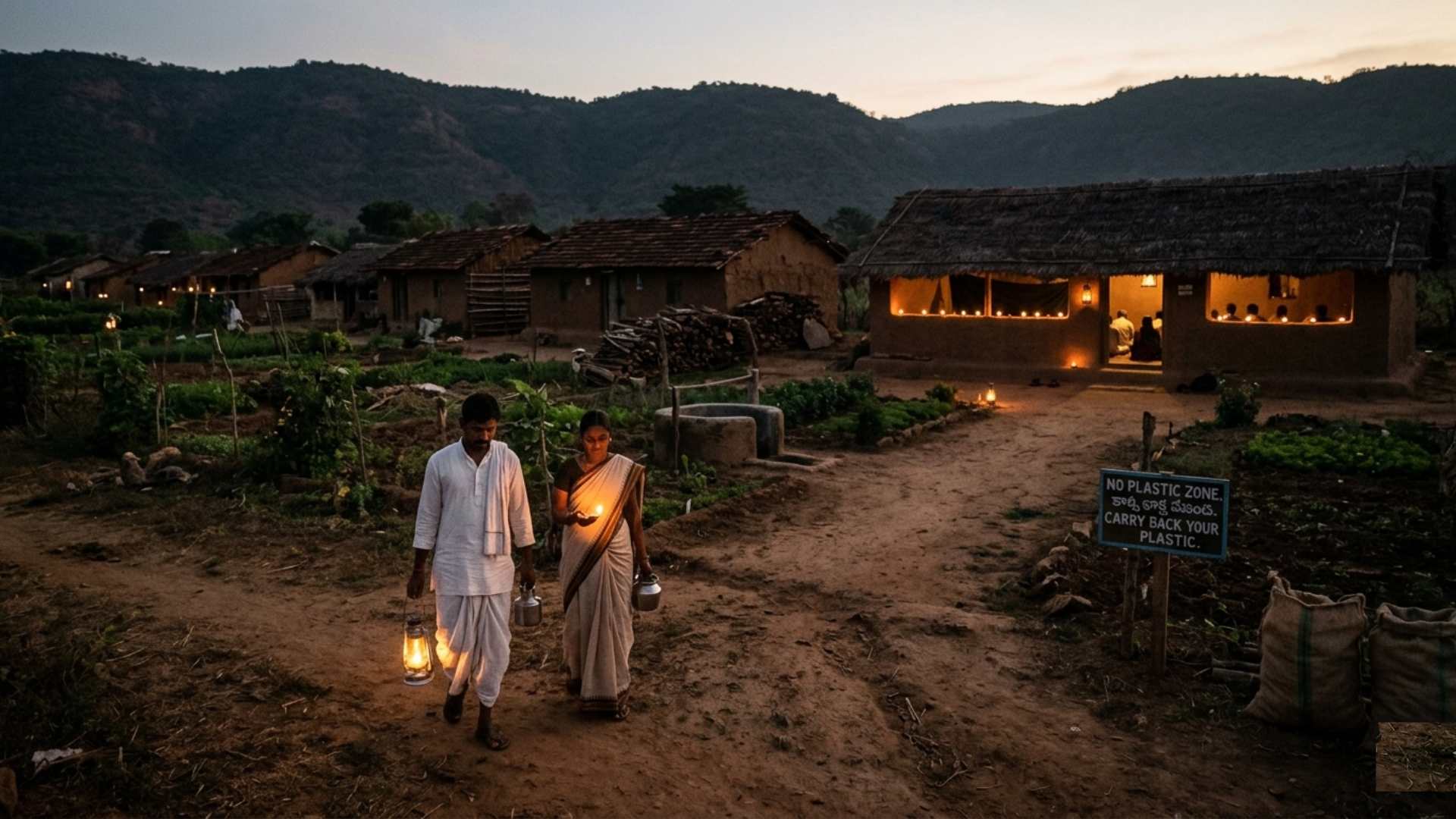
India's development narrative is largely defined by urbanisation, technological integration, and economic growth. Yet a countermovement is quietly emerging — intentional communities that voluntarily withdraw from modernity in pursuit of spiritual and ecological living. Kurma Gramam, a 60-acre Vedic hamlet in Andhra Pradesh's Srikakulam district, is one such community. With 85 residents across 17 families — some of them engineering graduates — it represents a conscious rejection of consumerist values, offering a lens through which to examine India's social fabric, sustainability challenges, and ethical questions about the good life.
"The good life is one inspired by love and guided by knowledge." — Bertrand Russell
Background & Context
Established in 2018 under the spiritual guidance of Bhakta Vikas Swami, Kurma Gramam draws its name from the Sri Kurmam temple — the world's only shrine dedicated to Vishnu's Kurma (tortoise) avatar. What began with two families has grown to 85 residents from Andhra Pradesh, Telangana, Odisha, and Maharashtra.
The village operates entirely without electricity, LPG, mobile internet, and tap water. Houses are mud-and-wood structures with earthen floors. Clothing is handwoven within the village. The daily schedule — 3:30 AM to 8:30 PM — is anchored by twice-daily Bhagavad Gita discourses.
Key Concepts
| Concept | Relevance to Kurma Gramam |
|---|---|
| Intentional Community | Voluntary, value-based co-habitation outside mainstream society |
| Voluntary Simplicity | Deliberate reduction of consumption for spiritual/ecological reasons |
| Subsistence Living | Self-sufficiency through agriculture, handloom, and local crafts |
| Alternative Education | Gurukul model — Vedic knowledge, Sanskrit, skill-based learning over formal curriculum |
| Ecological Sanitation | Compost-based waste management; no septic tanks; zero plastic |
Sociological Significance
Kurma Gramam is a case study in what sociologist Durkheim called mechanical solidarity — community cohesion based on shared beliefs and homogeneous roles, as opposed to the organic solidarity of modern, differentiated societies. Its residents — including B.Tech graduates who walked away from IT careers — represent a growing disillusionment with the alienation of urban-industrial life.
The village also reflects the Gandhian ideal of gram swaraj: self-reliant village republics as the true unit of Indian civilisation. Gandhi wrote in Hind Swaraj that "real home rule is self-rule or self-control."
Education Model — A Critical Assessment
The village runs a Gurukul where children study until ages 13–14, after which they are guided toward vocational skills — agriculture, cooking, handloom, or carpentry — based on observed aptitude.
Strengths: Holistic development; low stress; skill-aligned learning; cultural preservation.
Limitations: No formal certification; children may face barriers to re-entering mainstream education or economy; potential restriction of individual choice in career paths; limited exposure to constitutional rights and civic awareness.
This raises a tension central to GS4 ethics — the conflict between community values and individual autonomy, and the State's obligation to ensure the Right to Education (Article 21A) is not inadvertently compromised.
Sustainability Practices
- Earthen architecture (low embodied energy, passive cooling)
- Firewood stoves (no LPG dependency, but raises indoor air quality concerns)
- Composting lavatories (circular waste management)
- Rainwater/well-based water sourcing
- Plastic ban with visible signage and community enforcement
- Subsistence farming with kitchen gardens
This aligns with several SDG targets: SDG 11 (Sustainable Cities & Communities), SDG 12 (Responsible Consumption), SDG 15 (Life on Land).
Challenges & Concerns
- Healthcare access: No modern medical facility within the village; dependence on traditional remedies raises concerns especially for children and elderly.
- Child rights: Alternative schooling, while culturally rich, may limit children's future agency and constitutional entitlements.
- Gender equity: Gendered spatial segregation (prayer hall divided by cloth; traditional dress codes for women) warrants scrutiny from an equality lens.
- Scalability: This model cannot address mass poverty or development deficits — it is a niche lifestyle choice accessible mainly to those with prior socioeconomic security.
- Information isolation: Complete unawareness of national and global events (West Asia crisis, elections, etc.) raises questions about civic participation and informed democratic citizenship.
Comparison: Intentional Communities in India
| Community | Location | Core Ideology | Key Feature |
|---|---|---|---|
| Kurma Gramam | Andhra Pradesh | Vaishnavite Vedic | No electricity, Gurukul, handloom |
| Auroville | Tamil Nadu | Integral Yoga (Sri Aurobindo) | Experimental township, 3,000+ residents |
| Sadhana Forest | Tamil Nadu | Ecological restoration | Vegan, reforestation-focused |
| Ralegan Siddhi | Maharashtra | Gandhian development | Watershed management, total liquor ban |
Governance & Policy Dimensions
The existence of Kurma Gramam poses nuanced questions for the State:
- Should the government ensure minimum service delivery (electricity, healthcare, education) even to communities that voluntarily opt out?
- Does non-enrolment in formal schooling violate the RTE Act, 2009?
- How should panchayati raj institutions engage with such self-governing communities?
- Can such models inform low-carbon rural development policy?
The village attracts ~200 daily visitors and ~500 on weekends — indicating growing urban interest in alternative living, which itself has sociological and economic implications for heritage tourism and rural revitalisation.
Conclusion
Kurma Gramam is neither a utopia to be romanticised nor an anomaly to be dismissed. It is a mirror held up to mainstream Indian society — reflecting anxieties about consumerism, ecological cost, and the meaning of progress. While its scalability is limited and certain practices raise rights-based concerns, the community's emphasis on ecological sanitation, skill-based education, and spiritual discipline carries lessons for sustainable rural development. The challenge for policymakers lies in respecting such voluntary choices while ensuring that the rights of every individual — especially women and children — within such communities are preserved and not foreclosed by collective norms.
