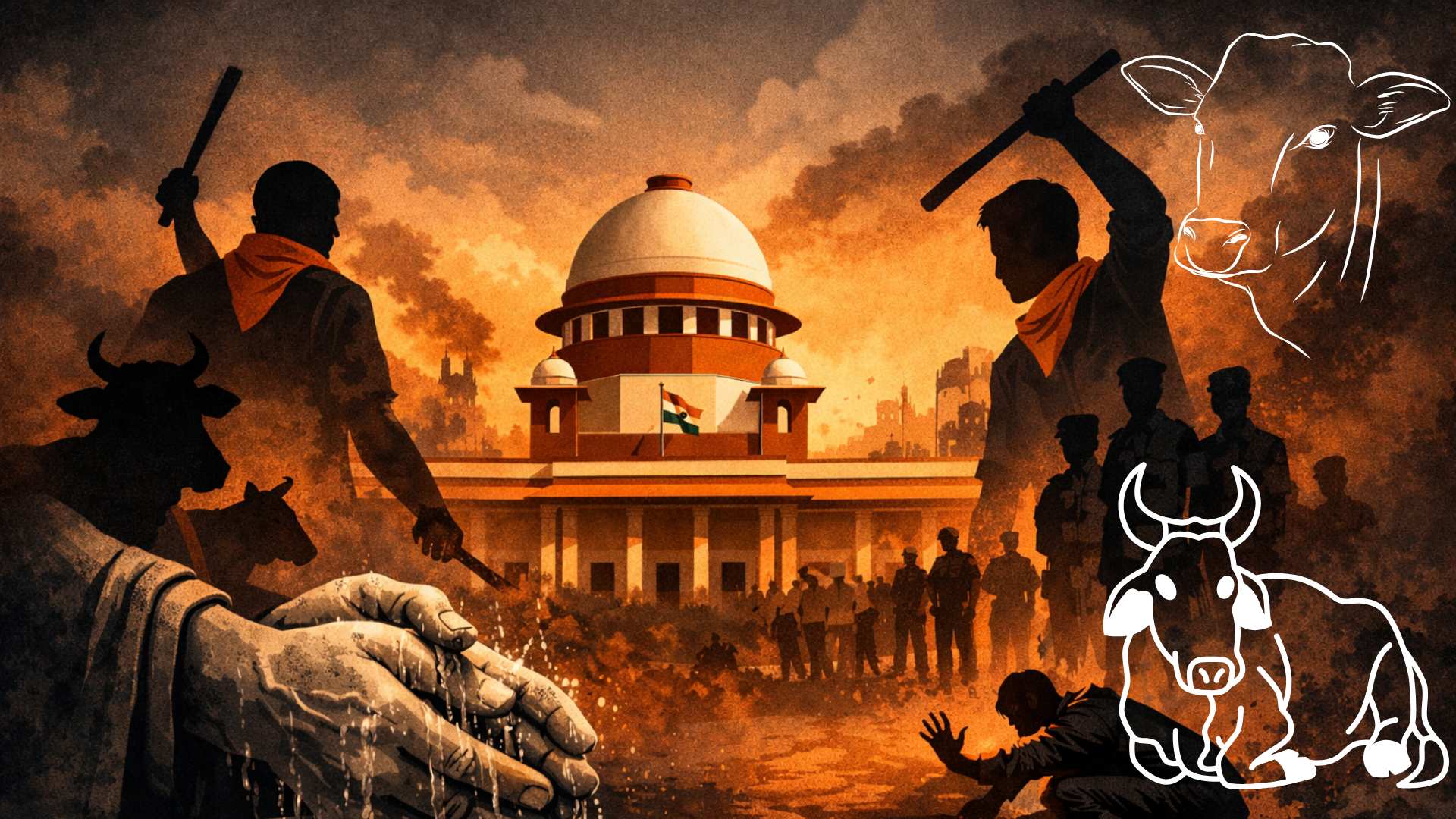
Supreme Court's Stance on Cow Vigilantism Raises Concerns
1. 2018 Supreme Court Judgment on Mob Lynching
In 2018, a Bench headed by then CJI Dipak Misra issued guidelines to prevent and punish mob violence, particularly incidents linked to cow vigilantism. The Court expressed shock at the growing incidents of lynching and emphasised that such acts must be curbed decisively.
The judgment laid down preventive, punitive and remedial measures for the Centre and States. It underscored that the State has a constitutional obligation to protect life and maintain public order.
“Lynching must be curbed and crippled.” — Supreme Court (2018) The State has a “sacrosanct duty” to protect citizens. — Supreme Court (2018)
The guidelines reflected judicial recognition that mob violence posed a systemic threat to constitutional governance and required coordinated executive action.
The 2018 judgment reaffirmed Article 21 (Right to Life) and the State’s monopoly over lawful use of force. If such directives are not enforced, it weakens constitutional supremacy and public confidence in institutions.
2. Judicial Retreat and the 2024–26 Position
On February 23, the Chief Justice of India, Justice Surya Kant, observed that the “general directions” issued in 2018 were “unmanageable.” The Court indicated a preference for addressing individual cases rather than continuing supervisory enforcement.
Petitioners had sought contempt proceedings against States that allegedly failed to implement the Court’s directions. However, the Court suggested that affected individuals should pursue remedies in appropriate courts based on specific facts.
This signals a shift from structural monitoring to case-by-case adjudication. It reflects judicial reluctance to directly oversee executive compliance in matters of policing and public order.
The move from structural oversight to individual litigation narrows judicial intervention. If systemic issues persist, reliance solely on individual remedies may dilute deterrence and accountability.
3. Federalism, Policing and Separation of Powers
Policing and public order fall within the State List under the Constitution. In principle, law enforcement agencies are expected to prevent and prosecute acts of violence without requiring judicial supervision.
The need for Supreme Court intervention in 2018 indicated perceived gaps in routine policing functions. The Court’s earlier assumption was that its guidelines would guide executive conduct without prolonged judicial monitoring.
However, subsequent reluctance to entertain broader challenges—such as special petitions against legal empowerment of vigilante groups—has reinforced the position that High Courts and trial courts are the appropriate fora for such disputes.
In a functioning federal structure, executive accountability should operate without judicial micromanagement. However, where institutional failure is alleged, judicial withdrawal may raise questions about effective constitutional remedies.
4. Rule of Law and Majoritarian Pressures
Mob violence in the name of cow protection raises concerns regarding equality before law (Article 14) and protection of life and liberty (Article 21). When non-state actors assume quasi-policing roles, it blurs the line between lawful authority and vigilantism.
The editorial highlights claims that in some States, vigilante groups have been given legal or quasi-legal backing, potentially conflicting with the spirit of the 2018 judgment. It also refers to allegations that law enforcement agencies have, in certain instances, failed to act decisively.
Unchecked mob action undermines procedural justice and the State’s exclusive authority to enforce criminal law. It can also create perceptions of selective enforcement.
Rule of law requires that violence be addressed through lawful institutions, not popular mobilisation. If majoritarian impulses override constitutional guarantees, institutional credibility and minority protections may erode.
5. Institutional Accountability and Contempt Jurisdiction
The petitioners sought contempt proceedings against States for non-compliance with the 2018 guidelines. Contempt jurisdiction is a constitutional mechanism to ensure adherence to judicial orders.
The present stance of the Court suggests hesitation in using contempt as a tool for systemic enforcement in this context. Instead, the Court appears to favour traditional adjudication mechanisms.
This raises broader governance questions about how judicial directives are implemented, monitored, and evaluated over time.
Judicial authority ultimately depends on enforceability. If directions are issued without follow-up mechanisms, their normative value may diminish, affecting long-term institutional authority.
6. Implications for Governance and Constitutionalism
The issue intersects with multiple GS dimensions:
- Separation of powers, federalism, and judicial review
- Protection of fundamental rights
- Internal security and law-and-order administration
- Rule of law vs. populism
The debate reflects tension between judicial activism and judicial restraint. While structural monitoring ensures accountability, excessive intervention may raise separation-of-powers concerns.
Conversely, complete judicial disengagement in situations of alleged systemic non-compliance may leave enforcement gaps.
Balancing judicial restraint with constitutional guardianship is central to democratic governance. If courts neither monitor nor enforce their own directives, constitutional remedies may become formal rather than substantive.
Conclusion
The evolution of the Supreme Court’s approach—from issuing strong anti-lynching guidelines in 2018 to expressing reluctance to supervise their implementation—highlights enduring tensions between judicial activism, federal autonomy, and executive accountability.
For the rule of law to remain robust, institutional mechanisms must ensure that constitutional protections are not dependent solely on individual litigation but are embedded in routine governance and policing practices.
Attribution
Original content sources and authors
Syllabus classification
How this article maps to GS papers
Main syllabus
GS1Indian SocietyQuick Q&A
What were the 2018 Supreme Court guidelines on mob lynching and cow vigilantism, and what constitutional principles did they seek to uphold?
Key directions included:
- Appointment of nodal officers in each district to prevent mob violence.
- Fast-track courts for expeditious trials.
- Victim compensation schemes and witness protection.
- Strict action against officials who fail to prevent or act against such crimes.
Constitutional foundation: The guidelines were rooted in Articles 14 (equality before law), 19 (freedoms), and 21 (right to life and personal liberty). By framing lynching as a systemic threat, the Court reinforced that mob violence cannot override constitutional morality. Thus, the 2018 judgment represented judicial recognition that majoritarian impulses cannot supersede the rule of law.
Why is the Supreme Court’s recent reluctance to enforce its 2018 guidelines significant for the rule of law?
Implications for separation of powers: While policing is an executive function, judicial review ensures executive accountability. If the Court limits itself to adjudicating individual cases without systemic scrutiny, structural issues—such as police complicity or political encouragement—may persist unchecked.
Broader impact: Persistent mob violence undermines constitutional supremacy and minority rights. If the highest court declines to ensure compliance with its own directives, it could erode public confidence in constitutional remedies under Article 32. Thus, the issue transcends cow vigilantism and touches the core of India’s democratic framework.
Critically analyse the argument that mob lynching cases should be handled individually rather than through broad judicial guidelines.
Counter-argument: However, mob lynching often reflects systemic failures rather than isolated incidents. Patterns of impunity, political patronage, or delayed investigations require structural remedies. Broad guidelines provide uniform standards and ensure compliance across States.
Balanced assessment: While case-specific adjudication respects procedural fairness, systemic issues may demand policy-level directives. A middle path could involve periodic compliance reviews without micromanaging investigations. The challenge lies in balancing judicial restraint with constitutional responsibility.
What factors have contributed to the persistence of cow vigilantism despite judicial intervention?
Administrative lapses: Reports indicate instances where police have failed to register FIRs promptly or have turned against victims. In some States, vigilante groups have been accorded quasi-policing powers, contradicting judicial guidelines.
Legal gaps: India lacks a dedicated anti-lynching law at the national level. Without codified standards, enforcement relies heavily on general criminal law provisions. Thus, weak implementation, political patronage, and absence of uniform legislation collectively sustain the problem.
As a district magistrate in a communally sensitive district, how would you implement measures to prevent mob violence while respecting constitutional freedoms?
Administrative measures:
- Ensure prompt FIR registration and time-bound investigation.
- Conduct regular police training on constitutional rights and minority protection.
- Establish victim compensation and witness protection mechanisms.
Balancing rights: While preventing violence, it is crucial not to curb lawful freedoms of speech and assembly arbitrarily. Prohibitory orders must be proportionate and legally justified.
Outcome: Such an approach integrates preventive vigilance with constitutional safeguards, reinforcing that law enforcement—not mobs—has the legitimate authority to maintain order.
How does judicial retreat in cases of mob violence affect constitutional remedies under Article 32?
Impact of judicial retreat: If the Court declines to enforce compliance with its own guidelines, citizens may perceive Article 32 as less effective in addressing structural violations. This could shift the burden to High Courts under Article 226, potentially leading to fragmented jurisprudence.
Constitutional balance: Judicial restraint can preserve institutional legitimacy, but excessive disengagement may dilute the Court’s role as guardian of fundamental rights. The challenge is to maintain credibility while ensuring effective constitutional enforcement.
Practice questions
2 questions for mains preparation