Introduction
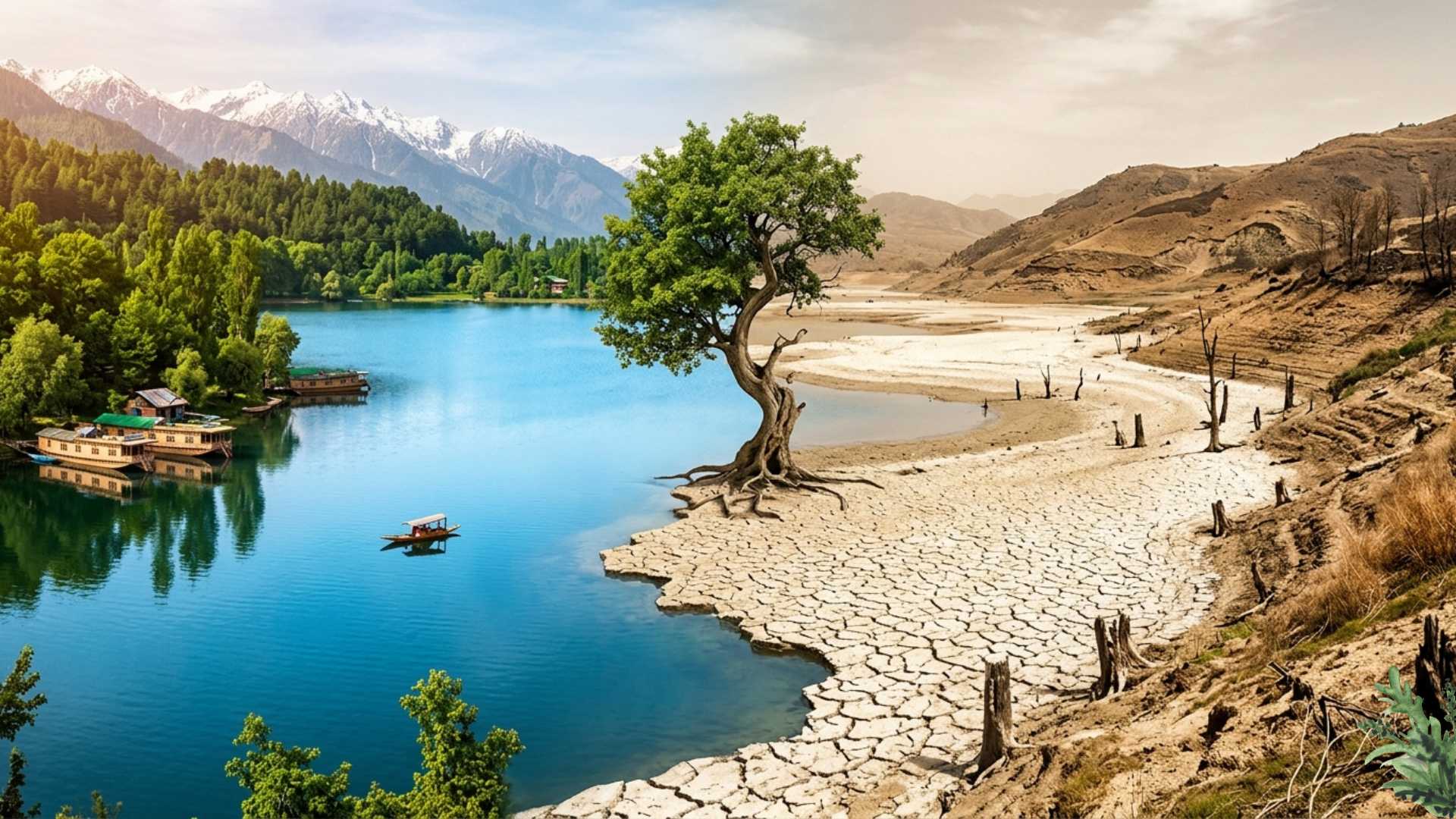
India holds approximately 5% of the world's freshwater resources, yet its inland lakes face mounting anthropogenic and governance pressures. The CAG audit (up to March 2022) on J&K's 697 lakes presents a grim picture of institutional failure and ecological collapse.
"Lakes are natural flood balancing reservoirs and the first line of defence in the flood regulating system." — CAG Report on Lake Conservation, J&K, 2022
| Indicator | Figure |
|---|---|
| Total lakes surveyed in J&K | 697 |
| Lakes disappeared or shrunk | 518 (74%) |
| Water area lost (disappeared lakes) | 1,537.07 ha |
| Water area lost (shrunk lakes) | 1,314.19 ha |
| Lakes at critical extinction risk | 63 |
| Lakes with active conservation plans | 6 only |
Key Statistics
| Parameter | Lakes | % of 697 | Area |
|---|---|---|---|
| Fully disappeared | 315 | 45% | 1,537.07 ha lost |
| Shrunk (water area decreased) | 203 | 29% | 1,314.19 ha lost |
| At critical risk (≥50% water lost) | 63 | — | High extinction risk |
| Water area increased | 150 | 22% | +538.22 ha |
| Water area static | 29 | 4% | 14,535.76 ha unchanged |
Jurisdictional Breakdown
Of the 315 fully disappeared lakes:
- 80 lakes (25%) — under Forest Department jurisdiction
- 235 lakes (75%) — under Revenue Department and Agriculture Department
Of the 203 lakes with decreased water area:
- 98 lakes (48%), 83 lakes (41%), 20 lakes (10%), and 2 lakes fall across different departmental jurisdictions — indicating a multi-department governance gap.
Causes of Lake Degradation
1. Anthropogenic Pressures Encroachment, unregulated construction, and land-use change around lake boundaries are the primary drivers. Four administrative departments and the Forest Department lacked lake-generic management programmes, leaving these pressures unchecked.
2. Aquatic Vegetation Overgrowth Absence of active management led to unchecked growth of aquatic vegetation, reducing open water area and degrading lake ecosystems.
3. Siltation Even high-altitude lakes in protected areas — largely free from direct human encroachment — face siltation and loss of water source connectivity.
4. Survey and Data Gaps The J&K Ecology, Environment & Remote Sensing Department failed to conduct a detailed survey of all 697 lakes. Without physical, chemical, and biological data, no development or conservation plans could be prepared.
Governance Failures Identified by CAG
| Failure | Details |
|---|---|
| No management programmes | 4 administrative departments + Forest Dept lacked lake-generic plans |
| Limited conservation coverage | J&K government has active plans for only 6 lakes: Dal, Wular, Hokersar, Manasbal, Surinsar, Mansar |
| Forest Dept gap | 255 lakes under Forest Dept jurisdiction have no comprehensive conservation plan |
| No baseline survey | Complete physical, chemical, biological data unavailable for 697 lakes |
| District administration failure | 44 lakes saw active land-use changes due to failure to implement management activities |
Linkage to Flood Disasters
The CAG report explicitly connects lake degradation to the catastrophic September 2014 floods in J&K. Lakes, by functioning as natural retention basins, absorb excess water during heavy rainfall events. Their disappearance and shrinkage significantly reduced the region's natural flood buffering capacity, amplifying the disaster's scale. This is a critical case study linking environmental governance failure to disaster vulnerability.
Implications
Ecological: Loss of biodiversity, disruption of aquatic food chains, disappearance of migratory bird habitats, and degradation of wetland ecosystem services.
Climate: Shrinking lakes reduce localised humidity, disrupt rainfall patterns, and accelerate land surface warming — aggravating regional climate insecurity.
Disaster Risk: Reduced natural flood retention capacity increases the frequency and intensity of flood events downstream.
Livelihood: Fishing communities, farmers dependent on lake-fed irrigation, and tourism sectors face direct economic loss.
Governance: The report is a damning audit of inter-departmental coordination failure, absent baseline data infrastructure, and lack of long-term environmental planning.
Policy and Legal Context
- National Wetland Conservation Programme (NWCP): India's flagship scheme for wetland protection, now subsumed under the National Plan for Conservation of Aquatic Eco-systems (NPCA).
- Wetlands (Conservation and Management) Rules, 2017: Mandate state-level wetland authorities and management plans — their implementation in J&K has been inadequate.
- National Water Policy, 2012: Calls for integrated water body management, including lakes and wetlands.
- Ramsar Convention: India has 85 Ramsar-designated wetlands (as of 2024) — Wular Lake and Hokersar in J&K are listed, yet governance gaps persist even for these protected sites.
Way Forward
- Immediate comprehensive survey of all 697 lakes with physical, chemical, and biological baseline data.
- Formulation of lake-specific management plans for all lakes, not just the current six.
- Establishment of a unified J&K Lake Authority with inter-departmental coordination mandate.
- Strict enforcement of buffer zone regulations around lake boundaries under the 2017 Wetlands Rules.
- Community-based lake monitoring involving local panchayats and fishing cooperatives.
- Integration of lake health metrics into District Disaster Management Plans given the flood risk linkage.
Conclusion
The CAG report on J&K lakes is not merely an environmental audit — it is a governance indictment. The disappearance of 315 lakes and the shrinkage of 203 more reflects the cost of institutional inaction: fractured departmental accountability, absent scientific data, and conservation plans covering fewer than 1% of lakes. As climate change intensifies hydrological stress, India cannot afford to treat lake management as a residual administrative task. Robust legislative enforcement, scientific monitoring infrastructure, and genuine inter-departmental coordination are non-negotiable prerequisites for reversing this crisis.
Attribution
Original content sources and authors
Syllabus classification
How this article maps to GS papers
Main syllabus
GS1GeographyQuick Q&A
What is the significance of lakes in maintaining ecosystem balance and climate security, particularly in regions like Jammu & Kashmir?
One of the most critical roles of lakes is their function as natural flood buffers. By absorbing excess rainfall and regulating water flow, lakes reduce the risk of floods. The 2014 floods in J&K highlighted how shrinking lake areas weakened this natural defense mechanism. Lakes like Wular and Dal historically acted as flood sinks, but their degradation has reduced their capacity to mitigate disasters.
Furthermore, lakes contribute to climate security by influencing local temperature and humidity patterns. Their degradation leads to ecological imbalance, increased vulnerability to extreme weather events, and loss of biodiversity. Thus, lakes are not merely water bodies but integral components of ecological resilience and climate adaptation strategies.
Why has the large-scale disappearance and shrinkage of lakes in Jammu & Kashmir become a serious environmental concern?
A major concern is the increase in disaster vulnerability. Lakes act as natural flood regulators, and their shrinkage contributed to the devastating floods of 2014. Reduced water retention capacity leads to rapid runoff during heavy rainfall, increasing flood risks and associated economic losses.
Additionally, the decline reflects governance failures and unchecked anthropogenic pressures such as encroachment, construction, and pollution. The lack of comprehensive management programmes for most lakes has allowed degradation to continue unchecked. Thus, the issue is not only environmental but also administrative, highlighting the urgent need for policy intervention and sustainable management.
How do anthropogenic activities contribute to the degradation of lakes in Jammu & Kashmir?
Pollution is another major factor. Discharge of untreated sewage, agricultural runoff, and solid waste leads to eutrophication, causing excessive growth of aquatic vegetation. This reduces oxygen levels in water, harming aquatic life and accelerating the transformation of lakes into marshlands.
Additionally, lack of proper planning and monitoring exacerbates the problem. The failure to conduct detailed surveys of lakes means that their physical, chemical, and biological characteristics remain poorly understood. Without this data, effective conservation strategies cannot be developed. Thus, human activities, combined with weak governance, have led to a steady decline in lake ecosystems.
What are the institutional and governance-related reasons behind the failure to conserve lakes in J&K?
Another critical issue is the absence of comprehensive management programmes. The CAG report highlights that most lakes lack generic conservation plans, with only six major lakes receiving focused attention. This selective approach neglects smaller but ecologically significant lakes, accelerating their degradation.
Moreover, the lack of scientific data and monitoring has hindered evidence-based policymaking. The failure to conduct detailed surveys of lakes means that their ecological dynamics remain unknown. Combined with weak enforcement against encroachments and pollution, these factors have created a governance vacuum, allowing environmental degradation to persist unchecked.
Critically analyse the implications of selective conservation efforts focusing only on major lakes in Jammu & Kashmir.
This approach also leads to unequal resource allocation. Concentrating financial and administrative resources on a few lakes leaves many others vulnerable to degradation. Over time, the cumulative loss of smaller lakes can have a cascading effect on biodiversity, groundwater recharge, and climate resilience.
From a policy perspective, this reflects a reactive rather than proactive approach. Instead of addressing the root causes of degradation across all lakes, efforts are limited to high-visibility projects. A holistic strategy that includes all water bodies, supported by scientific data and community participation, is essential for sustainable conservation.
Provide examples of how lake degradation can lead to socio-economic and environmental consequences.
Environmentally, the loss of lakes leads to biodiversity decline. Wetlands like Hokersar are महत्वपूर्ण habitats for migratory birds. Their degradation disrupts migratory patterns and reduces species diversity. Similarly, the disappearance of smaller lakes affects local ecosystems and food chains.
On a broader scale, lake degradation increases disaster risks and water scarcity. The 2014 floods in J&K demonstrated how reduced lake capacity can exacerbate flooding. At the same time, declining water bodies reduce groundwater recharge, leading to water shortages. These examples highlight the interconnected nature of ecological and socio-economic impacts.
Suggest a comprehensive strategy for the conservation and sustainable management of lakes in Jammu & Kashmir.
Second, scientific assessment and data collection are crucial. Conducting detailed surveys to understand the physical, chemical, and biological characteristics of lakes will enable evidence-based planning. Technologies like remote sensing and GIS can be used for monitoring changes in lake area and health.
Third, community participation and sustainable livelihoods should be promoted. Local communities can be involved in conservation efforts through awareness programmes and eco-tourism initiatives. Strict enforcement of regulations against encroachment and pollution is also necessary.
Finally, adopting a holistic conservation model that includes both major and minor lakes will ensure long-term ecological sustainability. Lessons can be drawn from successful wetland management programmes like Chilika Lake in Odisha, where integrated efforts have led to ecological restoration and improved livelihoods.
J&K's lake degradation is a governance crisis leading to ecological and flood vulnerabilities.
Practice questions
1 question for mains preparation