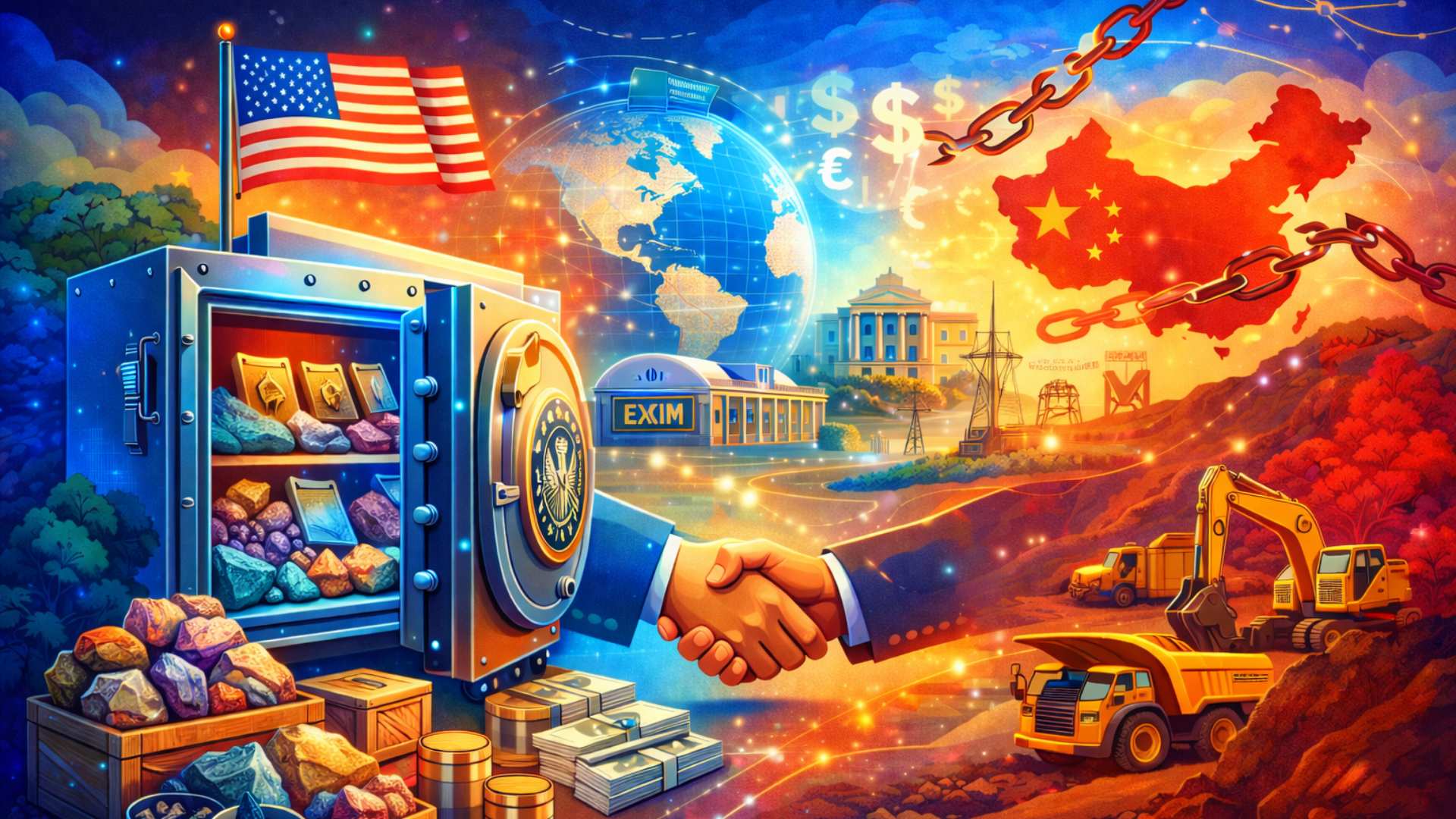
1. Project Vault: Strategic Stockpiling of Critical Minerals
In February 2025, the U.S. administration unveiled Project Vault, an independently governed public-private partnership to establish a strategic domestic reserve of critical minerals. Backed by 2 billion in private funds, the initiative aims to stockpile 60 critical minerals listed in the U.S. Geological Survey’s 2025 Critical Minerals List.
The model allows EXIM to provide long-term loans to purchase and store minerals within the U.S., thereby insulating civilian industries from supply chain disruptions. This marks a shift from traditional industrial policy toward a strategic doctrine that treats critical minerals as national security assets rather than mere commodities.
The initiative draws parallels with the Strategic Petroleum Reserve (1975), established after the 1973 oil embargo. However, unlike oil, critical minerals underpin sectors such as renewable energy, defence manufacturing, semiconductors, and electric vehicles—core to modern economic and technological power.
"Energy security is national security." — U.S. Department of Energy (official policy articulation)
Similarly, in the 21st century, mineral security is increasingly equated with economic sovereignty.
Strategic stockpiling reflects a governance approach that anticipates market shocks and geopolitical coercion. If ignored, concentration of supply in a few countries can cripple domestic industries and undermine economic resilience.
2. Geopolitical Trigger: China’s Dominance and Supply Chain Vulnerabilities
China dominates multiple stages of critical mineral value chains—mining, processing, and rare earth magnet manufacturing. In 2025, it restricted exports of rare earth magnets in retaliation to U.S. tariffs, leading to near shutdowns of automobile manufacturing in the U.S. and globally.
This disruption exposed vulnerabilities in U.S. supply chains and dealt a setback to domestic manufacturing revival plans. It also forced firms to consider shifting production to China, where finished exports faced fewer restrictions.
The episode demonstrated how concentration of critical mineral production in one country can be weaponised for geopolitical leverage, affecting access, affordability, and industrial continuity.
Key Drivers:
- China’s dominance in mining and processing
- Export restrictions on rare earth magnets (2025)
- Supply chain dependence of automobile and technology sectors
The logic is clear: supply chain concentration creates asymmetric leverage. Without diversification and reserves, economic coercion can derail domestic industrial policy and strategic autonomy.
3. Design Features of Project Vault
Project Vault allows domestic manufacturers to procure minerals without geographic restrictions and store them based on commercial considerations. Withdrawal and replenishment are guided by predefined conditions of market disruption.
Unlike reactive crisis management, this is a rules-based framework that aims to ensure predictability. It reduces panic-driven procurement and stabilizes industrial planning.
This initiative represents a “whole-of-government” approach, complementing efforts to expand domestic mining and processing capacity.
Financial Structure:
- $10 billion EXIM financing
- $2 billion private investment
- Stockpiling of 60 minerals
Institutionalised reserve mechanisms reduce uncertainty and improve industrial confidence. Without clear rules, stockpiles risk politicisation or inefficiency.
4. Allied Engagement: Bilateral and Multilateral Dimensions
While Project Vault prioritises domestic manufacturing, the U.S. has simultaneously pursued allied engagement to diversify supply chains. It has signed 11 bilateral agreements with Japan, the EU, Mexico, and the United Kingdom, proposing border-adjusted price floors to support non-Chinese producers.
At the multilateral level, the U.S. hosted 54 countries at the Critical Minerals Ministerial and launched the Forum on Resource Geostrategic Engagement (FORGE). The platform aims to coordinate policy, pricing, and project development among partner nations.
These initiatives seek to create a preferential trading bloc that aligns regulatory standards and ensures minimum pricing to sustain alternative supply chains.
Multilateral Efforts:
- 54 countries participated
- FORGE platform for policy coordination
- Border-adjusted minimum pricing mechanisms
"Interdependence, when weaponized, becomes vulnerability." — Henry Farrell & Abraham Newman, Weaponized Interdependence (2019)
Allied coordination spreads risk and reduces overdependence on a single supplier. However, without trust and policy stability, such coalitions may remain fragile.
5. Pax Silica: Linking Critical Minerals with AI Geopolitics
Launched in December 2025, Pax Silica aims to build secure supply chains foundational to Artificial Intelligence (AI), integrating energy, critical minerals, and semiconductors.
Members include Australia, Japan, Israel, Singapore, South Korea, the UK, UAE, and others. India has been invited as a full member, with the EU, Canada, Netherlands, and Taiwan as guest contributors.
The initiative seeks to combine capital, energy resources, mineral reserves, technological know-how, and market demand across jurisdictions to multiply AI capabilities through regulatory alignment and coordinated investment.
This reflects a broader geoeconomic strategy where technology leadership is inseparable from supply chain security.
Technological dominance increasingly depends on upstream resource security. Without integration of minerals, energy, and semiconductors, AI leadership becomes structurally vulnerable.
6. Challenges: ‘America First’ and Trust Deficit
Despite its collaborative architecture, implementation may be shaped by ‘America First’ politics, which often treats partners hierarchically and demands alignment with U.S. national security priorities.
Concerns arise from:
- Asymmetrical trade negotiations
- Policy volatility
- Coercive tariff measures
- Unpredictable executive decisions
The recently released U.S. National Security Strategy emphasises that U.S. exports and standards drive global progress, reinforcing perceptions of strategic dominance rather than equal partnership.
Coalitions function best under conditions of predictability and mutual trust. Volatility can discourage long-term commitments from partner countries that must hedge against policy reversals.
"Trust arrives on foot but leaves on horseback." — Dutch Proverb
Supply chain alliances require credibility and institutional stability. If partners perceive unpredictability, diversification efforts may fragment rather than consolidate resilience.
7. Implications for Global Governance and India
Strategic Implications
- Marks transition from globalization to geoeconomic bloc formation
- Minerals become instruments of strategic statecraft
- Emergence of price-floor mechanisms and preferential trade arrangements
For India
-
Invitation to Pax Silica offers opportunity for:
- Integration into high-value AI and semiconductor supply chains
- Diversification away from China-centric trade networks
- Strategic balancing in Indo-Pacific geopolitics
However, participation requires careful calibration to preserve strategic autonomy while leveraging new supply chain partnerships.
For middle powers like India, mineral geopolitics creates both opportunity and strategic complexity. Engagement must balance economic gain with policy flexibility.
Conclusion
Project Vault, FORGE, and Pax Silica signal a decisive shift toward strategic management of critical minerals as pillars of economic and national security. They reflect the evolution of industrial policy into geoeconomic statecraft.
However, the long-term success of such initiatives will depend less on financial scale and more on institutional predictability, allied trust, and balanced leadership. In an era where supply chains shape power hierarchies, resilience will depend on cooperation anchored in credibility rather than coercion.