Somnath at 1000: Civilisational Memory and Policy Relevance
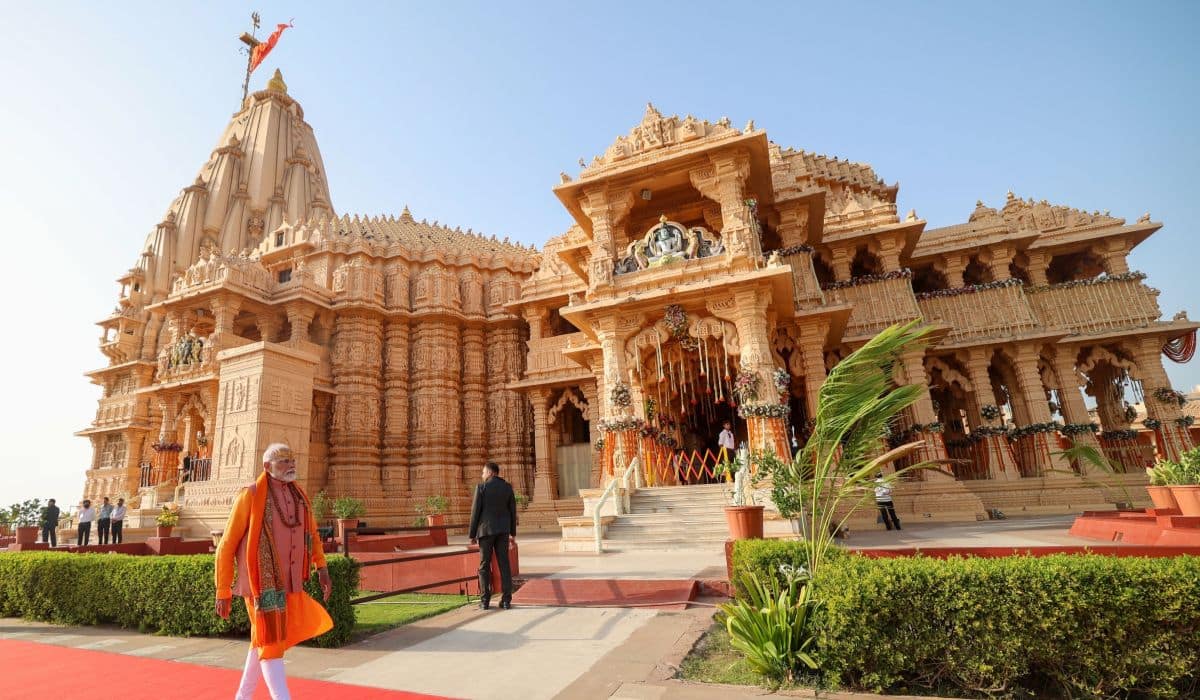
Prime Minister Shri Narendra Modi paid tribute to 1000 years of Somnath’s resilience, marking a millennium since the first recorded assault on the Somnath Temple (1026 AD). As one of the 12 Jyotirlingas, Somnath forms part of India’s sacred and cultural network. The 2026 tribute reframes its story as a collective testament to cultural protection and institutional renewal.
Somnath’s story reflects India’s ability to convert historic adversity into collective identity and policy direction. In governance, heritage symbols serve both internal cohesion and external soft-power signalling.
Quick Facts
- Shows role of public institutions as market and cultural stabilisers
- Connects history → policy → economy → diplomacy
- Example of heritage-led identity without institutional rupture
- 12 Jyotirlingas as pan-India cultural geography
- Rebuilt post-Independence by Sardar Patel, reopened in May 1951 by Dr. Rajendra Prasad
- Symbol used in national messaging and coastal tourism policy
“Culture is the widening of the mind and of the spirit.” – Jawaharlal Nehru “A nation that forgets its heritage loses its soul.” – Winston Churchill (contextually relevant to heritage discourse)
1026 AD: The First Assault and Historical Credibility
The first major attack on Somnath is attributed to Mahmud of Ghazni, documented by chroniclers including scholar Al-Biruni, a credible non-Indian observer of medieval India. The event has since occupied a strong position in India’s cultural recall — representing both adversity and resistance, followed by reconstruction by Indian rulers like Kumarapala and patrons such as Ahilyabai Holkar.
The 2026 tribute uses this memory to reinforce India’s long-horizon cultural endurance, where remembrance acts as a unifier and not a divider. Historical credibility is strengthened when events are backed by external chroniclers like Al-Biruni.
Scholarly Importance
- Al-Biruni: Trusted chronicler of medieval India
- Provides non-domestic validation of events
Reconstruction Tradition: Continuity Over Rupture
Somnath was rebuilt multiple times across centuries. Post-Independence reconstruction was driven by Patel’s resolve, backed by a temple trust + state patronage model, demonstrating how heritage revival can have economic and governance multipliers. Gujarat integrated Somnath into coastal tourism circuits and infrastructure upgrades.
India’s reconstruction tradition reflects resilience supported by public patronage, legal legitimacy, and institutional frameworks. This mirrors modern policy preference for structured recovery and long-horizon stability in strategic sectors.
Tourism Multipliers
- Annual footfall (est.): 70–80 lakh visitors/year
Infrastructure add-ons:
* Somnath Promenade
* Light & sound shows
* Coastal circuits under **PRASHAD scheme**
* Swadesh Darshan linkages
From Heritage to Soft Power Diplomacy
PM Modi’s tribute links Somnath to India’s broader soft power stack — cultural icons, diaspora sentiment, tourism circuits, and digital outreach. India increasingly deploys heritage symbols for diplomacy — similar to global messaging around Yoga, Ayurveda, Buddhist circuits, and cultural corridor projects (Kashi, Ayodhya, etc.).
Somnath’s narrative complements India’s soft power approach — attraction through cultural endurance rather than coercion. Digital messaging on X reaching millions instantly reflects India’s modern heritage communication capacity.
Soft Power Parallels
- International Day of Yoga
- PRASHAD tourism scheme
- Buddhist and spiritual tourism diplomacy
- Temple-linked diaspora cultural outreach
“Soft power is the ability to get what you want through attraction rather than coercion.” – Joseph Nye
Conclusion: Template for India’s Governance Story
The 1000-year milestone is not just historical remembrance but a model for India’s capacity to rebuild, remember, and persist with institutional legitimacy. It bridges emotion + economy + governance + diplomacy into a single national message, showing that resilience lies in continuity, not the absence of conflict.
For UPSC aspirants, Somnath becomes a case of how heritage symbols are operationalised through policy frameworks, tourism economy, and national messaging.