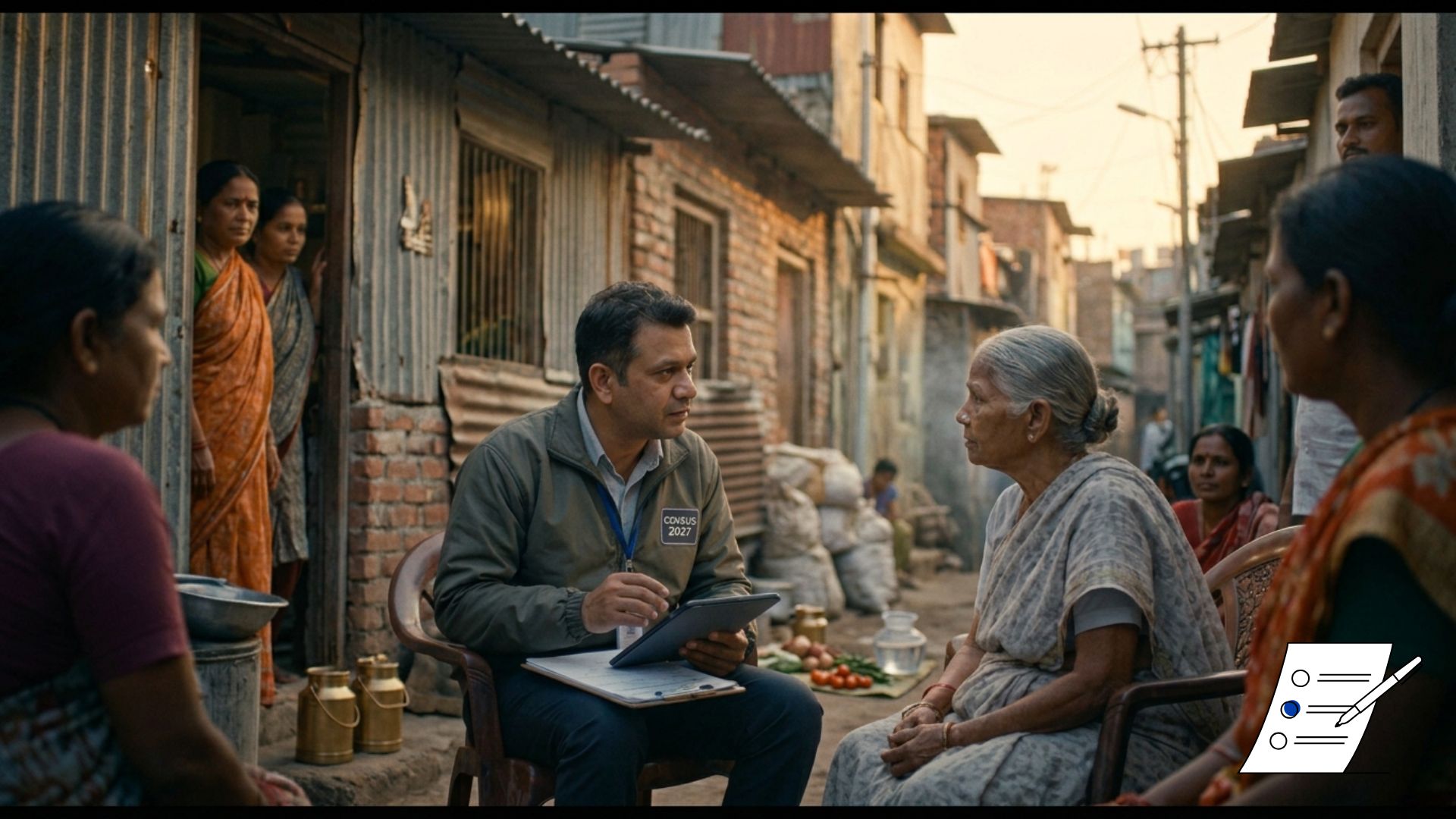
Census 2027: Counting People, Strengthening Democracy

“Not everything that counts can be counted, and not everything that can be counted counts.” — Albert Einstein
India has begun the world's largest enumeration exercise with Census 2027, a crucial exercise that goes beyond population counting to shape governance, welfare delivery, representation, and development. In a democracy where every vote matters, every individual count matters equally.
Why Census 2027 Matters
| Aspect | Details |
|---|---|
| Scale | Largest population count in the world |
| Phase 1 | Housing Census: assets, amenities, and household conditions |
| Phase 2 | Demographic details: education, migration, fertility, caste, etc. |
| Significance | Basis for governance, planning, welfare and representation |
A Long-Delayed Census
-
Census 2027 comes after a 15-year gap, instead of the usual 10 years.
-
Delays occurred due to:
- COVID-19 pandemic
- Lok Sabha elections
-
Policymaking has largely depended on:
- Census 2011 data
- Estimates from surveys such as NFHS
- UN and World Bank projections
Population Snapshot

Census 2011      : 121 crore
Estimated 2025   : 146+ crore
Expected increase: 25–30 crore people
An updated demographic database is therefore essential for evidence-based decision-making.
Census and India's Development Journey
The purpose of Census has evolved significantly.
| Colonial Era | Independent India |
|---|---|
| Administrative control | Inclusive development |
| Efficient governance for rulers | Welfare-oriented governance |
| Revenue and regulation | Planning and social justice |
The 1951 Census highlighted:
- Low literacy
- High poverty
- Low life expectancy
The 2027 Census will measure India's transformation in:
- Education
- Healthcare
- Infrastructure
- Mobility
- Connectivity
- Living standards
Census and Representative Democracy
The Census has major political implications.
Delimitation and Women's Reservation
- Future constituency boundaries will rely on Census data.
- Implementation of 33% reservation for women in legislatures is linked to delimitation.
- Accurate population figures are therefore essential for fair representation.
Electoral Roll Revision
The ongoing Special Intensive Revision (SIR) has reinforced awareness about:
- Inclusion in voter rolls
- Importance of being officially counted
The Significance of Caste Enumeration
One of the most debated features of Census 2027 is the inclusion of caste data.
Potential implications include:
- Better understanding of social composition
- Evidence-based policymaking
- Informed public debate
- Assessment of social inequalities
Why Caste Data Matters?

→ Reservation policies
→ Social justice measures
→ Welfare targeting
→ Representation of marginalized groups
Existing provisions for:
- Scheduled Castes (SCs)
- Scheduled Tribes (STs)
will also draw upon updated Census findings.
Census and Everyday Welfare
The Census directly influences citizens' lives.
It helps governments identify needs related to:
- Employment
- Food security
- Housing
- LPG access
- Drinking water
- Sanitation
- Education
- Healthcare
Accurate data enables:
- Better targeting of welfare schemes
- Efficient allocation of resources
- Reduced exclusion errors
Economic Importance
Census data guides:
| Institution | Use of Census Data |
|---|---|
| Finance Commission | Fiscal devolution |
| State Governments | Development planning |
| Local Bodies | Service delivery |
| Private Sector | Investment decisions |
Digital Census and Data Protection
For the first time, Census 2027 incorporates extensive digital data collection.
Key Features
- Online self-enumeration available
- More than one crore households have already participated
- Multiple language options
- Physical enumeration retained to ensure universal inclusion
“An enumerator will definitely visit your home.”
The Census Act, 1948 provides safeguards for confidentiality and protection of individual data.
Challenges Ahead
More than three million census personnel will have to:
- Reach remote habitations
- Cover dense urban settlements
- Overcome geographical barriers
- Address social and logistical challenges
The success of the Census ultimately depends on public cooperation and accurate disclosure of information.
Way Forward
- Ensure universal coverage without exclusion.
- Strengthen public awareness regarding the benefits of enumeration.
- Maintain transparency in data collection and processing.
- Protect privacy through robust digital safeguards.
- Use Census findings for evidence-based governance rather than political polarization.
- Integrate Census data with welfare and development planning at all levels.
Conclusion
Census 2027 is not merely a statistical exercise; it is the foundation of democratic representation, social justice, welfare delivery, and developmental planning. Just as citizens recognise the value of every vote, they must also recognise the value of every count. A successful Census ensures that no individual, community, or region remains invisible in the nation's developmental journey. In that sense, the slogan extends naturally from “Our Census, Our Development” to “My Census, My Right.”
Attribution
Original content sources and authors

Syllabus classification
How this article maps to GS papers
Main syllabus
GS1PopulationQuick Q&A
What is Census 2027 and why is it considered a crucial instrument for inclusive governance and development in India?
Why is an accurate and comprehensive population census indispensable for policy formulation and welfare delivery in India?
How does Census 2027 influence representative democracy, delimitation and social justice mechanisms in India?
What are the major debates and challenges associated with caste enumeration and demographic politics in Census 2027?
What are some practical examples demonstrating how census data shapes economic planning and public service delivery in India?
How does Census 2027 represent a significant transformation in data collection methods and citizen participation in India?
Practice questions
1 question for mains preparation