What are the key urban governance failures highlighted by the Malviya Nagar hotel fire incident in Delhi?
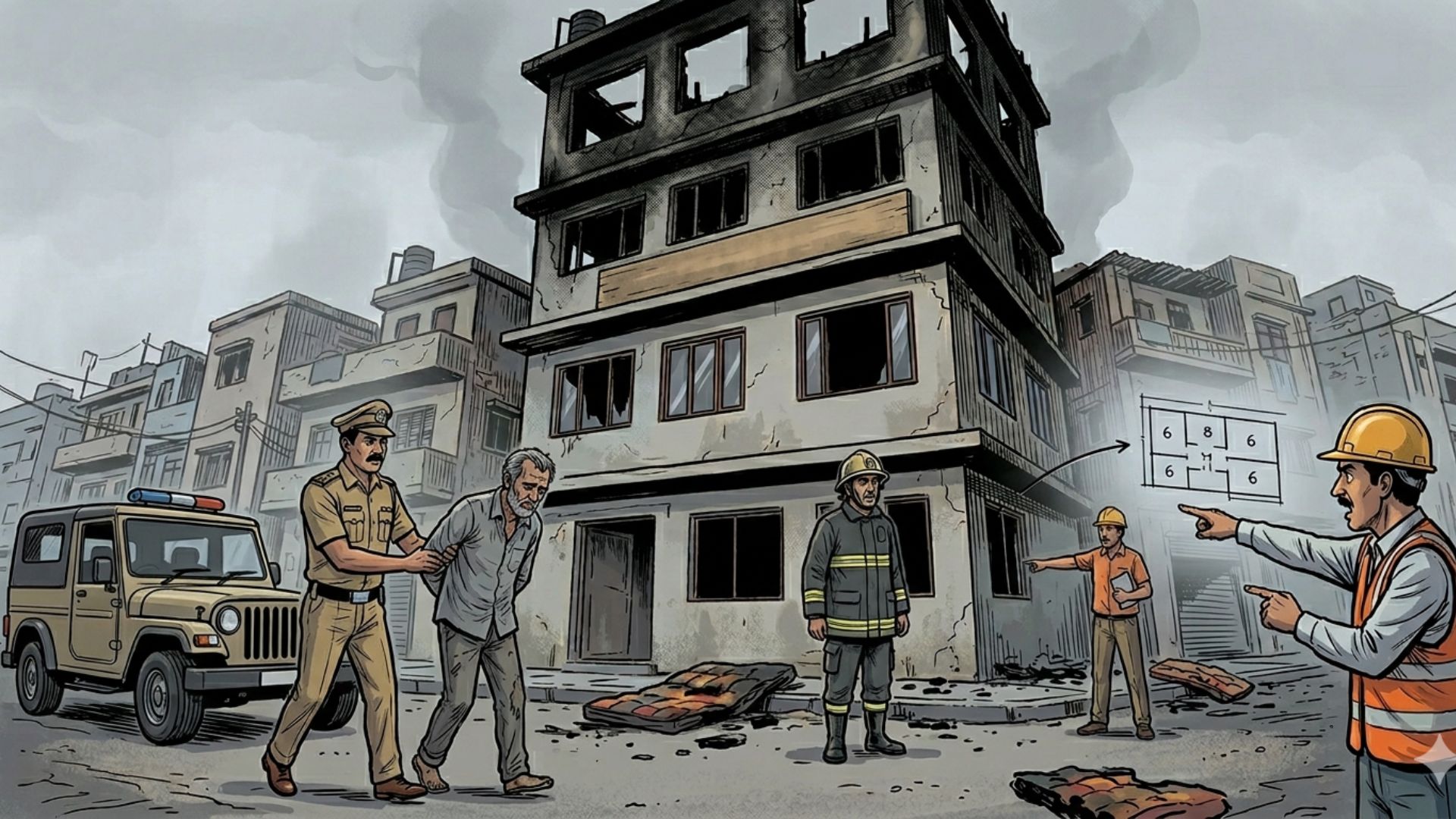
The Malviya Nagar hotel fire incident in Delhi, which resulted in the death of at least 21 people including foreign nationals, exposes multiple layers of urban governance failure. At its core, the tragedy reflects deficiencies in regulatory enforcement, urban planning, and safety compliance mechanisms in densely populated metropolitan areas. The building was reportedly operating without a Fire Department clearance, had approval for only six rooms but was functioning with more than 20 rooms, and had only a single entry-exit point. These violations directly point to weak enforcement by municipal and fire safety authorities.
Urban governance in India is governed by multiple agencies such as Municipal Corporations, Fire Departments, and local development authorities. However, overlapping jurisdiction and fragmented accountability often result in regulatory gaps. In this case, despite existing laws under municipal bylaws and fire safety regulations, enforcement appears to have been either delayed or ineffective.
The incident also highlights the failure of ex-ante risk prevention mechanisms. Fire No Objection Certificates (NOCs), occupancy certificates, and periodic safety audits are designed to prevent such disasters, but their implementation remains inconsistent. Furthermore, informal conversions of residential or semi-urban structures into commercial hospitality units, especially in mixed-use areas like Lal Dora villages, reflect inadequate zoning enforcement.
From a GS Paper I and GS Paper II perspective, this case underscores challenges of rapid urbanisation, informal urban growth, and governance deficits in Indian cities. It also raises ethical and administrative concerns regarding accountability of civic agencies. Ultimately, the tragedy demonstrates that urban safety is not merely a technical issue but a governance failure involving regulation, enforcement, and institutional coordination.
How do weak regulatory enforcement and building norm violations contribute to urban fire disasters in Indian cities?
Urban fire disasters in India are often the result of cumulative regulatory failures rather than isolated accidents. In the Malviya Nagar incident, multiple violations were reported, including absence of Fire Department clearance, overcrowding beyond permitted capacity, and lack of proper entry and exit points. These factors illustrate how weak enforcement of building codes directly translates into life-threatening vulnerabilities.
Regulatory frameworks such as municipal building bylaws, fire safety norms, and occupancy regulations are designed to ensure structural safety and emergency preparedness. However, enforcement is often compromised due to inadequate inspections, administrative delays, corruption, and lack of coordination among agencies like Municipal Corporations, Delhi Fire Service, and urban planning bodies.
Another critical issue is the phenomenon of illegal or semi-legal conversions of residential buildings into commercial establishments such as hotels, guest houses, and bed-and-breakfast units. In high-density urban areas, especially in Delhi, such conversions are often driven by economic incentives and weak monitoring. Once violations become normalized, enforcement becomes reactive rather than preventive.
Additionally, absence of regular fire audits and lack of updated safety infrastructure, such as fire alarms, sprinklers, and multiple exits, significantly increases risk. When disasters occur, response systems become overwhelmed, as seen in the large number of casualties and hospital admissions in this case.
For UPSC GS Paper I (Urbanisation) and GS Paper II (Governance), this highlights the need for strengthening urban local bodies, improving compliance mechanisms, adopting digital monitoring of building permissions, and enforcing strict accountability of civic agencies to prevent recurrence of such tragedies.
Why do urban fire safety failures persist in metropolitan areas despite the existence of strict regulatory frameworks and institutions?
Urban fire safety failures persist in Indian metropolitan areas due to a combination of institutional, administrative, and socio-economic factors. Although regulatory frameworks such as fire safety codes, municipal bylaws, and building regulations exist, their implementation is often weak and inconsistent. The Malviya Nagar incident highlights this gap between regulation and enforcement.
One major reason is institutional fragmentation. Urban governance in India involves multiple agencies—municipal corporations, fire departments, development authorities, and local police—often working in silos. This leads to diffusion of responsibility, where accountability is unclear until after a disaster occurs.
Second, rapid and unplanned urbanisation has resulted in high-density construction and conversion of residential properties into commercial establishments without adequate oversight. Economic incentives drive property owners to violate norms, especially in high-demand tourist or commercial zones.
Third, enforcement capacity is limited. Fire departments and municipal bodies often face staff shortages, outdated equipment, and insufficient inspection frequency. As a result, compliance becomes reactive rather than preventive.
Fourth, regulatory capture and informal practices sometimes weaken enforcement. Violations such as exceeding permitted room limits or lack of Fire NOCs often go unchecked until accidents occur.
From a governance perspective, these issues highlight systemic weaknesses in urban planning and accountability mechanisms. For UPSC GS Paper II, this connects to themes of accountability, public administration, and institutional reforms. It also raises ethical concerns regarding negligence and public safety. Ultimately, persistent fire safety failures reflect not absence of law but failure of governance systems to ensure effective implementation and coordination.
What does the Malviya Nagar hotel fire incident reveal as a case study in urban risk management and disaster preparedness?
The Malviya Nagar hotel fire incident serves as a critical case study in urban risk management and disaster preparedness, highlighting systemic vulnerabilities in India's urban governance framework. The incident resulted in at least 21 deaths, multiple critical injuries, and the rescue of dozens of individuals, exposing failures in both prevention and response mechanisms.
From a risk management perspective, the building exhibited multiple red flags: absence of fire clearance, overcrowding beyond permitted capacity, and inadequate evacuation infrastructure such as single entry-exit points. These factors significantly increased casualty risk and reduced survivability during the fire.
Disaster preparedness mechanisms, including fire safety audits, emergency evacuation planning, and compliance monitoring, appear to have been either absent or ineffective. In urban risk governance, prevention is considered more critical than response. However, in this case, regulatory prevention failed, placing disproportionate pressure on emergency response systems like fire services, hospitals such as AIIMS and Safdarjung, and local police.
The incident also demonstrates the importance of community-based response. Local residents played a crucial role in rescue efforts, using mattresses and makeshift arrangements to save lives before official responders fully intervened. This reflects both the strength of social capital and the inadequacy of institutional response systems.
For UPSC GS Paper III (Disaster Management) and GS Paper I (Urbanisation), this case highlights the need for integrated urban risk frameworks, regular safety audits, enforcement of building codes, and strengthening of emergency response infrastructure. It also underscores that disaster resilience depends on coordination between governance institutions, urban planning, and citizen participation.
What is the critical analysis of accountability mechanisms in urban governance as reflected in the Delhi hotel fire tragedy?
The Delhi hotel fire tragedy exposes deep shortcomings in accountability mechanisms within urban governance systems. While multiple institutions such as the Municipal Corporation of Delhi, Delhi Fire Service, and Delhi Police are responsible for enforcement and safety regulation, the incident reveals gaps in coordination, oversight, and proactive monitoring.
A key issue is ex-post accountability, where action is typically initiated only after a disaster occurs. In this case, the building owner was arrested under charges of culpable homicide not amounting to murder and mischief by fire under the Bharatiya Nyaya Sanhita. However, systemic accountability involving regulatory agencies that failed to prevent violations remains less clearly addressed.
The absence of regular inspections, failure to enforce Fire NOC requirements, and tolerance of unauthorized commercial expansion suggest institutional weaknesses. Urban governance in India often suffers from reactive rather than preventive accountability frameworks, where audits and enforcement intensify only after public tragedies.
Judicial and executive responses, including proposed sealing of unauthorized establishments and withdrawal of certain licensing schemes, indicate corrective measures. However, critics argue that such responses are episodic and do not address structural governance deficits such as staffing shortages, fragmented authority, and weak penal enforcement against officials.
From a UPSC GS Paper II perspective, this case highlights issues of transparency, institutional accountability, and administrative reform. Ethically, it raises questions about negligence, public trust, and duty of care in governance. A robust accountability framework would require periodic independent audits, digitized compliance tracking, stricter penalties for violations, and clearer assignment of responsibility across agencies. Without systemic reforms, such tragedies risk recurring in rapidly urbanising cities.
What are the major reasons behind recurring urban building safety violations and fire hazards in rapidly growing Indian cities?
Recurring urban building safety violations and fire hazards in Indian cities stem from structural, administrative, and socio-economic factors. Rapid urbanisation and high demand for commercial spaces often lead to unauthorized construction and conversion of residential buildings into hotels, guest houses, and commercial units, as seen in the Malviya Nagar incident.
One major reason is weak enforcement of building codes and fire safety regulations. Although legal frameworks exist, municipal bodies often lack adequate manpower and technological tools to conduct regular inspections. This leads to widespread non-compliance going undetected until disasters occur.
Second, fragmented governance across multiple urban agencies results in poor coordination. Responsibility for fire safety, building approvals, and zoning is distributed among different institutions, leading to accountability gaps.
Third, economic incentives encourage violations. Property owners often maximize space utilization beyond permitted limits, such as increasing room numbers or blocking exits, to enhance profitability in high-demand urban markets.
Fourth, informal urbanization in areas like Lal Dora villages creates regulatory ambiguity, where older settlements are converted into commercial hubs without adequate infrastructure upgrades.
Fifth, inadequate emergency infrastructure such as narrow access roads, lack of hydrant systems, and insufficient fire exits exacerbates risks.
For UPSC GS Paper I and II, these issues highlight challenges of urban governance, planning deficits, and regulatory enforcement in India’s cities. Addressing these requires strengthening urban local bodies, implementing GIS-based monitoring systems, ensuring strict compliance audits, and improving inter-agency coordination. Ultimately, urban safety failures reflect governance deficits rather than mere technical shortcomings.