
Introduction
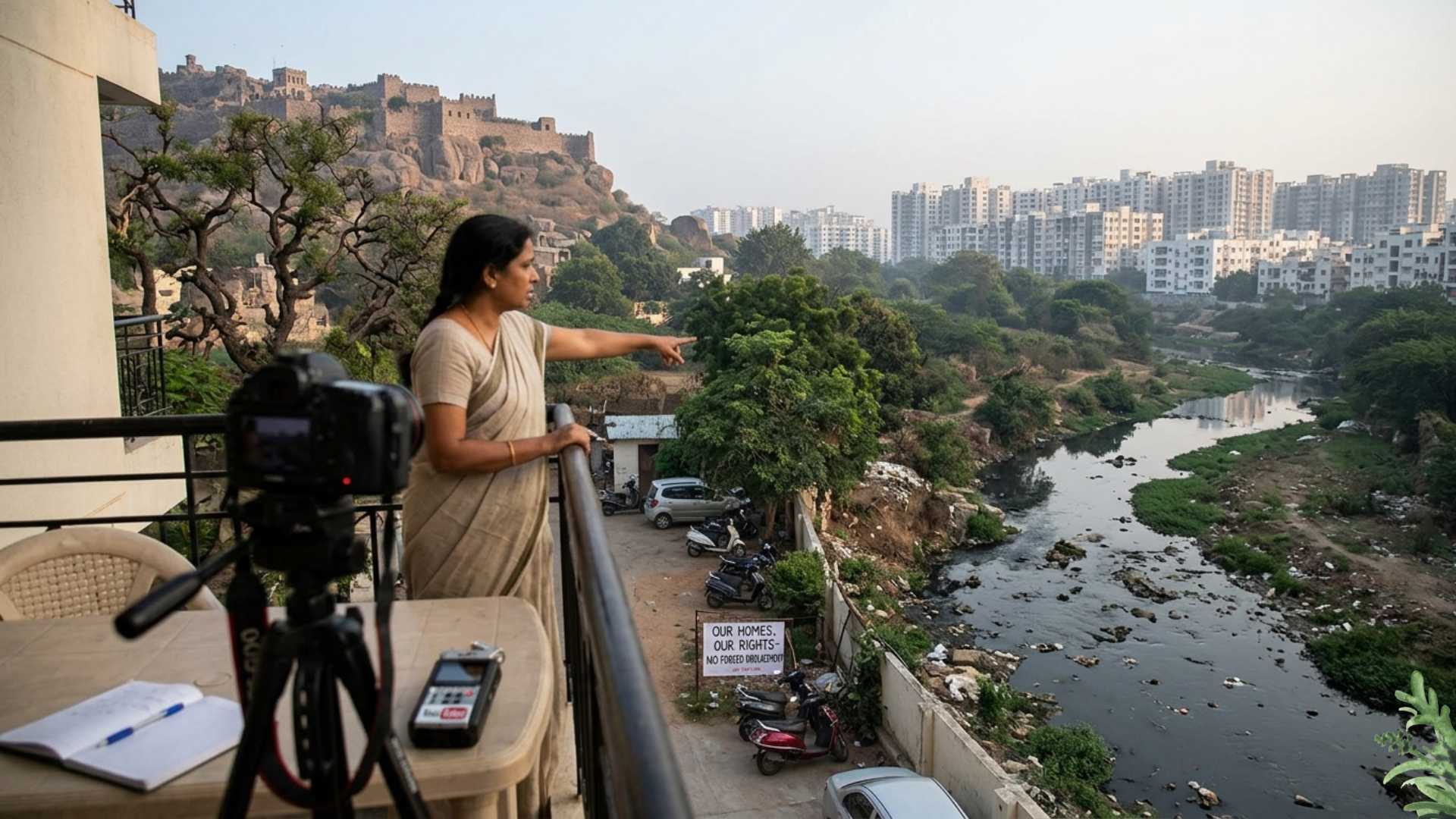
Urban riverfront development has emerged as a signature governance ambition across Indian cities — yet the gap between aesthetic ambition and ecological reality has never been starker than in Hyderabad's Musi, a seasonal river that has become a perennial pollution channel.
"Restoring the Musi means restoring the basin, replanting vegetation, protecting tributary streams, and reviving the traditional tank and pond systems — ecological restoration of the catchment isn't just background work, it is the work." — Donthi Narasimha Reddy, Environmentalist
| Indicator | Figure |
|---|---|
| Total River Coverage (MRDP) | 55 km through Hyderabad |
| Daily Sewage & Effluent Inflow | ~1,800 MLD through 64 outlets |
| Phase I Estimated Cost | ₹6,500–7,000 crore (excl. land acquisition) |
| Total Properties for Acquisition | 10,000+ across 3,279 acres |
| Legal Framework for Acquisition | RFCTLARR Act, 2013 |
Background: The Musi River and Its Decline
The Musi riover is a seasonal 240–260 km left bank tributary of the Krishna river originating in the Ananthagiri hills, flowing 55 km through Hyderabad before joining the Krishna at Wadapally, Nalgonda.
Key Historical Interventions:
- 1908: Osman Sagar and Himayat Sagar reservoirs built after catastrophic floods — feeding the Moosa and Esi tributaries that merge to form the Musi within the city
- 1996: Construction and polluting industries banned across the 11,000 sq km catchment (84 villages) to protect twin drinking water reservoirs
- 1997: First riverfront proposal — slum evictions undertaken, project abandoned after 2000 floods destroyed concrete bunds
- 2009: Rubber dam built for tourism; led to weed growth, garbage, and mosquitoes — abandoned
- 2017: Musi Riverfront Development Corporation Limited (MRDCL) formed under BRS government
- 2025: Current Congress government revives MRDP with ADB funding and Meinhardt Group (Singapore) as DPR consultant
"Roughly 90% of what flows through the Musi in Hyderabad is sewage and industrial effluent — around 1,800 million litres a day pouring in through 64 outlets, carrying pharmaceutical waste from the city's bulk drug manufacturing hubs." — Donthi Narasimha Reddy, Environmentalist and Public Policy Professional
Project Scope and Features
| Parameter | Details |
|---|---|
| Total River Coverage | 55 km through Hyderabad |
| Phase I Coverage | 11.2 km (Moosa) + 9.8 km (Esi) |
| Phase I Cost | ₹6,500–7,000 crore (excluding land acquisition) |
| Total Properties for Acquisition | 10,000+ across 3,279 acres |
| Sewage Treatment Capacity Planned | ~3,000 MLD (27 major stormwater drains) |
| Water Diversion Plan | 2.5 tmcft from Mallanna Sagar (Godavari) |
| Funding Agency | Asian Development Bank (ADB) |
| DPR Consultant | Meinhardt Group, Singapore |
| Implementation Model | 5 phases; East-West road corridor on BOT (toll-based) |
Stated Objectives: Flood mitigation, accessible riverfront, connected city, sustainable development, heritage tourism, employment and revenue generation.
Marquee Feature: Gandhi Sarovar Project — 200 acres, 123-feet Gandhi statue, cultural centre and museum at Moosa-Esi confluence.
Global Inspirations Cited: Cheonggyecheon (Seoul), Sumida (Tokyo), Seine (Paris), Thames (London), Sabarmati (Ahmedabad).
Key Issues and Analytical Dimensions
1. Displacement and Land Acquisition
The MRDP requires acquisition of 10,000+ properties across 3,279 acres — one of the largest urban land acquisition exercises in recent Indian history.
The project invokes the RFCTLARR Act, 2013 for acquisition — but uses a 2017 amendment to exempt itself from the mandatory Social Impact Assessment (SIA), a key safeguard under the original Act designed to assess displacement impact before acquisition proceeds.
Core governance concerns:
- Gram Sabhas cancelled without explanation
- Compensation details not disclosed to affected residents
- Buffer zone rules applied retrospectively to buildings constructed with valid permissions before 2012 AP Building Rules
- TDR (Transferable Development Rights) offered as primary compensation — inadequate for senior citizens and mortgaged property owners
- Chief Minister's public statement that property values will become "zero" — coercive rather than consultative
2. Ecological vs. Cosmetic Restoration
A 2024 research paper (Phani & Prasad, Osmania University / Cyient) confirmed the Musi is heavily contaminated with chemical pollutants from pharmaceutical and industrial effluents — described as a toxic cocktail.
The MRDP's ecological components include:
- Sewage Treatment Plants (3,000 MLD capacity)
- Nature-based solutions: floating wetlands, sedimentation basins, vegetated swales
- Dredging of toxic silt and sludge
Critical gap: No specific plan for treatment and disposal of dredged toxic waste. No plan to arrest pollution at source from industries on Hyderabad's northern fringe — the primary polluters.
"The project has no component for addressing the pollution at source. Let them first arrest the pollution released into the river from the industries before talking about a clean-up." — Jeevan Kumar, Human Rights Forum
"Restoring the Musi means restoring the basin, replanting vegetation, protecting tributary streams, and reviving the traditional tank and pond systems that once recharged groundwater across 40 villages." — Donthi Narasimha Reddy, Environmentalist
3. Water Diversion and Catchment Risk
The plan to divert 2.5 tmcft from Mallanna Sagar (Godavari) to maintain the Musi as a perennial river raises serious concerns:
- The 1996 order protecting the 11,000 sq km catchment of Osman Sagar and Himayat Sagar (Hyderabad's drinking water sources) may be scrapped to accommodate the diversion
- Chief Minister's statement — "We will do real estate, why not?" — at the project launch signals that catchment protection may be sacrificed for real estate development
- Opening the catchment to construction would threaten hill streams, groundwater recharge, and long-term water security of Hyderabad
4. RFCTLARR Act and SIA Exemption
| RFCTLARR Act, 2013 Provision | Status in MRDP |
|---|---|
| Social Impact Assessment (SIA) mandatory | Exempted via 2017 amendment |
| Gram Sabha consent for acquisition | Gram Sabha cancelled |
| Fair compensation (4x market value in rural, 2x in urban) | Details not disclosed to residents |
| R&R (Rehabilitation & Resettlement) plan | Not made public |
| Transparency and public disclosure | DPR not yet made public |
The SIA exemption is particularly significant — it removes the statutory requirement to assess how many families will be displaced, their vulnerability profile, and whether the public purpose justifies the displacement. This is precisely the safeguard that RFCTLARR 2013 introduced over the older Land Acquisition Act, 1894.
5. Real Estate vs. Ecological Interests
Opposition parties and civil society allege that the MRDP is primarily a real estate-driven project using ecological restoration as justification:
- East-West road corridor on Build-Operate-Transfer (toll) model — prime riverfront land monetisation
- Marquee commercial developments (shopping areas, leisure spaces) on acquired land
- ADB's environmental and social framework may be violated — MJA has formally written to ADB flagging these concerns
- Historical precedent: 1997 project similarly evicted slum dwellers; 2009 rubber dam created ecological problems rather than solving them
Comparison: Global Riverfront Projects
| Project | City | Key Approach | Outcome |
|---|---|---|---|
| Cheonggyecheon | Seoul | Removed elevated expressway; restored buried stream | Ecological + urban success; 168% biodiversity increase |
| Thames Revival | London | 168 years of sewage treatment investment; Clean Rivers Act | Salmon returned after century; ecological recovery |
| Sabarmati Riverfront | Ahmedabad | Embankment, promenades; slum displacement | Urban aesthetic success; significant displacement criticism |
| Seine | Paris | Long-term pollution control; no forced displacement | Tourism + ecology balanced |
| Musi MRDP | Hyderabad | Cosmetic + infrastructure; displacement; source pollution unaddressed | Outcome uncertain; contested |
Key lesson from global cases: Successful riverfront restoration requires decades of upstream pollution control before any aesthetic development — not simultaneous or cosmetic-first approaches.
Civil Society Response: Musi Jan Andolan (MJA)
MJA — a coalition of affected residents, NGOs, environmentalists, and human rights groups — has demanded:
- Public disclosure of the Detailed Project Report
- Protection of residents' rights — no displacement without informed consent and adequate compensation
- Ecology-first approach — river basin restoration, not real estate-led beautification
- Source pollution control — industries to be held accountable before cosmetic riverfront work begins
- Formal complaint filed with ADB flagging violations of the bank's environmental and social framework
Implications and Challenges
- Displacement without rehabilitation: 10,000+ properties; senior citizens, defence personnel, single parents with mortgages — all facing acquisition with vague compensation promises
- Retrospective buffer zone enforcement: Legal permissions granted before 2012 Building Rules being nullified — raises serious rule of law concerns
- Ecological window dressing: Without source pollution control, STPs alone cannot restore a river receiving 1,800 MLD of industrial and pharmaceutical effluent daily
- Catchment destruction risk: Sacrificing the 1996 protection order for real estate would cause irreversible damage to Hyderabad's long-term water security
- ADB accountability: International funding agencies carry their own environmental and social safeguard obligations — MJA's complaint could stall or restructure the project
- Precedent for urban India: How Hyderabad handles this project will set the template for dozens of similar urban river restoration projects planned across India
Conclusion
The Musi Riverfront Development Project is a microcosm of India's broader urban development dilemma — the collision between infrastructure ambition and ecological integrity, between city beautification and community rights. Hyderabad's Musi cannot be restored by cosmetic promenades and Gandhi statues while 1,800 MLD of untreated sewage continues to flow through it daily. True river restoration requires source pollution control, basin-level ecological thinking, transparent community consultation, and time — not just capital and political will. The RFCTLARR Act's safeguards — SIA, Gram Sabha consent, transparent R&R — exist precisely for projects of this scale and complexity. Bypassing them sets a dangerous precedent for urban displacement across India. The Musi's revival, if it must happen, must be built on ecological science and constitutional rights — not real estate economics and political optics.