Introduction
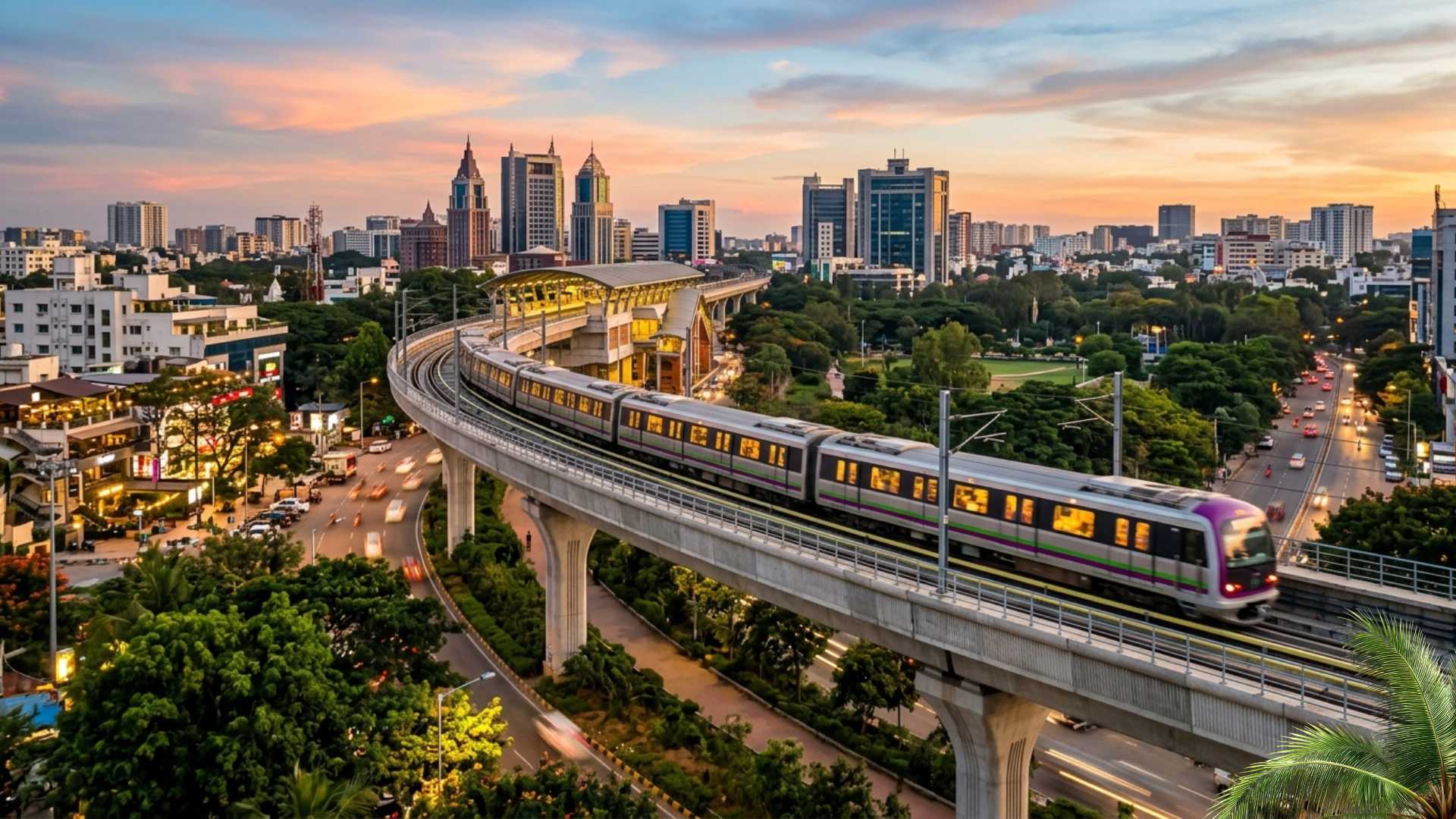
Urban mobility is a major challenge for rapidly growing cities. According to the TomTom Traffic Index, cities like Bengaluru rank among the most congested in the world. To address this, metro rail systems are being expanded across India. Bengaluru currently has about 96 km of metro network with 83 stations, making it the second-largest metro system in India, built at a cost exceeding ₹67,000 crore. However, challenges related to planning, connectivity, and cost escalation continue to limit its full potential.
Background: Namma Metro Development
The Namma Metro project was launched to reduce congestion and promote public transport usage.
| Phase | Key Details |
|---|---|
| Phase 1 (2005–2017) | 42.3 km network constructed |
| Phase 2 | Major expansion across city corridors |
| Total operational network | ~96 km |
| Total expenditure so far | ~₹67,460 crore |
The system is implemented by the Bangalore Metro Rail Corporation Limited (BMRCL).
Key Urban Mobility Issues in Bengaluru
Despite metro expansion, Bengaluru continues to experience severe congestion due to:
- Rapid urbanisation
- Concentration of IT employment clusters
- High private vehicle ownership
| Indicator | Data |
|---|---|
| Registered vehicles (2020–21) | ~1 crore |
| Registered vehicles (2025) | ~1.23 crore |
| Major employment hubs | Electronics City, Whitefield, Outer Ring Road |
The growth of vehicles has outpaced public transport expansion.
Planning Challenges in the Metro Network
Urban transport experts highlight several planning gaps.
1. Route Prioritisation Issues
Early metro corridors focused on areas with lower commuter demand, while major employment corridors were added later.
| Early Metro Corridors | Major Employment Corridors (Delayed) |
|---|---|
| M.G. Road | Outer Ring Road |
| Basavanagudi | Electronics City |
| Malleswaram | Whitefield–ITPL corridor |
This mismatch reduced the metro’s ability to attract daily commuters.
2. First- and Last-Mile Connectivity Problems
Many commuters must rely on multiple modes of transport to reach metro stations.
Common issues include:
- Lack of feeder bus services
- Limited pedestrian infrastructure
- Dependence on autos or taxis
A 2023 study by the Bengaluru Political Action Committee found that:
- 95% of private vehicle users would shift to metro if reliable last-mile connectivity existed.
Cost Escalation in Metro Construction
Metro projects often face cost increases due to delays and technical challenges.
| Phase | Initial Cost | Final/Updated Cost | Increase |
|---|---|---|---|
| Phase 1 | ₹6,395 crore | ₹14,405 crore | >100% |
| Phase 2 | ₹26,405 crore | ₹40,425 crore | >53% |
Reasons for Cost Escalation
- Underground tunnelling complexity
- Land acquisition costs
- Inflation in construction materials
- Design revisions and route extensions
- Delays in project execution
Financing Structure
A significant portion of funding for the Bengaluru Metro comes from international financial institutions.
| Institution | Role |
|---|---|
| Japan International Cooperation Agency | Infrastructure financing |
| Asian Development Bank | Loan assistance |
| European Investment Bank | Infrastructure loans |
| KfW Development Bank | Development financing |
Since these are loan-funded projects, delays increase financial burden due to rising interest costs.
Impact of Route Expansion on Ridership
Metro connectivity to employment hubs significantly increases ridership.
| Corridor | Impact |
|---|---|
| Whitefield extension (2023) | Ridership increased by ~2.5–3 lakh passengers/day |
| Electronics City Yellow Line (2025) | ~60,000 daily passengers within weeks |
This demonstrates the importance of demand-driven transport planning.
Institutional Governance Issues
The Bengaluru Metropolitan Land Transport Authority (BMLTA) was created to ensure integrated transport planning.
However, challenges include:
- Political influence in route selection
- Delays in project approvals
- Coordination issues between agencies
Experts argue that transport planning should be based on commuter demand and urban mobility patterns rather than political considerations.
Urban Transport Lessons from Bengaluru
Key lessons for urban transport planning in Indian cities:
Integrated Planning
Metro systems must align with employment hubs and population density.
Multi-Modal Connectivity
Integration with buses, cycling networks, and pedestrian infrastructure is essential.
Transit-Oriented Development (TOD)
Metro stations should encourage mixed-use development and high-density housing.
Land Value Capture (LVC)
| Mechanism | Purpose |
|---|---|
| Development charges | Capture increased land value near metro stations |
| Commercial leasing | Revenue from station spaces |
| Transit-oriented real estate | Mixed-use development |
LVC can help reduce dependence on fare revenue and public debt.
Expert Insight
Urban transport expert M. N. Srihari emphasises:
“Public transport infrastructure must follow commuter demand rather than political priorities.”
Conclusion
The experience of Namma Metro highlights both the potential and the challenges of large urban transit projects in India. While metro systems are essential for sustainable urban mobility, their success depends on demand-driven planning, efficient project management, and strong multimodal integration. Addressing issues such as last-mile connectivity, institutional coordination, and financial sustainability will be crucial for Bengaluru and other Indian cities seeking to build effective metro networks.