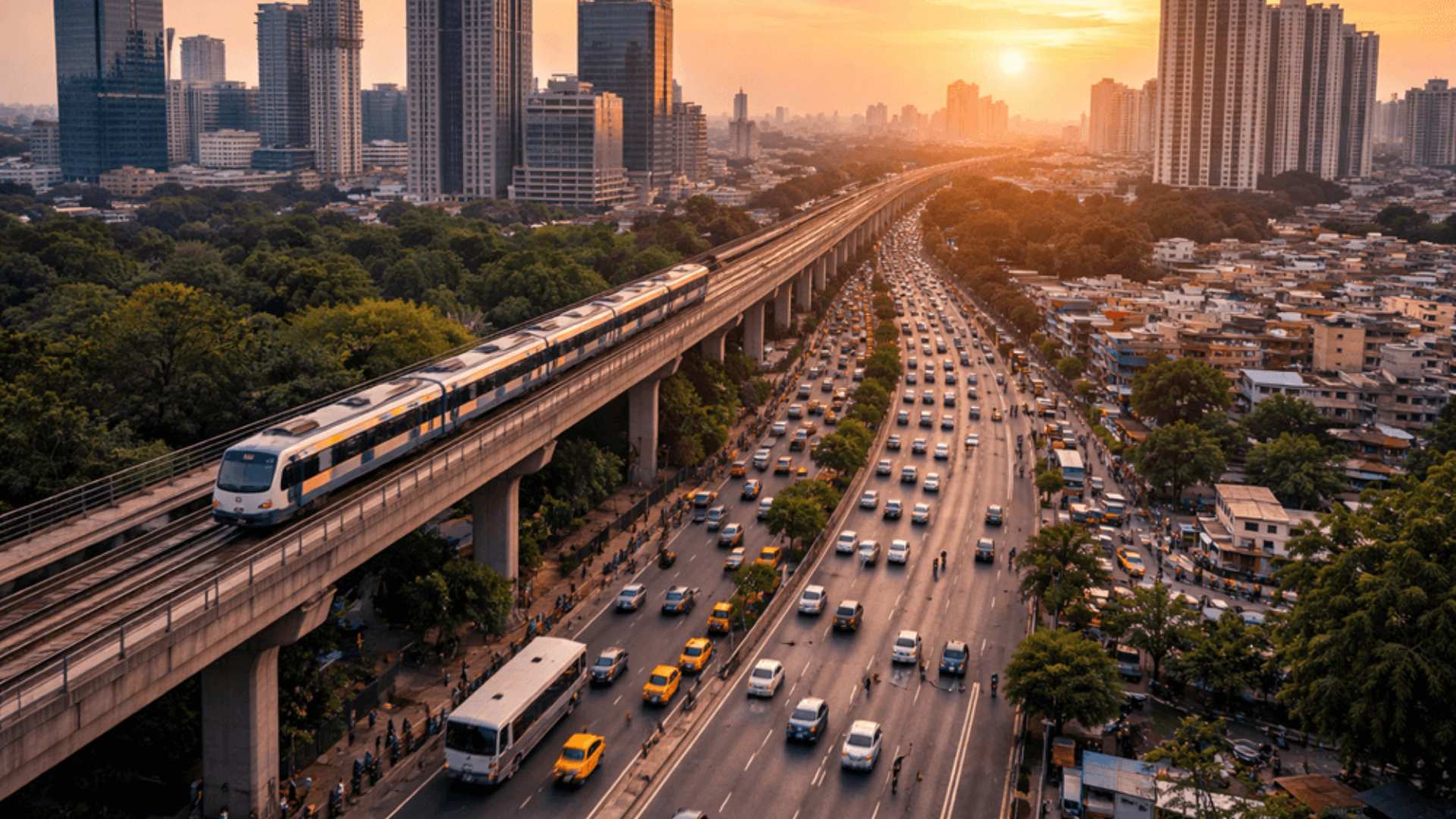
India's Urban Mobility Crisis: Beyond Just Infrastructure Spending

The Union Budget's focus on cities must address urban mobility challenges to enhance productivity effectively and sustainably.
S
Surya
5 mins read
Urban congestion underscores need for people-centric mobility to unlock city-led growth
Not Started

1. Urban Growth Strategy in the Union Budget: Cities as Economic Engines

The Union Budget places cities at the centre of India’s growth strategy, signalling a recognition that urbanisation will drive productivity, employment, and innovation in the coming decades. This is reflected in a sharp push to public capital expenditure, including ₹12.2 trillion for infrastructure.

Announcements such as seven new high-speed rail corridors, continued Metro expansion, the proposal to create “city economic regions”, and incentives for municipal corporations to access the bond market indicate an ambition to unlock agglomeration economies. These measures align urban policy with national growth objectives.

However, the focus so far remains heavily asset-oriented. Infrastructure creation alone does not automatically translate into economic efficiency unless systems deliver reliable outcomes. If this gap persists, rising congestion and inefficiencies can offset the benefits of high public investment.

The governance logic is that cities must function as efficient systems, not just construction sites; ignoring outcomes risks undercutting the very growth dividends urbanisation promises.


2. Urban Mobility as the Backbone of City Productivity

The Economic Survey 2025–26 explicitly recognises transportation as central to urban functioning, describing it as the “bloodstream, spine and muscles” of a city. Efficient mobility enables the flow of labour, goods, and ideas that sustain urban economies.

When mobility systems fail, congestion, pollution, and declining productivity follow, directly affecting economic output and quality of life. Urban transport thus becomes a macroeconomic concern rather than a narrow sectoral issue.

This framing elevates mobility from a municipal service to a national growth constraint. Neglecting it risks cities becoming centres of inefficiency rather than engines of development.

“Transportation is the bloodstream, spine and muscles of a city.”Economic Survey 2025–26

Urban governance must treat mobility as core economic infrastructure; failure to do so imposes hidden but persistent productivity losses.


3. Economic Cost of Congestion: Evidence from Indian Cities

Empirical estimates underline the scale of losses caused by congestion. A study by the Centre for Science and Environment shows that even an unskilled worker in Delhi can lose up to ₹19,600 annually, while skilled workers lose nearly ₹26,000 due to congestion.

The Institute for Social and Economic Change estimated that Bengaluru lost about 700,000 productive hours in 2018 alone. At the national scale, a Uber–Boston Consulting Group report estimates congestion costs in India’s four largest metros at $22 billion annually.

Global comparisons further highlight severity. The TomTom Traffic Index 2025 ranks Bengaluru as the second-most congested city globally, with Kolkata and Pune also among the slowest. Overall, India ranks fifth globally and second in Asia in congestion.

Unchecked congestion acts as a silent tax on labour and firms; ignoring it erodes competitiveness despite high infrastructure spending.

Key statistics:

  • ₹19,600–₹26,000 annual income loss per worker in Delhi
  • 700,000 productive hours lost in Bengaluru (2018)
  • $22 billion annual congestion cost in four metros
  • India ranked 5th globally in congestion (TomTom 2025)

4. Limits of Rail-Centric Urban Transport Expansion

India has significantly expanded mass rapid transit over the past decade. As of 2025, more than 1,036 km of Metro and regional rapid-transit systems are operational across 24 cities, with further expansion underway.

However, rail systems alone cannot solve urban mobility challenges in cities dominated by private vehicles. Roads increasingly function as parking spaces rather than movement corridors, reducing overall transport efficiency.

Without complementary surface transport and demand management, rail investments face diminishing returns. This risks underutilisation of costly assets and persistent congestion.

Infrastructure without modal balance leads to suboptimal outcomes; rail expansion must be embedded within a wider mobility ecosystem.


5. Neglect of Bus Systems and Last-Mile Connectivity

Buses remain the most flexible and cost-effective form of mass transport, yet they are systematically underprovided. The Ministry of Housing and Urban Affairs recommends 40–60 buses per 100,000 people, but India’s cities together have only about 47,650 buses.

Nearly 61% of these buses are concentrated in just nine mega cities, leaving smaller and medium cities underserved. Weak first- and last-mile connectivity further reduces the effectiveness of Metro and rail investments.

This imbalance pushes commuters towards private vehicles, reinforcing congestion and pollution cycles. Ignoring buses undermines inclusive and affordable urban mobility.

Bus neglect creates a structural bias towards private transport; without correction, public investment fails to reach the majority of commuters.

Challenges:

  • Severe bus shortage relative to norms
  • Uneven distribution across cities
  • Weak first- and last-mile integration

6. People-Centric Urban Mobility: Pathway to Outcomes

Achieving meaningful improvement requires a shift from asset-centric to people-centric planning, where viable alternatives to private vehicles become the default. This involves expanding and digitising bus fleets, improving service reliability, and integrating shared mobility for last-mile access.

Making walking and cycling safe and attractive, implementing transit-oriented development to shorten trip lengths, and adopting technology-led traffic management are equally important. Demand-based parking policies can discourage excessive car use.

Urban mobility has thus become a central determinant of economic growth. Without reforming how people move within cities, infrastructure-led growth risks stalling.

“Cities have the capability of providing something for everybody, only because, and only when, they are created by everybody.”Jane Jacobs

Mobility reform is a governance challenge as much as a technical one; ignoring behavioural and spatial planning locks cities into congestion traps.


Conclusion

The Union Budget’s urban focus reflects a clear recognition of cities as engines of growth. However, translating capital expenditure into economic outcomes depends critically on fixing urban mobility. A shift towards integrated, people-centric transport systems is essential to ensure that India’s urbanisation strengthens productivity rather than constraining it.

Quick Q&A

Everything you need to know

Placing cities at the centre of the Union Budget’s growth strategy signifies a recognition that India’s future economic growth will be predominantly urban-driven. With rapid urbanisation underway, cities are no longer just administrative units but engines of productivity, innovation and employment. The Budget’s emphasis on large-scale public capital expenditure, high-speed rail corridors, Metro expansion and the creation of “city economic regions” reflects an understanding that urban agglomerations generate scale efficiencies, dense labour markets and knowledge spillovers that rural or dispersed growth cannot easily replicate.

This approach also reflects a shift from welfare-centric urban policy to productivity-oriented urban governance. Investments worth ₹12.2 trillion in infrastructure are intended to reduce transaction costs within cities, improve labour mobility and enhance competitiveness. The Economic Survey’s description of transport as the “bloodstream, spine and muscles” of a city underlines that without efficient mobility systems, urban concentration can quickly turn into congestion, pollution and declining quality of life. Thus, cities are seen not just as consumption centres but as production hubs critical to achieving sustained high growth.

However, the article cautions that asset creation alone is insufficient. If infrastructure investments do not translate into improved outcomes—such as reduced travel time, lower congestion and inclusive access—the growth promise of cities will remain unrealised. Therefore, the significance of this strategy lies not merely in spending more on cities, but in fundamentally rethinking how urban systems, especially mobility, are planned, governed and used.

Urban mobility has emerged as a critical constraint because inefficient movement of people and goods directly undermines productivity, inclusiveness and environmental sustainability. The article highlights that congestion imposes measurable economic costs on individuals and the economy. Estimates show that workers in cities like Delhi lose tens of thousands of rupees annually due to time wasted in traffic, while Bengaluru alone lost around 700,000 productive hours in a single year. At a macro level, congestion in India’s largest metros costs the economy billions of dollars annually.

The problem is particularly acute because Indian cities are simultaneously experiencing rapid motorisation and incomplete public transport coverage. As incomes rise, private vehicle ownership increases, but road space does not expand proportionately. Roads increasingly function as parking lots rather than mobility corridors. This results in slower average speeds, higher fuel consumption, increased pollution and stress on urban residents. Global indices such as the TomTom Traffic Index reinforce the severity of the issue, with Indian cities ranking among the most congested worldwide.

From a growth perspective, poor mobility reduces effective labour market size, discourages investment and weakens agglomeration benefits. Firms face higher logistics costs and employees face longer, more uncertain commutes. Thus, unless urban mobility systems improve, the large capital investments announced in the Budget risk delivering diminishing returns, making mobility reform central to sustaining urban-led growth.

The persistence of congestion despite extensive Metro and rail expansion highlights structural weaknesses in India’s urban transport ecosystem. While over 1,036 km of Metro and regional rapid-transit systems are operational across 24 cities, rail-based systems alone cannot solve mobility challenges in cities that remain overwhelmingly dependent on private vehicles for daily travel.

One major reason is the neglect of buses, which are the most flexible, scalable and cost-effective form of mass transport. The Ministry of Housing and Urban Affairs recommends 40–60 buses per 100,000 people, yet India’s cities together have a severe shortfall, with buses unevenly concentrated in a few mega cities. Without robust bus networks, Metro systems cannot attract sufficient ridership, especially for shorter trips and peripheral areas. Weak first- and last-mile connectivity further reduces the practical utility of rail investments.

Additionally, urban planning has prioritised infrastructure creation over travel behaviour change. Parking policies, road design and land-use patterns continue to incentivise private vehicle use. As a result, even with modern rail systems, many commuters find cars or two-wheelers more convenient. This mismatch between investment and usage explains why congestion persists, underscoring the need for integrated, multimodal planning rather than isolated flagship projects.

The article’s assertion that urban mobility is not primarily a funding problem but a planning and governance challenge is well-founded. India has significantly increased spending on urban transport, particularly on capital-intensive projects like Metros, high-speed rail and road infrastructure. Yet outcomes in terms of reduced congestion, shorter commute times and modal shift away from private vehicles remain limited, indicating systemic inefficiencies.

From a planning perspective, transport investments are often supply-driven rather than demand-responsive. Projects are planned in silos, without integrating land use, housing and employment patterns. This leads to long commute distances and underutilised infrastructure. Governance fragmentation compounds the problem, as multiple agencies control roads, traffic management, public transport and land use, often with weak coordination and accountability for outcomes.

However, it would be simplistic to dismiss funding constraints entirely. Adequate and predictable financing is still required for bus fleet expansion, maintenance, digital systems and pedestrian infrastructure. The key issue is not the quantum of spending but its allocation and effectiveness. Therefore, solving India’s urban mobility crisis requires institutional reform, outcome-based funding, empowered city governments and people-centric planning rather than merely increasing budgetary outlays.

A people-centric urban mobility approach shifts the focus from moving vehicles to moving people efficiently, safely and affordably. Such an approach prioritises public transport, walking and cycling, while making private vehicle use less attractive through demand management. The article outlines several policy measures that together can transform urban mobility outcomes.

Expanding and digitising bus fleets is a foundational step. Cities like Indore and Surat have demonstrated how improved bus services, integrated ticketing and real-time information can significantly increase public transport usage. Safe pedestrian infrastructure and dedicated cycling lanes encourage short trips to shift away from motorised modes, as seen in parts of Delhi’s complete-streets initiatives. Integrating shared mobility options such as e-rickshaws and bike-sharing improves first- and last-mile connectivity to Metro stations.

Transit-oriented development around transport hubs can shorten trip lengths by bringing jobs, housing and services closer together. Technology-led traffic management and demand-based parking policies further discourage excessive car use. Collectively, these measures can reduce congestion, improve air quality and enhance productivity. The case illustrates that meaningful urban transformation depends less on iconic projects and more on consistent, people-first policy choices implemented at the city level.

Attribution

Original content sources and authors

Sign in to track your reading progress

Comments (0)

Please sign in to comment

No comments yet. Be the first to comment!