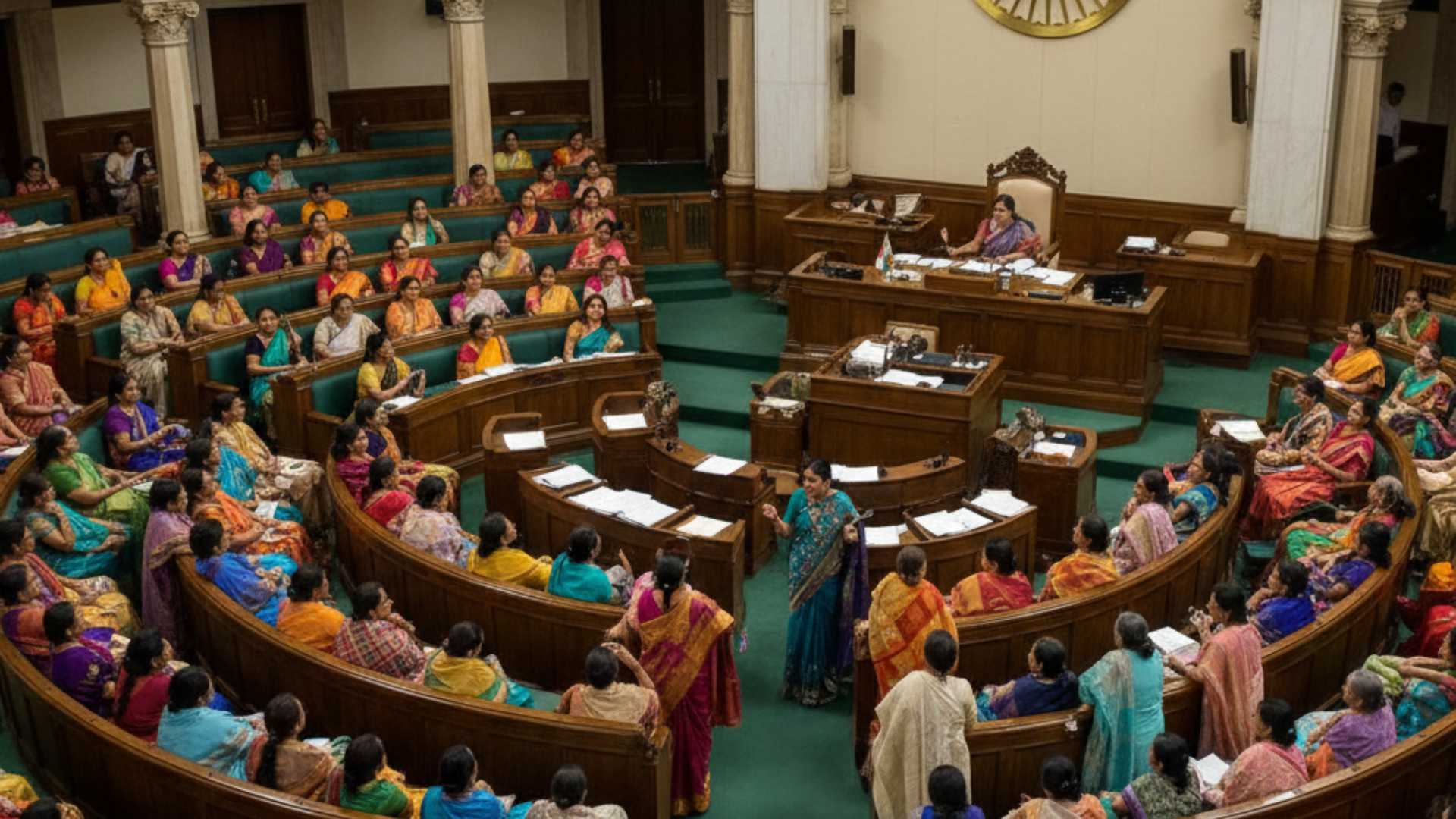
1. Legislative Promise and Constitutional Timeline
The Women’s Reservation Act, 2023 provides for one-third reservation for women in the Lok Sabha and State Legislative Assemblies. It was presented as a major step toward gender justice and political inclusion after nearly three decades of legislative attempts since 1996.
However, the Act contains a critical enabling clause: reservation will take effect only after the first Census conducted post-2026 and the subsequent delimitation exercise. This makes implementation contingent upon two sequential constitutional processes.
Given that the next general election is due in 2029, and the Census is scheduled for 2027, the timeline makes implementation in 2029 legally improbable. Census data publication, followed by constitution of a Delimitation Commission under Article 82, and completion of redrawing constituencies would extend beyond that date.
The governance implication is clear: constitutional sequencing determines political outcomes. When rights are made contingent on complex institutional processes, delay becomes structurally embedded, potentially postponing representation despite legislative intent.
2. Constitutional and Logistical Constraints: Census and Delimitation
The Act mandates two non-bypassable steps:
- Conduct of a national Census
- Delimitation of constituencies based on that Census
After enumeration in 2027, Census data must be verified and officially published, a process that historically takes 12–18 months. Only then can the President constitute a Delimitation Commission under Article 82.
India has had four Delimitation Commissions since Independence. None completed its task in fewer than three years. The most recent (constituted in 2002) took six years, even though it only redrew internal boundaries without reallocating seats among States.
The upcoming delimitation will be more complex because it will:
- Reallocate parliamentary seats among States for the first time since 1976
- Redraw 543 parliamentary constituencies
- Redraw over 4,000 State Assembly constituencies
- Integrate SC, ST, and now women’s reservations simultaneously
Even on an optimistic timeline, delimitation may conclude only by 2032–33, pushing implementation to the 2034 general election.
Institutional processes like delimitation are foundational to electoral fairness. However, when policy design makes social reform dependent on such large-scale administrative exercises, reform timelines become uncertain and politically contingent.
3. Political Economy of the Delimitation Linkage
If reservation were implemented immediately within the existing 543-seat Lok Sabha, approximately 181 seats would become women-only constituencies. This would displace an equivalent number of sitting male MPs.
Instead, the linkage with delimitation allows for potential expansion of the Lok Sabha—possibly to 800 or even 888 seats—after the Census. In such a scenario, one-third reservation can be accommodated without displacing current incumbents.
Thus, the burden of adjustment shifts from replacement to expansion. Politically, this reduces resistance from parties and sitting representatives.
However, this design delays representation for women by at least one full electoral cycle. The trade-off reflects political feasibility over immediate implementation.
The episode highlights how constitutional engineering often balances reform with political stability. Yet, delayed inclusion risks undermining the normative legitimacy of reform itself.
4. Federal Dimensions: Delimitation and the North–South Debate
Delimitation has been frozen since 1976, and the freeze was extended in 2001, primarily to prevent penalising States that successfully implemented population control measures.
When delimitation occurs post-2026:
- States with higher population growth may gain more seats.
- States with stable or declining fertility may see reduced proportional representation.
By tying women’s reservation to delimitation, the Act links gender justice to unresolved federal demographic tensions. This creates the risk that political disagreement over inter-State seat distribution could further delay women’s representation.
The issue therefore intersects with:
- GS2: Federalism
- GS1: Population and Demography
- GS2: Representation and Constitutional Bodies
When social justice reform becomes embedded within contentious federal restructuring, consensus becomes harder. If delimitation stalls due to inter-State disputes, women’s reservation could remain suspended indefinitely.
5. Design Gaps in the Act
Beyond timing, several structural issues remain:
Scope Limitations
- Applies only to Lok Sabha and State Legislative Assemblies
- Excludes Rajya Sabha and State Legislative Councils
Sub-Reservation
- SC and ST women receive proportional sub-quotas.
- No sub-reservation for OBC women, despite their significant demographic presence.
Rotation Mechanism
- Reserved constituencies will rotate after each general election.
Operational clarity is lacking regarding:
- Candidate continuity
- Interaction with future delimitation changes
- Administrative predictability
These ambiguities may generate litigation, political bargaining, and uncertainty for women candidates.
Incomplete institutional design often shifts the burden of clarity to implementation agencies and courts. Without clear operational rules, even well-intentioned reforms face friction in execution.
6. Constitutional Options for Immediate Implementation
There is no inherent constitutional necessity linking reservation to delimitation. Parliament, which created the linkage, retains the authority to amend it.
Possible approaches include:
- Amending the Constitution to delink reservation from delimitation.
- Expanding the Lok Sabha immediately by adding around 180 seats earmarked for women.
- Implementing reservation within existing constituencies for limited election cycles before full delimitation.
Article 15(3) empowers the State to make special provisions for women and children. This provides normative constitutional backing for affirmative measures.
These alternatives would allow implementation before 2034 while managing concerns regarding incumbent displacement.
Constitutional flexibility exists, but its activation depends on political consensus. Reform delayed by design can also be accelerated by design.
7. Historical Context of Women’s Political Representation
The first Women’s Reservation Bill was introduced in 1996. It was repeatedly debated and lapsed with successive Lok Sabhas. It passed the Rajya Sabha in 2010 but was never adopted by the Lok Sabha.
The 2023 Act ended decades of legislative deadlock but deferred operationalisation. Women who anticipated contesting under the new framework in 2029 may have to wait until 2034.
At the global level, women’s political participation is widely recognised as essential to inclusive governance.
"Political power is not a means to an end; it is the end." — B.R. Ambedkar
In representative democracies, access to political power determines access to policymaking influence.
The prolonged legislative history indicates that while normative acceptance of women’s representation has strengthened, institutional consensus on implementation mechanisms remains fragile.
8. Governance and Democratic Implications
Delayed implementation has broader systemic consequences:
- Slows progress toward substantive gender equality in law-making.
- Limits diversity in parliamentary deliberation.
- Weakens India’s global positioning on inclusive democratic practices.
- Creates uncertainty in electoral planning and party candidate selection.
Conversely, well-designed and timely implementation could:
- Improve representational legitimacy.
- Strengthen deliberative democracy.
- Enhance policy responsiveness to gendered concerns.
The issue therefore intersects with:
- GS2: Parliament and State Legislatures
- GS2: Issues relating to women
- Essay: Representation, Democracy, and Justice
Representation is central to democratic legitimacy. When constitutional promises remain operationally distant, citizen trust in institutional reform may erode.
Conclusion
The Women’s Reservation Act, 2023 marks a constitutional commitment to gender inclusion in legislative bodies. However, its linkage to Census and delimitation creates structural delays that may postpone implementation until 2034.
The challenge before Parliament is not merely legal but institutional: whether to allow demographic and federal complexities to determine the pace of gender justice, or to recalibrate the constitutional design to ensure timely inclusion.
The effectiveness of the Act will ultimately depend not on its symbolism, but on its operational realisation within India’s evolving democratic framework.