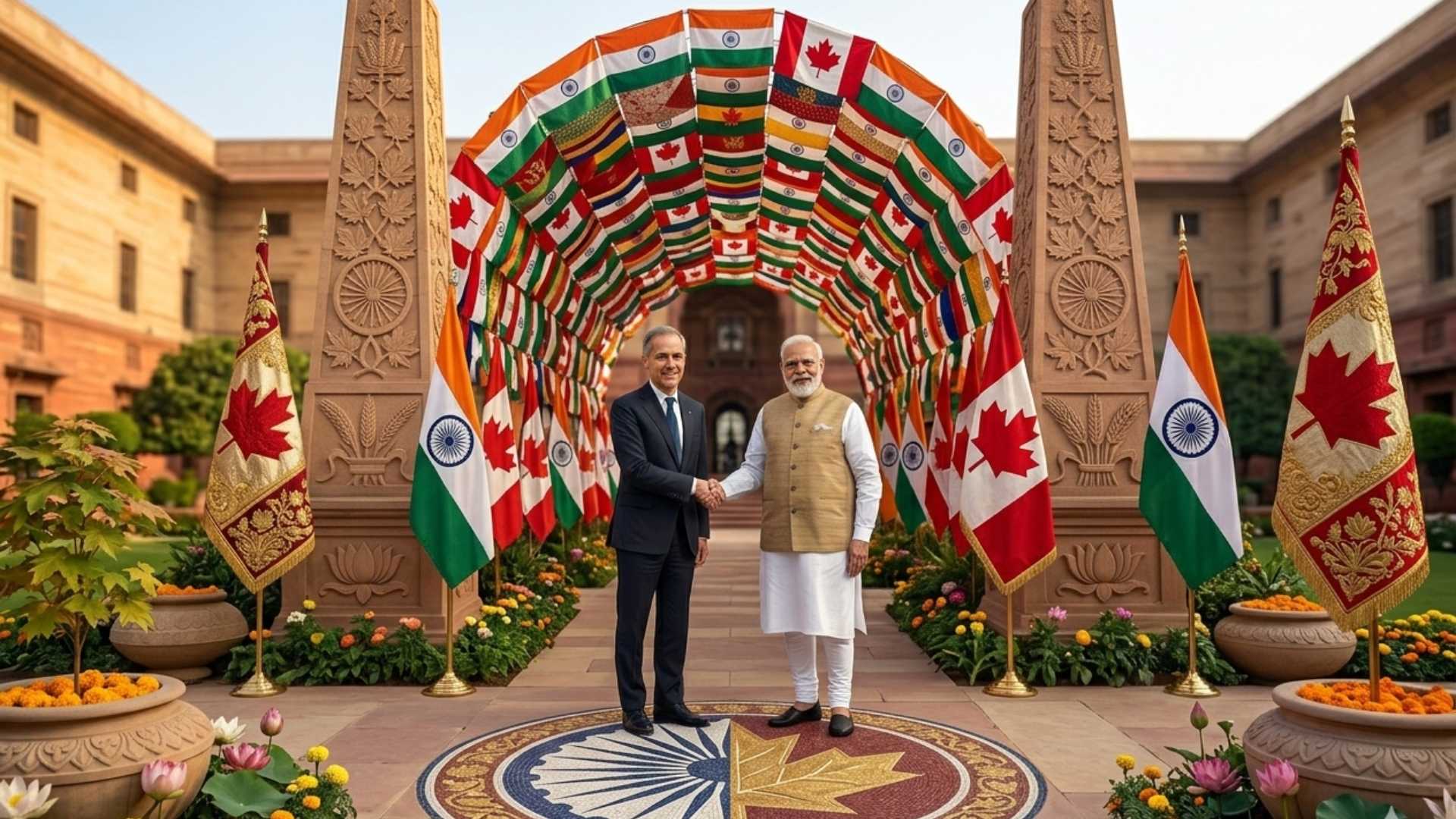
India and Canada Sign $1.9 Billion Uranium Supply Deal

Leaders discuss strategic trust and address allegations related to Nijjar killing while setting economic ties in motion.
G
Gopi
5 mins read
India–Canada Reset: Uranium Deal Signed, Strategic Ties Recalibrated Amid Tensions
Not Started

1. Strategic Reset in Bilateral Relations

India and Canada have agreed to a $1.9 billion, 10-year uranium supply deal and committed to concluding the Comprehensive Economic Partnership Agreement (CEPA) in 2026. The talks between Prime Minister Narendra Modi and Prime Minister Mark Carney aim to rebuild “strategic trust” after years of diplomatic strain.

This visit marks the first standalone bilateral visit by a Canadian Prime Minister since 2018. Relations had deteriorated over allegations of transnational repression and concerns regarding the presence of Khalistani groups in Canada, culminating in a sharp diplomatic exchange after the killing of Hardeep Singh Nijjar.

The reset reflects pragmatic recognition of mutual economic and strategic interests. For India, Canada is a critical partner in energy security and critical minerals. For Canada, India represents a major market and geopolitical partner in the Indo-Pacific.

Stable bilateral relations between middle powers like India and Canada are essential for economic cooperation, energy diversification, and Indo-Pacific balancing. Continued mistrust could limit trade expansion, disrupt energy flows, and weaken multilateral coordination.


2. Uranium Supply Agreement and Energy Security

India signed a 1.9billionagreementwithCanadiancompanyCamecotoimport10,000tonnesofuranium(20272035)foritsnuclearreactors.Thisfollowsanearlieragreementfor2,700tonnes(20152020)worth1.9 billion agreement** with Canadian company Cameco to import **10,000 tonnes of uranium (2027–2035)** for its nuclear reactors. This follows an earlier agreement for **2,700 tonnes (2015–2020) worth 262 million, which faced implementation challenges amid diplomatic tensions.

The new agreement strengthens India’s civil nuclear energy programme, which depends significantly on imported uranium for its Pressurised Heavy Water Reactors (PHWRs). Reliable fuel supply is critical for ensuring energy transition goals while reducing carbon intensity.

This deal also forms part of a broader Strategic Energy Partnership, covering renewable energy, LPG, uranium, and cooperation in critical and emerging technologies.

Key Features:

  • 10,000 tonnes uranium supply (2027–2035)
  • Total value: $1.9 billion
  • Builds upon previous 2,700 tonnes agreement (2015–2020)

Energy security is foundational to economic growth and climate commitments. If fuel supply uncertainties persist, nuclear power expansion may slow, affecting India’s decarbonisation strategy and long-term energy diversification.


3. Comprehensive Economic Partnership Agreement (CEPA)

India and Canada issued the “Terms of Reference” to conclude CEPA negotiations this year, aiming to double bilateral trade by 2030.

CEPA is expected to expand market access, reduce tariffs, and facilitate investment flows. It also signals Canada’s strategic shift towards Indo-Pacific engagement and India’s diversification of trade partnerships beyond traditional Western blocs.

Economic cooperation provides a stabilising anchor to otherwise politically strained relationships. Trade integration often reduces volatility in bilateral ties.

Expected Outcomes:

  • Trade liberalisation
  • Investment facilitation
  • Supply chain diversification
  • Services sector expansion

Trade agreements deepen interdependence and reduce geopolitical friction through economic stakes. Failure to conclude CEPA may reinforce strategic drift and limit India’s export diversification goals.


4. Security Cooperation and Counterterrorism

Despite tensions, both countries agreed to strengthen cooperation on violent extremism, terrorism, and organised crime, and to convene the Joint Working Group on Counterterrorism.

India has consistently raised concerns about the presence of Khalistani separatist groups in Canada. Canada, meanwhile, has reiterated its commitment to combating “transnational repression.”

“Prime Minister Carney also underscored that Canada will continue to take measures to combat transnational repression.” — Statement from Canadian PM’s Office

The joint statement reflects cautious engagement—acknowledging security concerns without escalating rhetoric.

Counterterrorism cooperation is central to sovereign security. Without institutional dialogue, mistrust may intensify, affecting diaspora relations, intelligence sharing, and diplomatic engagement.


5. Nijjar Case and Diplomatic Frictions

Fresh reports in Canadian media, citing intelligence sources, alleged involvement of two Indian consular officials in the killing of Hardeep Singh Nijjar. India firmly rejected these allegations.

“These claims are baseless, politically motivated and unsupported by credible evidence…” — P. Kumaran, Secretary, MEA

The case remains a major irritant in bilateral ties. Canada has previously described India as a “perpetrator of foreign interference and espionage,” while India insists that concerns must be addressed through credible legal processes rather than public narratives.

The persistence of this issue highlights the fragility of the diplomatic reset.

Allegations involving sovereignty and foreign interference strike at the core of diplomatic trust. If unresolved through institutional mechanisms, they can undermine long-term cooperation in trade, security, and multilateral forums.


6. Multilateral and Strategic Convergence

Canada decided to join India-led initiatives such as the International Solar Alliance (ISA) and the Global Biofuel Alliance. This reflects expanding cooperation in climate governance and sustainable energy.

The two leaders also discussed the escalating conflict in West Asia. India reiterated its call for “diplomacy and dialogue,” while Canada had earlier supported U.S. strikes on Iran, indicating nuanced differences in foreign policy approaches.

India’s emphasis on dialogue reflects its strategic autonomy doctrine, balancing relations across global power centres.

Participation in climate and energy alliances enhances India’s leadership credentials in Global South diplomacy. Divergences on West Asia, however, underline the importance of managing geopolitical differences without derailing bilateral progress.


7. Strategic Significance for India (GS Linkages)

GS2 (IR):

  • Bilateral diplomacy amid geopolitical tensions
  • Managing diaspora politics and sovereignty concerns
  • Indo-Pacific strategic balancing

GS3 (Energy & Economy):

  • Nuclear fuel security
  • Energy transition and decarbonisation
  • Trade diversification and CEPA

Essay & Ethics Dimensions:

  • Strategic trust in international relations
  • Balancing economic pragmatism with national sovereignty

Conclusion

The India–Canada engagement reflects pragmatic diplomacy driven by energy security, trade expansion, and multilateral cooperation. However, unresolved allegations and trust deficits remain significant challenges.

Sustained institutional dialogue, economic interdependence through CEPA, and credible legal processes will determine whether this reset evolves into a durable strategic partnership or remains a temporary thaw in a volatile relationship.

Quick Q&A

Everything you need to know

The $1.9 billion, 10-year uranium supply agreement between India and Canada marks a significant step in strengthening India’s nuclear energy security. Under the deal, Canadian company Cameco will supply approximately 10,000 tonnes of uranium from 2027 to 2035. Given India’s limited domestic uranium reserves and its ambition to expand nuclear power capacity as part of its clean energy transition, assured long-term uranium supply is strategically important.

Beyond energy, the agreement represents a diplomatic reset in relations strained over the Nijjar case and allegations of transnational repression. The earlier 2015–2020 uranium agreement did not fully meet expectations amid political tensions. Therefore, the renewed commitment signals an attempt to rebuild “strategic trust” and institutionalise cooperation through frameworks like the Strategic Energy Partnership and CEPA.

In a broader geopolitical context, nuclear cooperation with Canada diversifies India’s energy partnerships, reduces overdependence on specific suppliers, and reinforces India’s status as a responsible nuclear power under the civil nuclear framework established after the 2008 NSG waiver.

The proposed CEPA aims to double bilateral trade by 2030 and deepen economic integration between the two countries. For India, CEPA offers access to Canadian markets in sectors such as agriculture, technology, education, and clean energy. For Canada, India represents a fast-growing economy and an alternative market amid global supply chain reconfigurations.

Strategically, CEPA signals a shift from episodic engagement to institutionalised economic interdependence. Trade agreements create predictable regulatory environments, encourage investment flows, and build stakeholder constituencies that stabilise political relations. This is particularly relevant given the diplomatic tensions over the Nijjar case.

In the larger global context of protectionism and geopolitical fragmentation, CEPA could represent a “third way” in global politics—balancing economic openness with strategic autonomy. Thus, it is not merely a trade pact but a tool for diplomatic stabilisation and economic resilience.

The Nijjar case remains a major irritant in bilateral ties. Canadian investigative agencies have reportedly linked Indian consular officials to the killing of Hardeep Singh Nijjar, allegations that India has categorically rejected as “baseless” and politically motivated. This dispute highlights tensions between sovereignty, diaspora politics, and national security.

From Canada’s perspective, allegations of foreign interference raise concerns about domestic law enforcement and sovereignty. From India’s standpoint, Ottawa’s perceived tolerance of Khalistani extremism is viewed as a threat to India’s territorial integrity. These conflicting narratives complicate efforts to rebuild trust.

Thus, while economic and energy cooperation is progressing, political trust remains fragile. The case illustrates how diaspora politics and security concerns can overshadow economic pragmatism, making institutional dialogue mechanisms—such as the Joint Working Group on Counterterrorism—critical for sustained engagement.

Balancing security and economic cooperation requires a dual-track approach. First, both countries must strengthen structured security dialogue mechanisms, including regular meetings of National Security Advisers and counterterrorism working groups. Transparent law enforcement cooperation can prevent politicisation of allegations.

Second, economic engagement through CEPA and energy partnerships should be insulated from episodic political disputes. Institutional frameworks create continuity beyond leadership changes. For example, Canada joining the International Solar Alliance and Global Biofuel Alliance demonstrates shared long-term commitments in clean energy governance.

By compartmentalising disputes while maintaining principled dialogue, both nations can pursue mutual economic gains without compromising core security interests.

Canada’s decision to join the ISA and Global Biofuel Alliance underscores India’s strategy of leveraging issue-based multilateralism to build global coalitions. These platforms, initiated by India, focus on renewable energy transition and sustainable fuels, aligning climate goals with development needs.

Such participation demonstrates how India is shaping global governance beyond traditional geopolitical blocs. By attracting developed countries like Canada into these alliances, India enhances its credibility as a climate leader and expands its diplomatic influence.

This reflects a broader trend in India’s foreign policy—combining strategic autonomy with coalition-building in areas such as clean energy, digital governance, and supply chain resilience.

A strategic roadmap should rest on three pillars: energy security, economic integration, and calibrated security engagement. First, ensure timely implementation of the uranium supply agreement with robust contractual safeguards to avoid disruptions witnessed in the earlier deal. Diversifying suppliers while maintaining reliable partnerships will strengthen India’s nuclear programme.

Second, fast-track CEPA negotiations with clear sectoral priorities, ensuring that trade expansion benefits small and medium enterprises and enhances technology collaboration. Economic interdependence can serve as a stabilising force.

Third, maintain principled engagement on security issues. Encourage evidence-based judicial processes and avoid public escalation. By combining strategic patience with institutional cooperation, India can transform a fragile reset into a durable partnership rooted in mutual trust and pragmatic interests.

Attribution

Original content sources and authors

Sign in to track your reading progress

Comments (0)

Please sign in to comment

No comments yet. Be the first to comment!