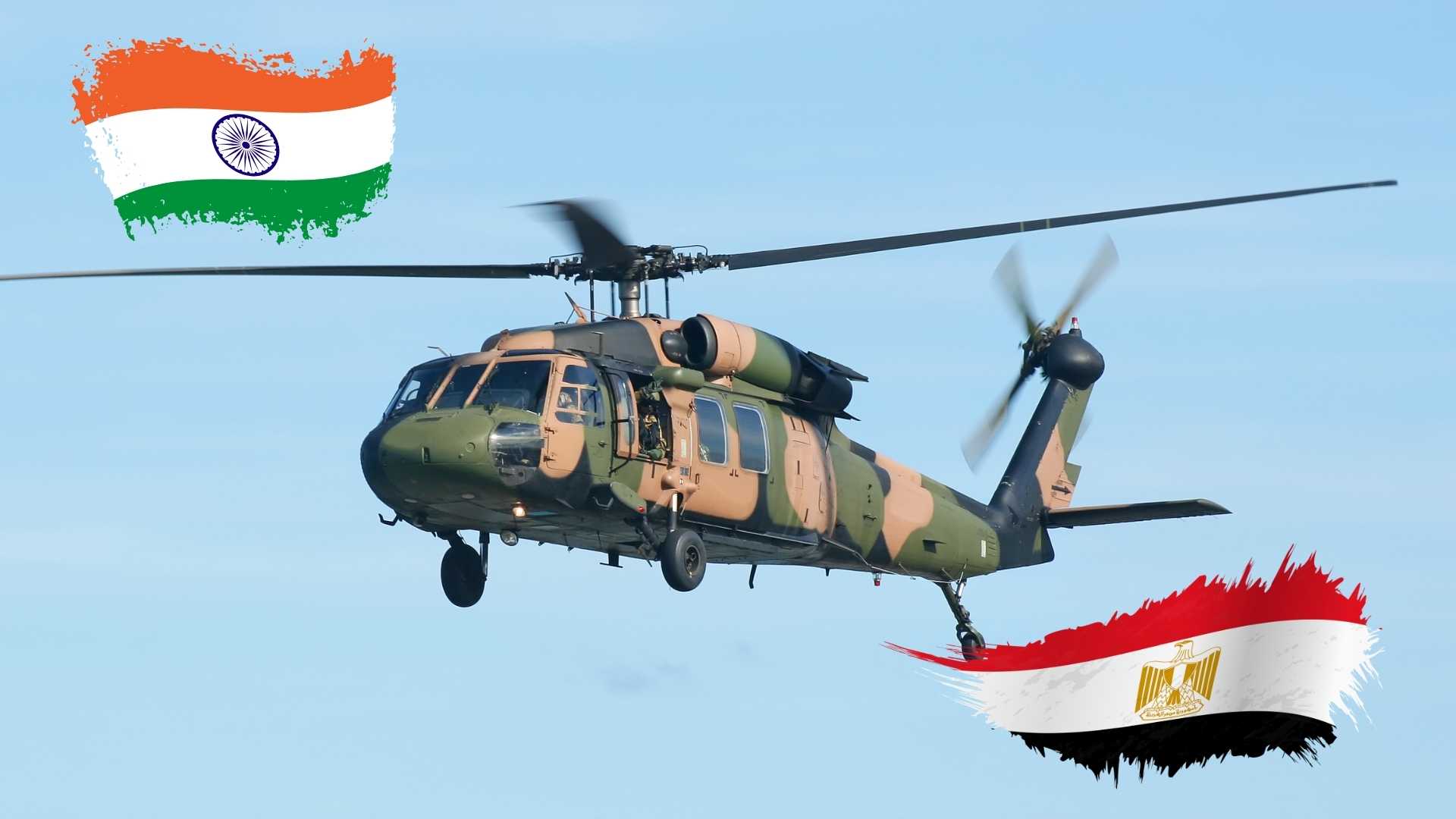
India and Egypt Strengthen Defence Ties at Cairo Meeting

Introduction
India and Egypt's bilateral relationship has undergone a significant strategic upgrade — from a historically warm but under-institutionalised partnership to a Strategic Partnership (2023), underpinned by a growing defence cooperation architecture. The 11th Joint Defence Committee (JDC) meeting in Cairo (April 20–22, 2025) marks a consolidation of this trajectory, with India's $20 billion+ defence manufacturing sector and Egypt's pivotal geographic position at the nexus of Africa, West Asia, and the Mediterranean converging into a substantive strategic alignment.
| Milestone | Year |
|---|---|
| MoU on Defence Cooperation signed | 2022 |
| Bilateral ties elevated to Strategic Partnership | 2023 |
| 11th Joint Defence Committee (JDC) meeting, Cairo | April 2025 |
| India's defence production value | >$20 billion |
| India's defence exports (to 100+ countries) | ~$4 billion |
Background & Context
- India-Egypt ties: historically rooted in Non-Aligned Movement (NAM) solidarity
  and shared post-colonial identity; both were founding NAM members (1961).

- Egypt's strategic location: Suez Canal (controls ~12% of global trade) +
  borders Israel, Libya, Sudan + Red Sea + Mediterranean access.

- India's strategic interest: Red Sea–Indian Ocean corridor security,
  post-Houthi disruptions to maritime trade (2023–25).

- 11th JDC Meeting: Cairo, April 20–22, 2025
  Indian delegation led by: Joint Secretary (International Cooperation)
  Amitabh Prasad

- Reviewed progress since 10th JDC; finalised bilateral defence
  cooperation plan for 2026–27.

- Inaugural Navy-to-Navy staff talks held on sidelines — a first,
  signalling maritime cooperation entering a new institutional phase.
Key Pillars of the 2026–27 Defence Cooperation Plan
1. STRUCTURED MILITARY ENGAGEMENTS
   → Expanding frequency and format of bilateral defence dialogues
   → Institutionalising annual JDC reviews

2. JOINT TRAINING EXCHANGES
   → Intensifying officer-level and technical training cooperation
   → Exchange programmes across Army, Navy, Air Force

3. MARITIME SECURITY COOPERATION
   → Inaugural Navy-to-Navy staff talks (April 2025)
   → India highlighted IFC-IOR (Information Fusion Centre –
     Indian Ocean Region) role in maritime domain awareness
   → Freedom of navigation in Indian Ocean Region (IOR)

4. MILITARY EXERCISES
   → Increasing scope and complexity of joint exercises
   → Existing exercise: Exercise CYCLONE (Special Forces, bilateral)

5. DEFENCE INDUSTRY COLLABORATION
   → Dedicated defence industry cooperation plan under development
   → Co-development and co-production opportunities identified
   → India presented its $20B+ production base + $4B exports to 100+ nations
Strategic Significance
For India
- Egypt is India's gateway to Africa + Arab League + Mediterranean — a trilateral geographic leverage point.
- Red Sea security: Post-Houthi disruptions (2023–25) have elevated maritime corridor security from a commercial to a strategic priority for India.
- Defence exports market: Egypt, with one of Africa's largest militaries (~440,000 active personnel), is a high-value potential customer for Indian defence products.
- Countering China's expanding footprint in Africa and the Arab world — Egypt has engaged with Chinese BRI infrastructure investments, making Indian engagement a strategic counterbalance.
For Egypt
- Diversification of defence suppliers beyond traditional dependence on the U.S. and Russia.
- Access to India's cost-competitive, increasingly capable defence manufacturing ecosystem.
- India's IFC-IOR maritime intelligence sharing enhances Egypt's Red Sea and Gulf of Aden situational awareness.
India's Defence Export Push — Context
| Parameter | Data |
|---|---|
| India's defence production value | >$20 billion (2024–25) |
| Defence exports value | ~$4 billion |
| Export destinations | 100+ countries |
| Target defence export value (by 2029) | $5 billion (GoI target) |
| Key export products | Dornier aircraft, BrahMos missile systems, ammunition, radars, helicopters |
| Key export partners | Armenia, Philippines, Vietnam, Egypt (emerging) |
Implications & Challenges
Opportunities
- Co-production arrangements can position Egypt as a regional hub for Indian defence products entering the African and Arab markets.
- Navy-to-Navy talks can be institutionalised into a formal Maritime Security Dialogue — similar to India's dialogues with France, Australia, and the U.S.
- Heliopolis War Memorial wreath-laying: Soft power dividend — reinforces shared World War II historical memory and civilisational respect.
Challenges
- Egypt's existing defence relationships with the U.S. (F-16s, $1.3B annual military aid) and historical Russian procurement create a complex supplier landscape.
- Egypt's domestic political and economic instability (IMF bailout 2024) may constrain defence budget commitments to co-production investments.
- Translating JDC agreements into procurement contracts requires navigating Egypt's offset requirements and bureaucratic procurement timelines.
Geopolitical Context: Why This Matters Now
RED SEA CRISIS (2023–25)
──────────────────────────────────────────────────────────────────────
  Houthi attacks on commercial shipping → ~$200B+ in trade disrupted
  Egypt's Suez Canal revenues fell sharply (revenue down ~60% in 2024)
  India's exports to Europe rerouted → freight costs spiked
  → Common interest: both India and Egypt need a stable Red Sea corridor

INDIA'S EXPANDING DEFENCE DIPLOMACY
──────────────────────────────────────────────────────────────────────
  India has signed Defence Cooperation MoUs with 80+ countries.
  Recent strategic upgrades:
    → India-France: Horizon 2047 Roadmap
    → India-U.S.: COMCASA, BECA, iCET
    → India-Saudi Arabia: Strategic Partnership 2023
    → India-Egypt: Strategic Partnership 2023
  Pattern: India is systematically institutionalising defence ties
  across all major maritime corridors — Indo-Pacific to Mediterranean.
Conclusion
The India-Egypt defence partnership, anchored by the 2023 Strategic Partnership and now advancing through structured JDC frameworks, co-production dialogues, and inaugural naval staff talks, reflects a maturing Indian foreign policy calculus: converting historical goodwill into strategic depth. Egypt's position astride the Suez Canal and the Red Sea makes it indispensable to India's maritime security architecture, while India's defence manufacturing surge makes it an increasingly credible partner for Egypt's diversification away from traditional suppliers. For UPSC aspirants, this bilateral encapsulates the intersection of India's Act West policy, defence export ambitions, maritime security doctrine, and South-South cooperation — a model case study in India's evolving strategic partnerships.
Attribution
Original content sources and authors


Syllabus classification
How this article maps to GS papers
Main syllabus
GS2Bilateral RelationsQuick Q&A
What are the key features of the India–Egypt defence cooperation framework as highlighted in the 11th Joint Defence Committee (JDC) meeting?
A major pillar of this framework is defence industrial cooperation. India showcased its growing defence manufacturing capacity, with production exceeding $20 billion and exports reaching over 100 countries. Both nations are exploring co-development and co-production opportunities, which can reduce import dependence and promote technology transfer. This aligns with India’s ‘Atmanirbhar Bharat’ initiative and Egypt’s goal of modernizing its defence sector.
Another key feature is maritime and air force cooperation. The inaugural Navy-to-Navy staff talks underline the importance of maritime security, particularly in ensuring freedom of navigation in the Indian Ocean Region. Engagements between the air forces further strengthen defence ties. Overall, the framework reflects a multi-dimensional and institutionalized defence partnership rooted in shared strategic objectives and historical ties.
Why is defence cooperation between India and Egypt strategically important in the current geopolitical context?
From a geopolitical perspective, both countries share a commitment to regional stability, counter-terrorism, and non-alignment. In a world marked by great power competition and shifting alliances, India–Egypt cooperation provides a platform for strategic autonomy and multipolar engagement. The elevation of bilateral ties to a Strategic Partnership in 2023 reflects this growing convergence.
Economically, defence collaboration also opens avenues for industrial partnerships and export growth. India’s expanding defence manufacturing sector can find a reliable partner in Egypt, which seeks to modernize its military capabilities. This synergy enhances mutual capabilities while reducing dependence on traditional arms suppliers.
Thus, the partnership is not merely bilateral but has broader implications for regional security architecture, economic cooperation, and global strategic balance.
How can defence industrial collaboration between India and Egypt contribute to mutual strategic and economic goals?
For Egypt, such collaboration offers an opportunity to modernize its defence infrastructure while reducing reliance on Western suppliers. Co-production agreements can facilitate technology transfer, skill development, and local employment generation. For instance, joint manufacturing of military hardware such as aircraft components or naval systems can enhance Egypt’s self-reliance while providing India access to new markets in Africa and the Middle East.
Additionally, collaboration can extend to research and development (R&D), fostering innovation in emerging domains like cybersecurity, drones, and artificial intelligence in defence. This would not only strengthen military capabilities but also have spillover effects on civilian industries.
Overall, such partnerships create a win-win situation, combining India’s manufacturing strength with Egypt’s strategic location and regional influence, thereby advancing long-term economic and security objectives.
What factors have led to the recent intensification of India–Egypt defence ties?
In recent years, the changing geopolitical environment has acted as a catalyst. Instability in West Asia, the rise of non-traditional security threats, and increasing competition among global powers have necessitated stronger bilateral partnerships. The signing of the 2022 MoU on defence cooperation and the elevation to a Strategic Partnership in 2023 have provided institutional backing for deeper engagement.
Another important factor is the complementarity of interests. India seeks reliable partners to secure its maritime and energy interests, while Egypt aims to diversify its defence partnerships and modernize its military. The growing emphasis on maritime security, joint exercises, and defence industry collaboration reflects this alignment.
Thus, the convergence of historical ties, strategic needs, and institutional frameworks has led to a renewed and intensified defence partnership between the two countries.
Can you provide examples of recent initiatives that demonstrate deepening India–Egypt defence cooperation?
Another significant initiative is the inaugural Navy-to-Navy staff talks, which underscore the importance of maritime cooperation. India highlighted the role of its Navy and the Information Fusion Centre in ensuring maritime security and freedom of navigation. This collaboration is crucial for safeguarding sea lanes, particularly in the Indian Ocean Region and beyond.
Engagements between the air forces, including meetings with senior Egyptian Air Force officials, further demonstrate growing cooperation across all military domains. Additionally, the focus on defence industry partnerships, including co-development and co-production, reflects a shift towards long-term strategic collaboration.
These examples highlight a multi-layered and dynamic partnership, encompassing operational, industrial, and strategic dimensions.
Critically analyze the opportunities and challenges in strengthening India–Egypt defence relations.
However, several challenges need to be addressed. One major issue is competition from established defence suppliers such as the United States, रूसिया, and European countries, which have longstanding ties with Egypt. India must ensure that its offerings are competitive in terms of cost, technology, and reliability. Additionally, differences in bureaucratic processes and regulatory frameworks can slow down project implementation.
Another challenge is the volatile regional environment, which may affect long-term planning and cooperation. Political instability or conflicts in neighboring regions could disrupt joint initiatives. Furthermore, ensuring effective technology transfer and capacity building requires sustained commitment and trust.
In conclusion, while the partnership holds immense potential, its success will depend on addressing structural challenges, enhancing competitiveness, and maintaining strategic consistency.
Assume India aims to enhance maritime security in the Indian Ocean Region through partnerships. How can cooperation with Egypt contribute to this objective?
India can leverage mechanisms such as Navy-to-Navy staff talks, joint naval exercises, and information sharing to enhance coordination. The role of India’s Information Fusion Centre can be expanded to include Egyptian participation, enabling real-time monitoring of maritime threats such as piracy, smuggling, and terrorism. Joint patrols and capacity-building initiatives can further strengthen regional security.
Additionally, cooperation can extend to logistics and port access agreements, allowing Indian naval vessels to use Egyptian ports for refueling and maintenance. This would enhance India’s operational reach and presence in the region.
Thus, through a combination of strategic coordination, technological collaboration, and operational synergy, India–Egypt partnership can significantly contribute to a secure and stable maritime environment in the IOR.
Practice questions
1 question for mains preparation