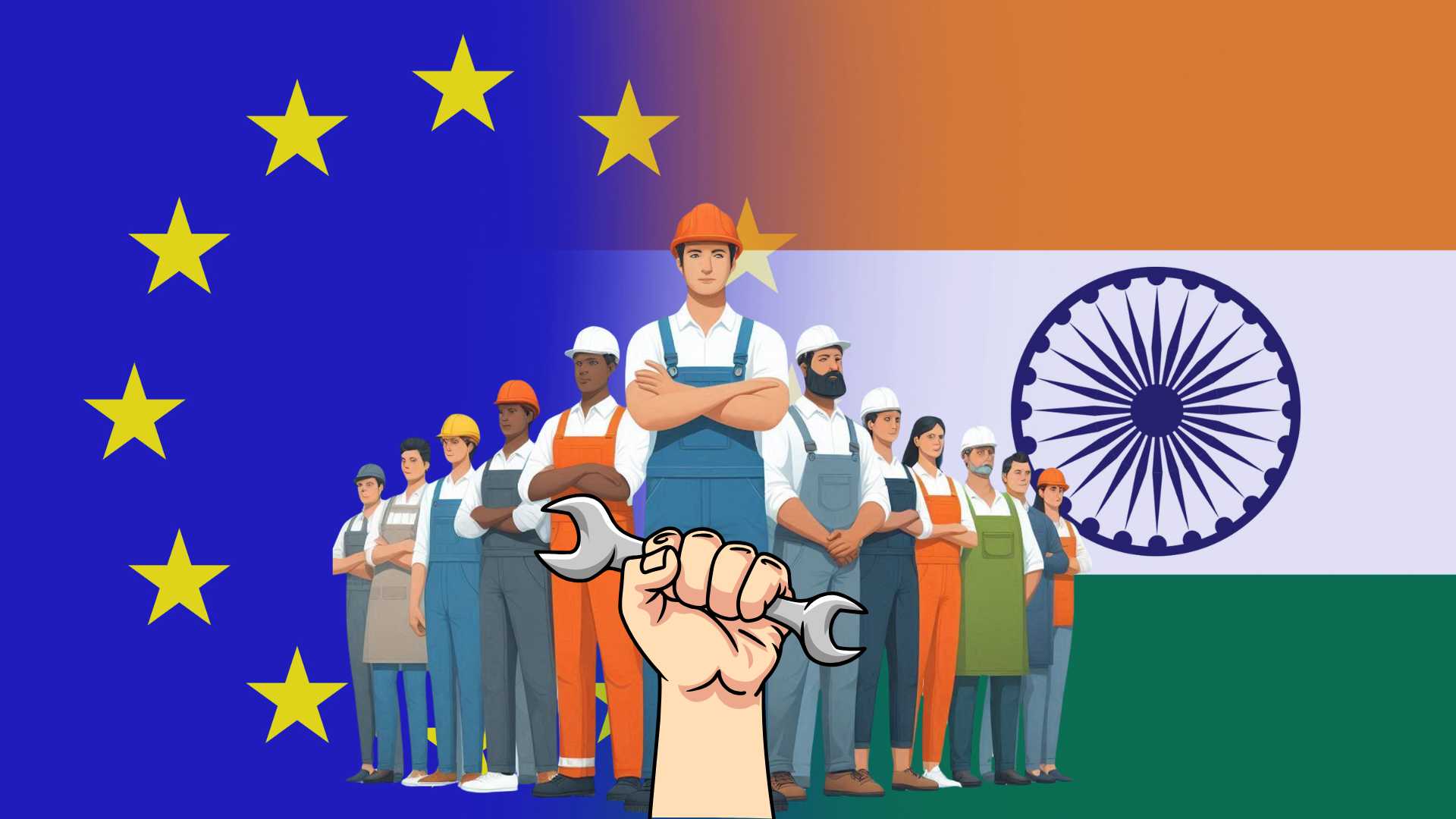
1. India’s Evolving FTA Strategy Under Current Leadership
India’s recent trade diplomacy is shaped by a strategic shift towards FTAs with developed, complementary economies rather than competitors. This reflects a calibrated approach where trade openness aligns with domestic capacity enhancement. The leadership emphasises clarity in economic vision and confidence in negotiating comprehensive agreements quickly.
The government positions FTAs as tools to accelerate India’s transition to a developed economy by 2047, arguing that economic engagement drives competitiveness, productivity, and global integration. This is framed as a departure from earlier trade negotiations with blocs like RCEP, which were viewed as misaligned with India's interests due to structural vulnerabilities.
The EU–India FTA process, initiated in 2021, is cited as evidence of improved administrative coherence and political stability. This stability, according to the government, increases trust among advanced economies and expedites negotiations that traditionally span many years.
The rationale is that a clear economic vision, combined with political predictability, enhances India’s negotiating leverage. If such coherence weakens, India risks slower FTA progress, reduced export competitiveness, and diminished global economic influence.
Impacts:
- India has completed 8 FTAs covering 37 countries under the present government.
- Prior FTAs with ASEAN, Japan, Korea are termed “poorly negotiated,” limiting export gains.
2. EU–India FTA: Drivers and Diplomatic Context
The EU–India FTA is described as independent of external pressures, including U.S. tariff actions. India frames the agreement as a result of strategic clarity rather than reactive policymaking. Conversely, some EU leaders view it as a geopolitical signal amidst rising global protectionism.
The government sees the EU’s trust in India’s political stability as a major enabler of negotiations. This has encouraged both sides to approach contentious issues with flexibility and mutual confidence. The agreement’s forward momentum is reinforced by the EU’s internal push for rapid operationalisation.
The FTA is portrayed as pragmatic rather than maximalist: capturing “low-hanging fruits,” avoiding contentious areas like sensitive agriculture, and building incremental gains. This avoids negotiation deadlocks observed in other EU agreements, such as the Mercosur deal.
The logic is that pragmatic sequencing ensures early benefits while preserving negotiating capital for later stages. Ignoring this approach could lead to stalled agreements and missed economic opportunities.
Key features highlighted:
- Operationalisation targeted for 2026.
- EU interest in accelerating text translation into 24 languages using AI.
3. Tariff Outcomes and Sectoral Gains Under EU FTA
Labour-intensive sectors form the core beneficiaries of the EU–India FTA. According to the government, potential gains of 33.5 billion in exports becoming 0% duty from Day 1 of implementation.
This shift addresses long-standing disparities where countries like Bangladesh (with 0% duty as an LDC) and Vietnam (existing FTA) significantly outperformed India in EU market access. Eliminating tariff disadvantages is expected to enhance competitiveness in textiles, apparel, leather, footwear, and jewellery.
The FTA also incorporates provisions related to the Carbon Border Adjustment Mechanism (CBAM). India frames the inclusion as part of a trust-based negotiation where sensitive issues were discussed transparently to avoid future disputes.
The economic logic is that tariff parity improves market access and job creation. Delay in such parity risks further erosion of India’s share in key global value chains.
Impacts:
- Immediate elimination of tariffs on ~96% (33.5/35 bn) of India’s labour-intensive exports.
- Enhanced competitiveness versus Bangladesh and Vietnam in EU markets.
- Opportunity for apparel and jewellery exporters affected by the U.S. 50% tariffs.
4. India’s Position on RCEP and Lessons for Trade Policy
The government reiterates its firm opposition to joining RCEP, terming the original decision to enter negotiations as strategically flawed. India had pre-existing FTAs with ASEAN, Japan, and Korea but saw limited export growth. The concern was that RCEP would function as a de facto FTA with China, exposing domestic manufacturing and MSMEs to import surges.
The argument is that post-RCEP patterns in member economies show rising Chinese imports, reinforcing India’s decision to withdraw. The government maintains there is “no question of revisiting” the decision, framing it as essential to protect jobs and prevent deindustrialisation.
This aligns with the broader strategy of choosing FTAs based on complementary, not competitive, economic structures. Developed economies are favoured as partners due to reduced threat of import flooding.
Ignoring such strategic calibration could risk premature liberalisation, harming domestic manufacturing, employment, and long-term industrialisation goals.
Challenges highlighted:
- RCEP risked making India a “B-team of China.”
- Potential large-scale displacement of MSMEs.
- Limited export gains from existing ASEAN/Japan/Korea FTAs indicate asymmetric benefits.
5. Performance of the India–UAE FTA and Trade Balance Concerns
The UAE FTA was expected to deliver quick export gains, but concerns have arisen due to rising imports. The government attributes the increase to oil and gold—products India must import irrespective of FTAs. Concessions on gold were presented as necessary for balancing negotiations since UAE’s export basket is limited.
Non-oil, non-gold exports reportedly show strong growth, which the government considers the real indicator of FTA performance. These sectors are more employment-intensive and align with India’s export promotion priorities.
The framing emphasises that FTAs should be evaluated on structural, not headline, trade balances, especially when dominated by essential commodities.
The reasoning is that focusing on core export sectors ensures job creation and long-term gains. Misinterpreting high-value commodity imports as FTA failure could lead to overly protectionist or misaligned trade strategies.
Key Points:
- Imports increased mainly due to oil and gold, not FTA-induced structural issues.
- India granted gold concessions to secure overall FTA balance.
- Non-oil, non-gold exports have shown “massive increase” since FTA enforcement.
Conclusion
India’s current FTA strategy is characterised by pragmatic sequencing, focus on complementary economies, and alignment with long-term development goals. The EU–India FTA exemplifies a trust-based negotiation model aimed at rapid implementation and early economic gains. Simultaneously, lessons from earlier FTAs and RCEP underline the need for calibrated liberalisation that protects domestic industry while pursuing global integration.
This balanced, sector-sensitive approach is positioned as essential for India’s aspiration to achieve developed country status by 2047, ensuring competitiveness without compromising economic security.