
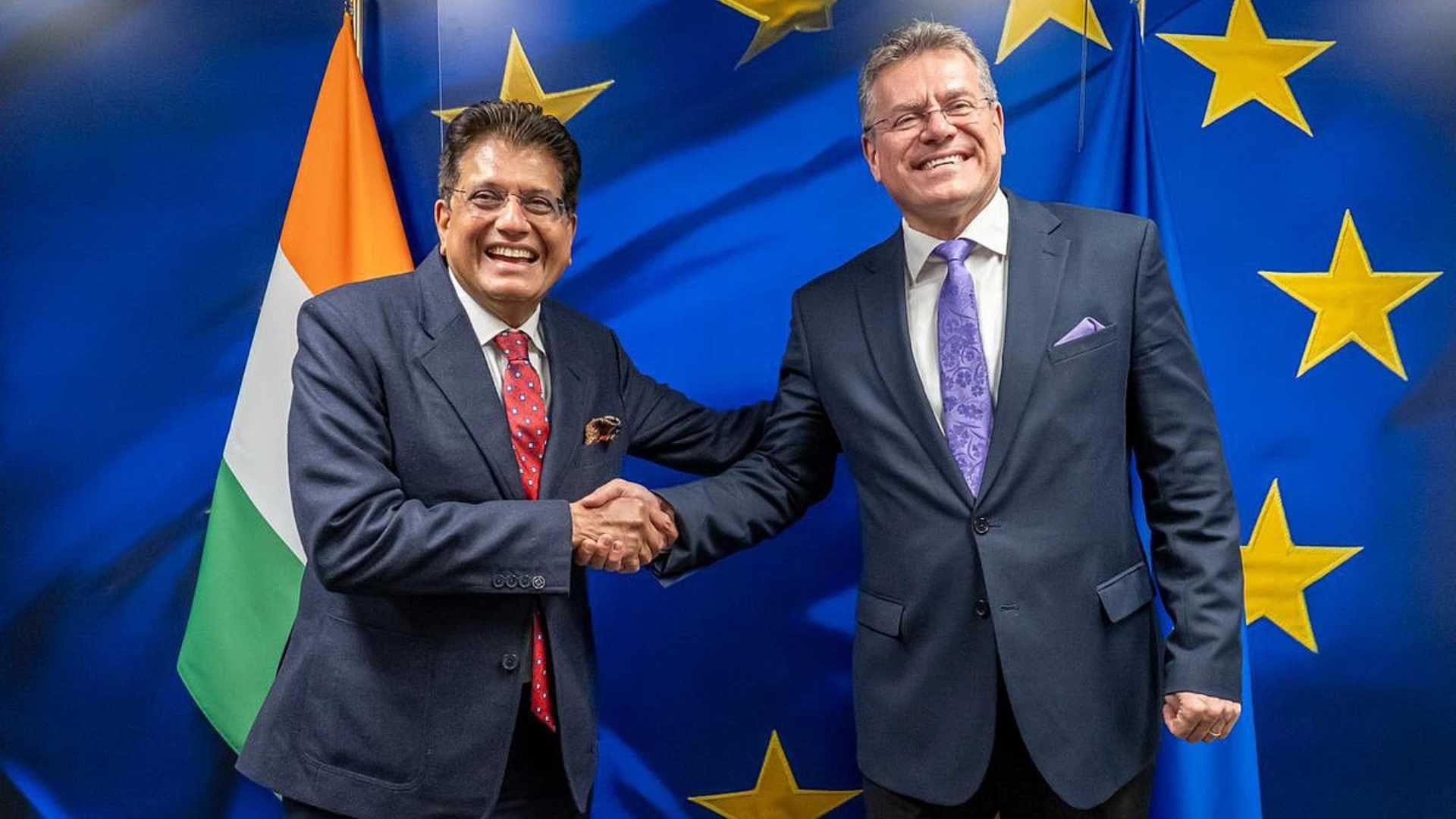
India and EU Trade Deal: Piyush Goyal's Optimistic Outlook

Commerce Minister Piyush Goyal shares confidence in nearing a fruitful conclusion of the EU-India Free Trade Agreement ahead of the upcoming summit.
SuryaSurya
5 mins read
India–EU FTA nears finish as leaders signal ‘fruitful outcome’ at summit
Not Started

1. Context: India–EU FTA at an Advanced Stage of Negotiation

The proposed India–European Union Free Trade Agreement (FTA) represents one of the most complex and long-drawn trade negotiations undertaken by India. Initiated in 2007, paused in 2013, and formally relaunched in 2022, the talks are now nearing conclusion after sustained engagement.

The imminent announcement of the agreement, expected around the India–EU Summit in New Delhi, reflects renewed strategic convergence between the two sides. The presence of senior EU leadership underscores the political salience attached to the pact.

For India, the FTA comes at a critical juncture when global trade is marked by fragmentation, protectionism, and uncertainty. For the EU, India is increasingly viewed as a key economic and strategic partner in Asia.

If the negotiations were to stall again, it would reinforce perceptions of India as a difficult trade partner and weaken its credibility in shaping future high-standard trade agreements.

“Sustained & constructive engagement between us & our teams over the past year has brought us closer to a fruitful outcome.”
Piyush Goyal, Union Minister for Commerce and Industry

The governance logic is that high-quality trade agreements require political backing and long-term commitment; without closure, negotiation fatigue undermines economic diplomacy.

2. Nature and Complexity of the India–EU Trade Negotiations

The India–EU FTA is described as one of the most comprehensive and technically complex trade pacts India has negotiated. It spans goods, services, investment, regulatory standards, and economic security considerations.

Unlike shallow tariff-cutting agreements, this FTA seeks deeper integration by addressing non-tariff barriers, market access for services, and investment facilitation. This complexity partly explains the long gestation period.

Both sides have engaged intensively over the past year, reflecting a shift from transactional trade talks to strategic economic partnership.

Failure to manage this complexity could result in a diluted agreement with limited developmental impact.

“We’re nearing the conclusion of our FTA negotiations… reflecting its importance.”
Maroš Šefčovič, EU Commissioner for Trade and Economic Security

The development logic is that comprehensive FTAs unlock higher-value trade gains, but require institutional capacity and political consensus to sustain.

3. Economic Rationale: Trade Integration in a Fragmenting Global Order

The impending FTA is being finalised against a backdrop of global trade fragmentation, rising protectionism, and increasing US–India trade frictions. These conditions heighten the importance of diversified and reliable trade partnerships.

By reducing tariffs and easing market access, the agreement could strengthen India’s participation in global value chains (GVCs) and act as a counter-cyclical buffer during periods of global slowdown.

This integration is expected to support export growth, supply-chain diversification, and resilience against external shocks.

Ignoring such opportunities could leave India more exposed to volatility in a narrow set of export markets.

“The deal could act as an effective counter-cyclical buffer by improving India’s export participation in global value chains.”
Madhavi Arora, Chief Economist, Emkay Global Financial Services

The governance logic is that trade diversification is a risk-management tool; without it, economic shocks transmit more sharply into domestic growth.

4. Trade Structure: From Market Competition to Production Partnership

India–EU trade is increasingly understood not as a zero-sum contest for market share, but as a production partnership between complementary economies. The EU specialises in high-end machinery, components, and precision inputs, while India offers scale manufacturing and cost efficiency.

Tariff elimination under the FTA is therefore expected to reduce production costs rather than displace domestic industries. This challenges the conventional fear that FTAs necessarily harm local manufacturing.

Such complementarities can deepen industrial integration and enhance competitiveness on both sides.

If this perspective is ignored, policy debates risk being dominated by protectionist anxieties rather than productivity gains.

“Since both economies specialise in different segments, tariff elimination works as a cost-reduction tool rather than a displacement shock.”
Ajay Srivastava, Founder, Global Trade Research Initiative (GTRI)

The logic is that when economies are structurally complementary, trade liberalisation enhances efficiency rather than triggering deindustrialisation.

5. Expected Economic and Strategic Implications

If concluded and ratified by the European Parliament, the FTA could significantly deepen India–EU economic integration. It is expected to reduce tariffs across a wide range of goods, ease services trade, and promote investment flows.

Beyond economics, the agreement carries strategic weight by reinforcing India–EU ties amid shifting global power equations and economic security concerns.

The pact also signals India’s willingness to engage in rule-based trade frameworks with advanced economies.

Delays in ratification or weak implementation could limit these potential gains.

Anticipated outcomes:

  • Reduction of tariffs on a broad basket of goods
  • Improved market access for services
  • Enhanced investment flows
  • Deeper India–EU economic integration

The governance logic is that trade agreements serve as anchors for long-term strategic partnerships; weak follow-through diminishes both economic and diplomatic dividends.

Conclusion

The near-conclusion of the India–EU FTA marks a significant moment in India’s trade diplomacy. By combining economic integration with strategic partnership, the agreement has the potential to strengthen India’s role in global value chains and provide resilience in an uncertain global trade environment. Its success, however, will depend on timely conclusion, credible implementation, and alignment with India’s broader development and industrial objectives.

Quick Q&A

Everything you need to know

Overview: The India–EU Free Trade Agreement (FTA) is a landmark trade initiative aimed at deepening economic and strategic ties between India and the European Union. Negotiations for this comprehensive pact began in 2007, were paused in 2013, and relaunched formally in 2022, reflecting the complex and sensitive nature of the discussions.

Economic Significance: The FTA aims to reduce tariffs on a wide range of goods, ease market access for services, and promote cross-border investment flows. This would enhance India’s participation in global value chains, improve export competitiveness, and integrate Indian manufacturing with European high-technology inputs, including machinery and precision components.

Strategic Importance: Beyond trade, the FTA strengthens the partnership in technology, innovation, and investment, positioning India as a reliable partner amid global trade fragmentation and rising protectionism. This comprehensive approach underscores the FTA’s role not just in commerce, but also in shaping India’s global economic and geopolitical engagements.

Global Trade Context: The FTA comes at a time of heightened global economic uncertainty, characterized by trade fragmentation, protectionist policies, and US–India trade frictions. In this environment, securing stable trade and investment partners becomes crucial for India’s economic resilience.

Counter-Cyclical Role: According to economists, the FTA could serve as a counter-cyclical buffer, helping India mitigate external shocks. By providing expanded market access in the EU, the deal would support Indian exports, integrate the country more deeply into global value chains, and diversify supply chains to reduce overdependence on a single region.

Strategic Implications: Strengthening ties with the EU not only improves economic prospects but also reinforces India’s strategic positioning in the global trade architecture. The agreement demonstrates India’s ability to negotiate economically rational trade arrangements while enhancing its geopolitical leverage with one of the world’s largest economic blocs.

Complementary Economic Structures: India and the EU have economies that specialise in different sectors. Europe is strong in machinery, components, and precision inputs, whereas India excels in scale manufacturing and consumer-ready products. This structural complementarity allows tariff elimination under the FTA to act as a cost-reduction tool rather than creating displacement shocks.

Production Partnership: The agreement would enable Indian factories to integrate advanced European inputs, boosting productivity and quality standards. In return, Indian manufacturing provides cost-efficient goods to European markets, fostering a mutually beneficial exchange. This model emphasises cooperation rather than a zero-sum competition for market share.

Example: For instance, European automotive and machinery components can enhance the efficiency of Indian production units, while textiles and pharmaceuticals produced in India can gain preferential access to European consumers, creating a virtuous cycle of trade and industrial competitiveness.

Opportunities:

  • Access to a high-value EU market for Indian goods and services.
  • Integration of Indian manufacturing with advanced European inputs, raising quality and productivity.
  • Increased foreign direct investment, technology transfer, and knowledge sharing.

Challenges:
  • Indian domestic industries may face competitive pressure from European firms, particularly in sectors where India lacks technological parity.
  • Regulatory and compliance standards in the EU could require Indian firms to invest in upgrading processes and certifications.
  • Tariff reductions may impact certain vulnerable domestic sectors if protective measures are insufficient.

Overall Assessment: While challenges exist, the FTA is designed as a mutually complementary partnership. Policymakers must ensure supportive domestic policies, including skill development, technology adoption, and infrastructure investment, to maximise gains while mitigating competitive risks.

Complexity of Agreement: The India–EU FTA is among the most complex trade negotiations India has undertaken, involving diverse sectors such as agriculture, manufacturing, services, and intellectual property. Each side has distinct economic priorities and regulatory frameworks, requiring extensive consultation and compromise.

Historical Pauses: Negotiations began in 2007 but were paused in 2013 due to differences over tariff reductions, market access, and regulatory alignment. Talks resumed formally in 2022, reflecting renewed strategic intent by both parties.

Strategic Considerations: Beyond trade, the FTA encompasses investment flows, supply-chain integration, and technology transfer. Both sides needed to reconcile economic gains with strategic safeguards, ensuring that sensitive industries are protected while maximising mutually beneficial outcomes. This multifaceted negotiation process explains the extended timeline.

Case Context: Amid global trade fragmentation and rising protectionism, the India–EU FTA represents a deliberate, economically rational approach to bilateral trade. Rather than competing for the same market share, India and the EU aim to leverage comparative advantages and complementary production strengths.

Economic Rationale: By reducing tariffs and easing market access, the agreement enhances efficiency, reduces production costs, and improves competitiveness on both sides. It also facilitates integration into global value chains, helping India diversify its export destinations and reduce dependency on any single market.

Implications: The FTA highlights the importance of strategic, rules-based agreements that balance domestic protection with international integration. It serves as a model for other emerging economies seeking to secure resilient trade partnerships, demonstrating that careful negotiation and sectoral complementarity can yield significant economic and geopolitical benefits even in uncertain global conditions.

Textiles and Apparel: Indian textile firms could gain preferential access to the EU market, allowing them to compete more effectively with countries like Bangladesh. Reduced tariffs would lower costs and increase exports, boosting revenues and employment in this labour-intensive sector.

Automotive and Manufacturing: Indian manufacturers could integrate European machinery and precision components into production, enhancing efficiency and product quality. For example, Mahindra & Mahindra could utilise advanced EU inputs to produce higher-specification vehicles for European consumers.

Services Sector: The agreement could open new opportunities in IT, finance, and consulting services, enabling Indian firms to expand operations in Europe while facilitating knowledge transfer. Overall, the FTA demonstrates sector-specific gains arising from structural complementarity and tariff liberalisation, benefiting both Indian industries and European partners.

Attribution

Original content sources and authors

Sign in to track your reading progress

Comments (0)

Please sign in to comment

No comments yet. Be the first to comment!