1. Strategic Context of the India–EU Summit in a Fractured Global Order
The India–EU Summit takes place against a backdrop of heightened global fragmentation marked by trade disputes, geopolitical rivalries, and weakening multilateralism. EU Commission President Ursula von der Leyen’s reference to a “fractured world” underlines the erosion of consensus in the international system, particularly amid rising transatlantic tensions between the European Union and the United States.
This context elevates the timing of the Summit beyond routine bilateral diplomacy. With the EU facing tariff threats and territorial assertions from the U.S., and India navigating strategic autonomy amid great power competition, the Summit signals a shared preference for dialogue, openness, and rule-based engagement.
By positioning India–EU relations as an alternative pathway, the engagement underscores the relevance of middle and major powers collaborating to stabilise global governance. If such partnerships are neglected, fragmentation could harden into blocs, reducing policy space for emerging economies like India.
Strategically, partnerships formed during systemic uncertainty help preserve institutional balance. Ignoring such convergence risks marginalising India and the EU in shaping global norms and trade rules.
2. Evolution and Significance of the India–EU Strategic Partnership
India and the European Union have steadily expanded their engagement from a trade-focused relationship to a comprehensive strategic partnership. Statements by EU leaders emphasising “strategic partnership, dialogue and openness” reflect this evolution from transactional to value- and interest-based cooperation.
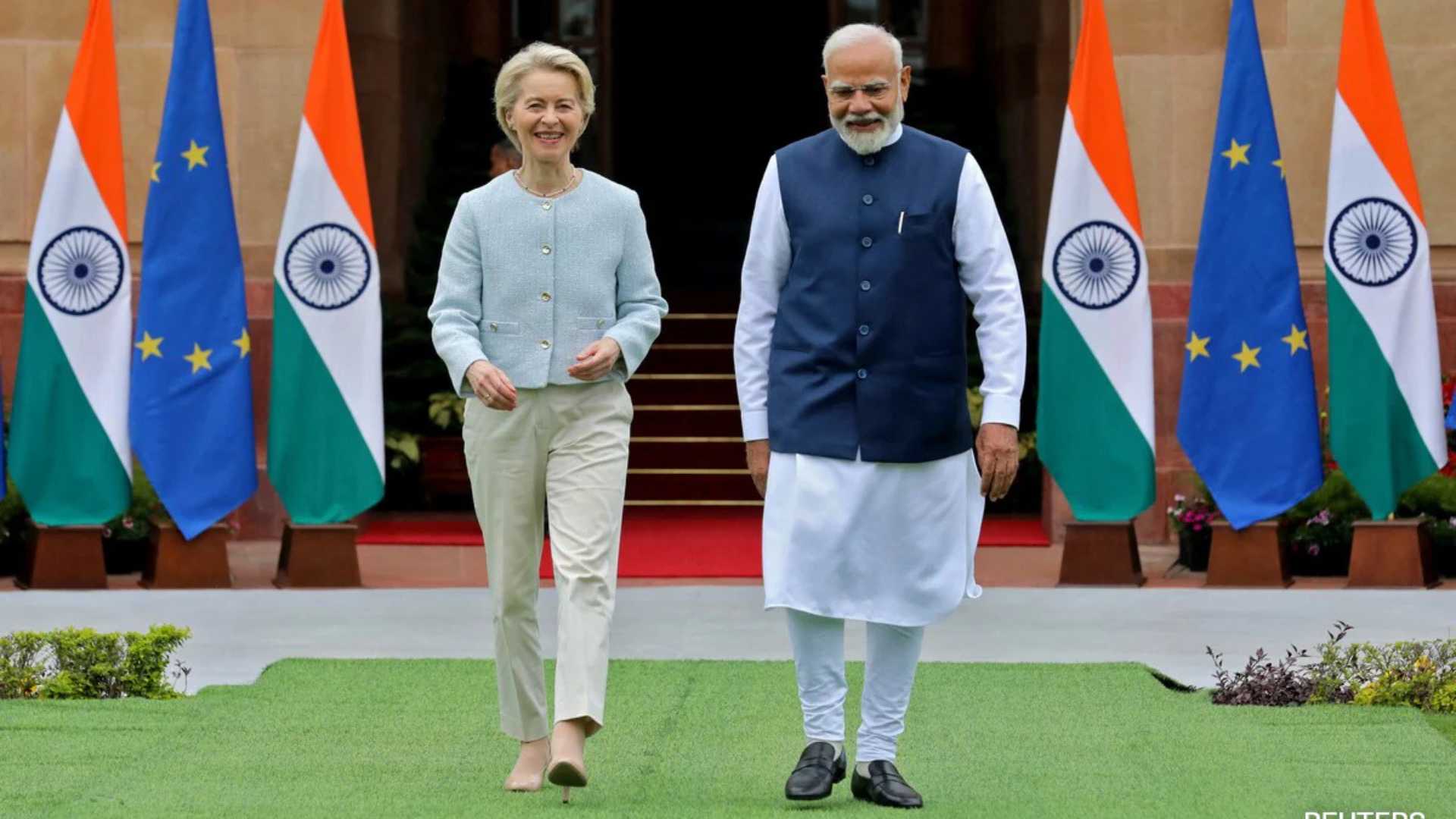
The adoption of a joint EU–India comprehensive strategic agenda during the visit formalises this shift. It covers security, defence, trade, technology, and connectivity, indicating recognition of India as a key pillar in Europe’s external partnerships.
Such institutionalisation matters for governance outcomes, as it provides continuity beyond leadership changes and episodic summits. Absence of structured agendas often leads to rhetorical partnerships without implementation depth.
Institutionalised partnerships enable predictability and policy alignment. Without them, cooperation remains ad hoc and vulnerable to external shocks.
3. India–EU Free Trade Agreement: Status and Economic Rationale
The India–EU Free Trade Agreement (FTA), under negotiation since 2007 and relaunched in 2022, is reported to be “nearing conclusion.” This reflects intensified engagement, with 10 ministerial-level meetings in the past year between the EU Trade Commissioner and India’s Commerce Minister.
The FTA aims to boost bilateral trade, investment flows, market access, technology cooperation, and employment opportunities. Progress has reportedly been made on tariff reductions and access to the Indian market for European firms, while India seeks gains in services, technology, and jobs.
However, sensitive issues remain, including agricultural goods, automobile tariffs, and environmental regulations. Failure to resolve these could delay economic gains and weaken confidence in India’s trade reform credibility.
Key Data:
- EU is India’s largest trading partner in goods
- Bilateral trade exceeded $136 billion last year
Trade agreements operationalise strategic intent. If stalled, strategic rhetoric loses economic substance, limiting long-term growth and competitiveness.
4. Security, Defence, and Technology Cooperation Dimensions
Beyond trade, the Summit advances cooperation in security and defence, with agreement to sign a dedicated partnership in this domain. This aligns with shared concerns over regional stability, maritime security, and supply chain resilience, especially in the Indo-Pacific.
Technology and connectivity feature prominently, reflecting mutual interest in reducing dependence on concentrated supply chains and fostering trusted technological ecosystems. This has implications for digital governance, infrastructure development, and strategic autonomy.
The relevance of this cooperation is amplified by the U.S. Defence Strategy 2026, which downplays Europe and omits India, thereby creating strategic space for India–EU convergence. Ignoring such opportunities could leave both actors strategically exposed.
Security and technology partnerships complement economic ties. Without them, strategic autonomy remains rhetorical rather than operational.
5. Global and Multilateral Issues on the Summit Agenda
The Summit agenda includes global issues such as the rules-based international order, the Indo-Pacific, Russia’s war in Ukraine, and the situation in West Asia. This reflects India–EU willingness to engage beyond bilateralism and shape global responses.
Emphasis on effective multilateralism is particularly significant as global institutions face legitimacy and effectiveness challenges. Coordinated positions can enhance reform momentum in forums like the UN, WTO, and G20.
Divergences, however, especially on geopolitical conflicts, require careful diplomatic management. Failure to sustain dialogue may reduce the credibility of both actors as stabilising forces.
Engagement on global issues reinforces normative leadership. Absence of coordination weakens multilateral problem-solving capacity.
6. Symbolism and Diplomatic Signalling of the Republic Day Engagement
EU leaders serving as chief guests at India’s 77th Republic Day carries symbolic and diplomatic weight. Such gestures elevate the partnership in public diplomacy and signal mutual respect at the highest political level.
Participation in ceremonial and informal engagements, such as the “At Home” reception, complements formal negotiations by building trust and political capital. These signals matter in sustaining long-term cooperation beyond technical agreements.
Neglecting symbolic diplomacy can reduce partnerships to bureaucratic exercises, limiting popular and political buy-in.
Symbolism reinforces substance in diplomacy. Without it, even robust agreements may lack durability and domestic support.
Conclusion
The India–EU Summit reflects convergence between two major actors seeking stability, openness, and strategic autonomy in a fragmented world. Progress on the FTA, security cooperation, and global governance coordination can yield long-term economic and institutional benefits. Sustained engagement and implementation will be critical to translate strategic intent into durable developmental outcomes.