
1. Context: Upgrading the India–EU Strategic Partnership
India and the European Union (EU) are set to upgrade their Strategic Partnership signed in 2004 by concluding a Security and Defence Partnership (SDP). This marks a qualitative shift from primarily economic and developmental cooperation to a more explicit security-oriented engagement.
The decision reflects the changing global order, marked by geopolitical instability, supply-chain vulnerabilities, and growing convergence between India and the EU on the need for a rules-based international system.
If such an upgrade is not institutionalised, India–EU relations risk remaining fragmented, limiting their collective ability to shape global governance outcomes.
Strategic partnerships must evolve with global realities; otherwise, they lose relevance as instruments of foreign policy.
2. India–EU Summit as a Diplomatic Platform
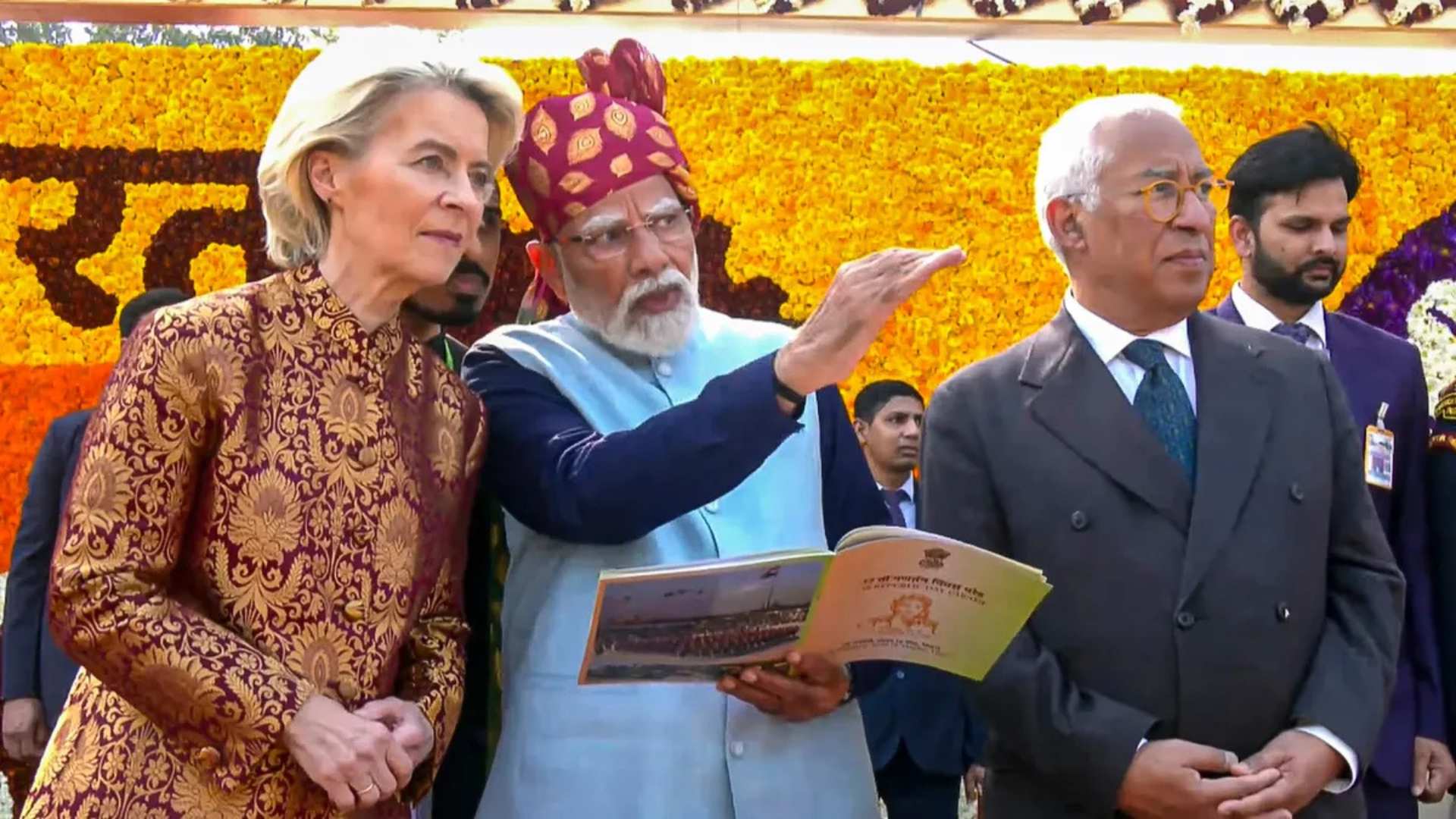
The 16th India–EU Summit, co-chaired by the Indian Prime Minister and the Presidents of the European Council and European Commission, provides the political momentum for this upgrade. It is the first full summit since 2020, when meetings were largely virtual.
The summit agenda spans trade, defence and security, climate change, critical technologies, and multilateral cooperation, signalling a comprehensive engagement rather than issue-specific diplomacy.
High-level participation from EU leadership underscores the EU’s intent to elevate India as a key strategic partner beyond the transatlantic framework.
If summit-level engagements stagnate, institutional mechanisms risk becoming procedural rather than strategic.
Summits translate bureaucratic cooperation into political commitment and strategic direction.
3. Security and Defence Partnership (SDP): Strategic Significance
The proposed Security and Defence Partnership is expected to explore Indian participation in European defence initiatives, marking India’s deeper integration into European security thinking.
This is significant given the EU’s evolving defence posture in response to the Russia–Ukraine war and broader concerns about strategic autonomy.
For India, this opens avenues for defence-industrial cooperation, interoperability, and shared assessments of global security threats.
Without such frameworks, defence cooperation would remain ad hoc and under-institutionalised.
Formal defence frameworks convert political trust into operational cooperation.
4. Trade and the India–EU Free Trade Agreement (FTA)
Trade remains a central pillar of the relationship. Negotiations for an India–EU FTA, first launched in 2007, were suspended in 2013 due to differences in ambition and re-launched in June 2022.
The renewed momentum reflects mutual recognition of economic complementarities amid global trade fragmentation and supply-chain diversification.
A credible FTA would enhance market access, investment flows, and regulatory cooperation, particularly in manufacturing and services.
Failure to conclude the FTA would limit the economic depth needed to sustain a strategic partnership.
Strategic partnerships without strong economic foundations struggle to endure.
5. Defence, Security, and Information Cooperation
Beyond the SDP, the two sides are also exploring a Security of Information Agreement (SOIA) and cooperation on mobility and intelligence-sharing.
Such agreements are foundational for trust-based defence and technology collaboration, especially in sensitive domains like cyber security and dual-use technologies.
They also reflect growing convergence on threat perceptions and the need to safeguard critical information.
Without information-security frameworks, advanced cooperation in defence and technology remains constrained.
Trust in information handling is a prerequisite for strategic cooperation.
6. Climate, Energy, and Sustainable Development Cooperation
Climate action is a major area of convergence. The India–EU Clean Energy and Climate Partnership (CECP), established in 2016, entered its third phase in November 2024.
The EU supports India’s energy transition through institutions like the European Investment Bank, financing projects in urban mobility, metro rail, and sustainable transport.
Cooperation also extends to offshore wind energy, gas infrastructure, methane reduction, and technology transfer.
Neglecting climate cooperation would undermine both partners’ global climate commitments and development goals.
Climate partnerships align development needs with global environmental responsibilities.
“Climate change is the defining issue of our time.” — António Guterres, UN Secretary-General
7. Connectivity, Technology, and Space Cooperation
The India–EU Connectivity Partnership (2021) focuses on transport, digital, energy networks, and the flow of people, goods, services, data, and capital.
In space cooperation, engagements have expanded rapidly:
- Inaugural India–EU Space Dialogue: November 2025
- ISRO–European Space Agency joint intent on human spaceflight: May 2025
Such cooperation strengthens strategic autonomy and technological capabilities on both sides.
Without sustained coordination, technology partnerships risk duplication and strategic drift.
Connectivity and space cooperation are new frontiers of strategic influence.
8. Science, Nuclear, and Water Cooperation
India and the EU have institutionalised scientific collaboration through the Science and Technology Cooperation Agreement (2007), covering areas such as smart grids, vaccines, water, and polar science.
In nuclear energy, an agreement between India’s Department of Atomic Energy and EURATOM was signed in July 2020, focusing on peaceful uses.
Water cooperation under the India–EU Water Partnership (2016) addresses policy, governance, and sustainability challenges, with the 6th Water Forum held in September 2024.
Such sectoral cooperation supports long-term development and resilience.
Technical cooperation reinforces strategic trust through shared problem-solving.
9. Migration, Mobility, and People-to-People Ties
Migration and mobility have emerged as critical enablers of economic and technological cooperation. The 9th India–EU High-Level Dialogue on Migration and Mobility was held in November 2025.
Mobility frameworks facilitate skilled labour movement, academic exchanges, and innovation linkages, benefiting both economies.
If mobility issues are neglected, demographic and skill complementarities remain underutilised.
People-to-people ties are the social foundation of strategic partnerships.
10. India–EU Partnership in a Global Context
India and the EU increasingly converge on defending a rules-based international order, especially amid conflicts in Ukraine and West Asia.
Their cooperation in trilateral development projects in third countries (agreed in June 2025) reflects a shared approach to global development and strategic outreach.
This positions the partnership beyond bilateralism, giving it global relevance.
Without such alignment, both risk marginalisation in shaping future global norms.
Strategic partnerships gain weight when they extend to global governance.
“Multilateralism is not an option but a necessity.” — Ursula von der Leyen, President, European Commission
Conclusion
The proposed Security and Defence Partnership marks a decisive evolution in India–EU relations from sectoral cooperation to strategic alignment. Anchored in trade, defence, climate action, technology, and multilateralism, the partnership reflects shared interests in stability, sustainability, and rule-based order. Its long-term success will depend on institutional depth, timely implementation, and the ability to translate political intent into tangible outcomes for global governance and development.

.jpeg)