
1. Background and Strategic Context
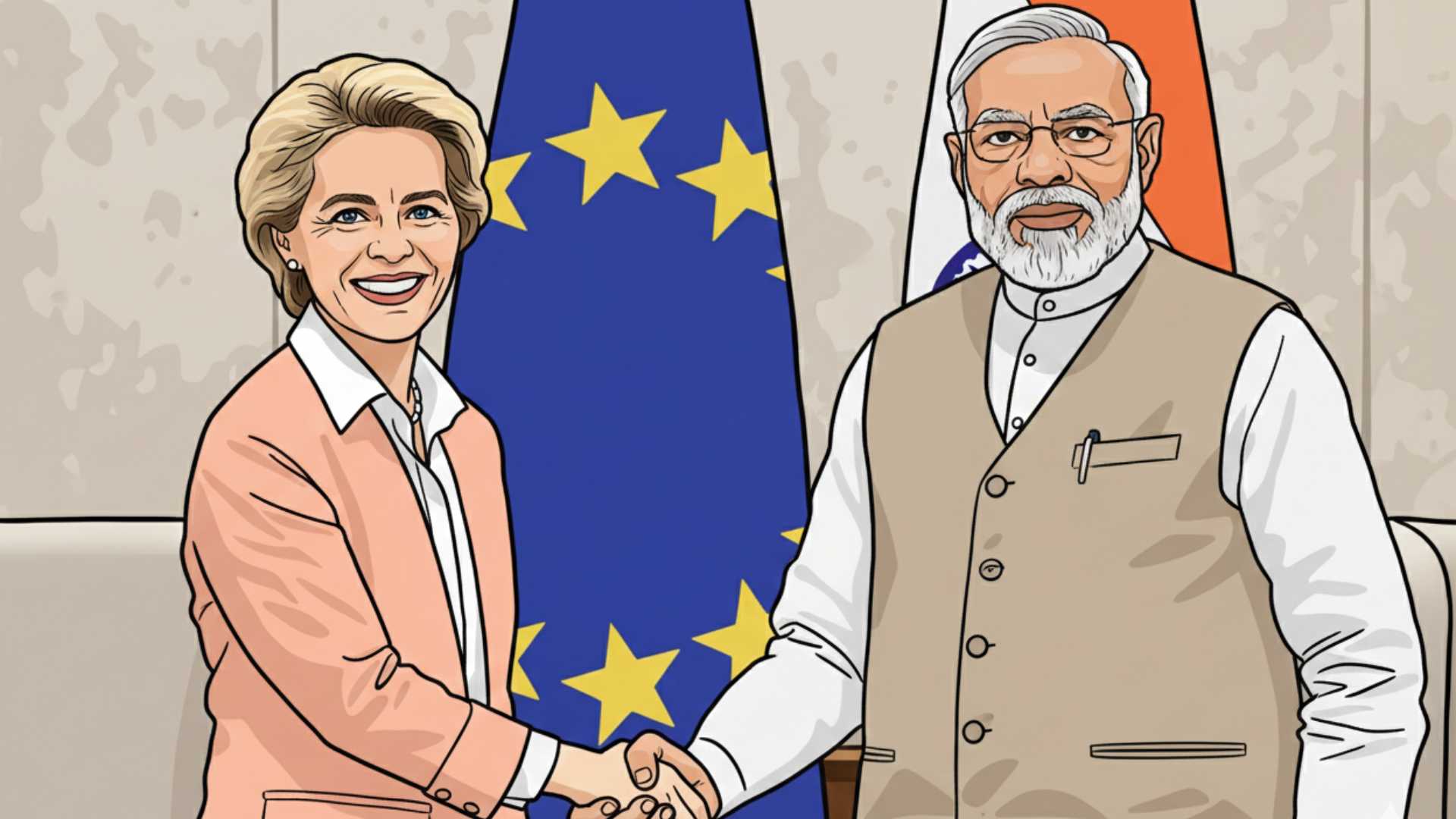
India and the European Union concluded negotiations on a comprehensive Free Trade Agreement (FTA) on January 27, 2026, ending a negotiation process that began in 2007 and saw multiple pauses and recalibrations. The conclusion reflects a convergence of strategic and economic interests amid shifting global trade dynamics.
The agreement was formally announced by senior political and trade leadership from both sides, signalling high-level political commitment. Its timing is significant, as both India and the EU seek to diversify trade partnerships in response to global supply chain disruptions and protectionist trends.
The FTA covers trade in goods and services, tariff liberalisation, and market access, while deliberately excluding politically and economically sensitive sectors. This selective ambition underscores a pragmatic approach to trade governance.
If such long-pending trade frameworks are not concluded, opportunities for scale, competitiveness, and strategic alignment risk being ceded to other global trading blocs.
The underlying logic is that prolonged negotiation without closure weakens credibility and delays economic gains; concluding the FTA converts strategic intent into institutionalised cooperation.
2. Salient Features of the India–EU FTA
The agreement commits the EU to eliminate tariffs on 99.5% of items exported by India, with most tariffs reduced to 0% immediately upon entry into force. India, in turn, offers tariff concessions covering 97.5% of the traded value between the two economies.
This asymmetric but broad-based liberalisation reflects differing levels of development while ensuring mutual market access. The design balances ambition with flexibility through phased reductions and quota-based access for sensitive products.
The FTA is projected to create a combined market of nearly 2 billion people, integrating the world’s second- and fourth-largest economies in purchasing power terms.
Without clear tariff schedules and phased commitments, trade agreements risk remaining symbolic rather than operational.
Key statistics:
- EU tariff elimination: 99.5% of Indian exports
- India tariff concessions: 97.5% of bilateral trade value
- Immediate zero-duty access for India: 90.7% of exports
The governance rationale lies in predictability—clear tariff commitments reduce uncertainty for producers and investors; absence of such clarity weakens trade utilisation.
3. Institutional and Ratification Process
Following the political announcement, the agreement will undergo technical finalisation, including language clean-up over 10–15 days and subsequent “legal scrubbing.” It will then be translated and sent to all 27 EU member states.
Ratification requires approval by the European Parliament, reflecting the EU’s multi-layered institutional structure. This process ensures democratic oversight but also introduces time lags.
For India, this phase is crucial for stakeholder preparedness, regulatory alignment, and sectoral adjustment. Delays or inadequate coordination during ratification can dilute early-mover advantages.
Institutional processes safeguard legitimacy; however, inefficient navigation of these processes can postpone real economic benefits.
4. Gains for India: Goods Trade
India secures tariff reductions across 97% of tariff lines, covering 99.5% of trade value. A substantial share of India’s labour-intensive exports will gain immediate duty-free access to the EU market.
Sectors such as textiles, leather, footwear, marine products, gems and jewellery, toys, and sports goods—key for employment generation—stand to gain enhanced competitiveness.
The removal of EU duties ranging from 4% to 26% directly improves price competitiveness of Indian exports, with implications for manufacturing growth and job creation.
If these sectors fail to leverage the new access through quality and scale upgrades, tariff advantages alone may not translate into sustained export growth.
Key sectoral duty eliminations:
- Marine products: up to 26%
- Textiles and apparel: 12%
- Leather footwear: 17%
- Chemicals: 12.8%
- Gems and jewellery: 4%
- Toys and sports goods: 4.7%
The economic logic is that tariff elimination lowers entry barriers; without domestic capacity enhancement, potential gains remain underutilised.
5. Gains for India: Services Trade
The EU has committed to market access across 144 services subsectors, including IT/ITeS, professional services, education, and business services. This expands opportunities beyond goods into high-value knowledge sectors.
Services commitments are particularly relevant for India’s demographic and skill profile, enabling deeper integration into global value chains and cross-border service delivery.
Enhanced services access also supports India’s objective of transitioning towards a more diversified export basket.
Ignoring services liberalisation would confine trade gains to traditional sectors, limiting long-term growth potential.
Services access complements goods trade by leveraging human capital; neglecting it constrains structural transformation.
6. India’s Concessions to the EU
India offers duty elimination or reduction on 92.1% of tariff lines, covering 97.5% of EU exports to India. Nearly 49.6% of tariff lines will see immediate elimination, with others phased over 5, 7, or 10 years.
These concessions primarily benefit EU exports of high-technology and capital-intensive goods, supporting India’s manufacturing and infrastructure ecosystem through cheaper inputs.
The approach reflects calibrated openness—liberalisation aligned with domestic capacity absorption rather than across-the-board cuts.
If import liberalisation is not accompanied by domestic competitiveness, it could strain certain industries.
Key EU sectors gaining access:
- Machinery and electrical equipment
- Aircraft and spacecraft
- Pharmaceuticals
- Motor vehicles
- Chemicals and medical equipment
The policy logic is input-cost reduction and technology diffusion; unmanaged exposure could, however, challenge vulnerable firms.
7. Sensitive Sectors and Safeguards
Both sides excluded politically sensitive sectors. India protected strategic agriculture and dairy, while the EU retained tariffs on products such as beef, sugar, rice, poultry, milk powder, and ethanol.
Automobiles and wine—contentious sectors—were resolved through quota-based systems. India agreed to lower car import duties from 110% to as low as 10% for vehicles priced above ₹25 lakh, subject to graded quotas.
Wine duties will reduce from 150% to 20–30%, also under quotas. These safeguards balance consumer access with domestic industry protection.
Absent such safeguards, trade liberalisation can provoke domestic backlash and undermine political support.
Safeguards ensure social and political sustainability of trade reforms; ignoring sensitivities risks reversal.
8. Strategic and Governance Implications
The FTA strengthens India–EU strategic partnership, reinforcing rules-based trade amid global uncertainty. It supports India’s manufacturing, export diversification, and global value chain integration goals.
For governance, the agreement necessitates regulatory coordination, standards compliance, and trade facilitation reforms at the domestic level.
Cross-dimension linkages span:
- Institutional cooperation and diplomacy
- Trade, industry, and supply chains
- Multipolar economic order
Failure to align domestic policy with FTA commitments could limit its transformative impact.
Trade agreements are enablers, not substitutes, for domestic reform.
9. Conclusion
The India–EU FTA represents a landmark in India’s trade diplomacy, combining scale, depth, and strategic intent. Its long-term success will depend on effective implementation, domestic competitiveness, and adaptive governance, positioning India more firmly within global economic networks.
.jpeg)
