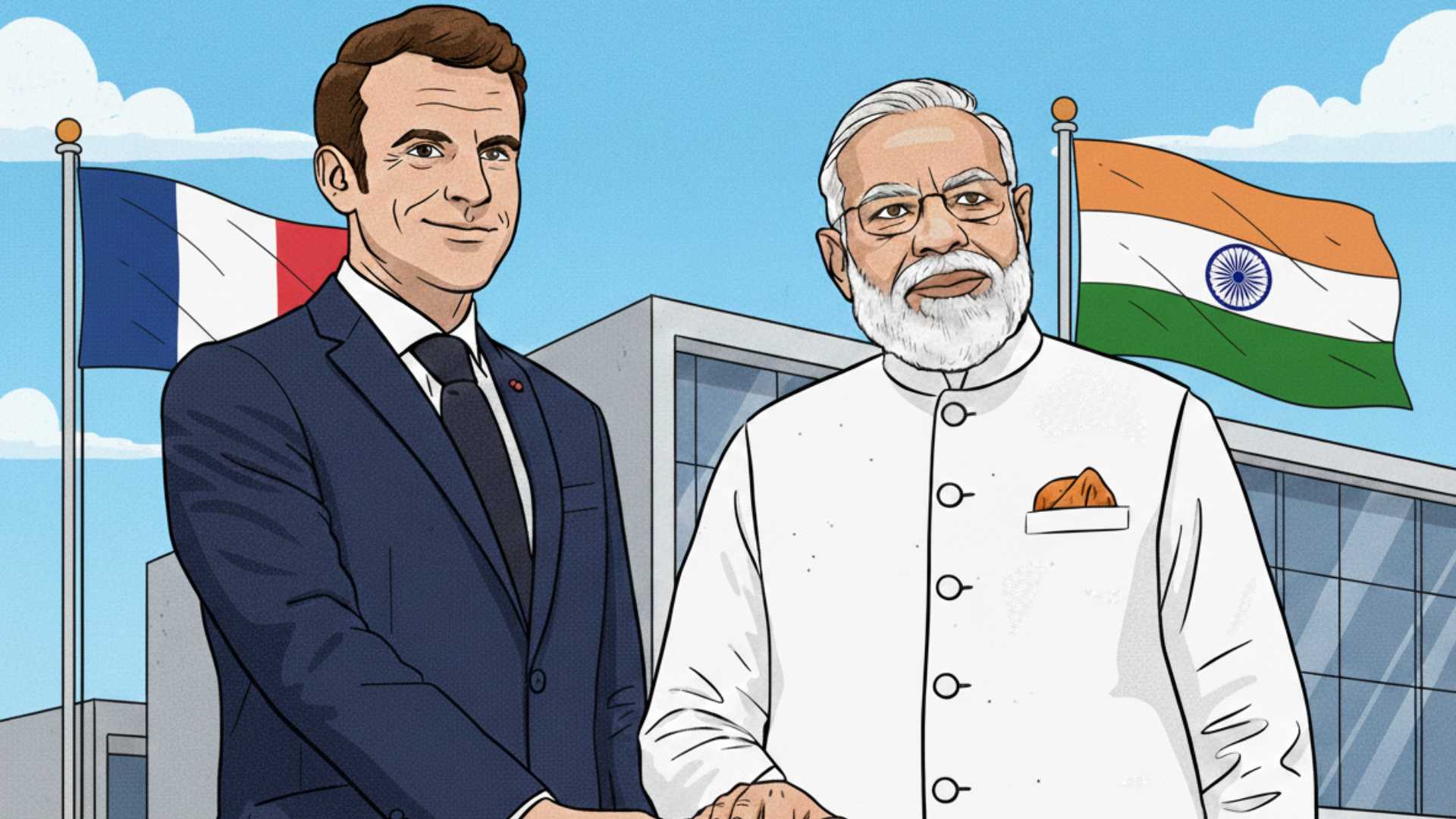
1. Strategic Context: Elevation to a ‘Special Global Strategic Partnership’
India and France have elevated their bilateral ties to a ‘Special Global Strategic Partnership’, signalling deepening cooperation amid global geopolitical uncertainty. In a world marked by strategic rivalries, supply chain disruptions, and contestations over global governance, both countries have projected their relationship as a stabilising force.
Prime Minister Narendra Modi described the partnership as “very special,” while President Emmanuel Macron emphasised cooperation based on rule of law and opposition to hegemonic world orders. The partnership spans defence, critical minerals, health, renewable energy, science and technology, and skilling—indicating multi-sectoral strategic convergence.
The visit marked the 20th meeting between the two leaders in recent years, reflecting high-level political continuity and trust. France’s consistent engagement with India reinforces its position as one of India’s most reliable European partners in strategic matters.
“The India-France partnership knows no boundaries. It can reach from deep oceans to the tallest mountains.” — Prime Minister Narendra Modi
The elevation of ties reflects a shared strategic vision in an uncertain global order. Ignoring such partnerships could limit India’s ability to diversify alliances and strengthen its autonomy in a multipolar world.
GS Linkages
- GS2: Bilateral relations, international institutions
- GS3: Strategic sectors, energy security
- Essay: Multipolarity, strategic autonomy
2. Defence and Strategic Cooperation
Defence remains the cornerstone of Indo-French ties. The agreement on the reciprocal deployment of armed forces strengthens interoperability and operational coordination, particularly in the Indo-Pacific region.
France is a key defence supplier to India and a trusted partner in high-end military technology. The inauguration of the H125 Helicopter Final Assembly Line at Vemagal, Karnataka, represents a shift from buyer-seller dynamics to co-production and localisation. It aligns with India’s ‘Make in India’ and defence indigenisation goals.
France’s support on counter-terrorism was reiterated during President Macron’s tribute to the victims of the 26/11 Mumbai terror attacks, reinforcing shared security concerns.
“In the face of terrorism, unity and determination.” — President Emmanuel Macron
Defence cooperation enhances India’s deterrence capabilities and supports strategic autonomy. Without such partnerships, India risks dependence on limited suppliers and reduced bargaining power in defence procurement.
Strategic Implications:
- Greater interoperability in the Indo-Pacific
- Support for India’s defence manufacturing ecosystem
- Strengthening counter-terror cooperation
- Balancing hegemonic influences in global geopolitics
3. Economic and Institutional Frameworks
The amendment of the Double Taxation Avoidance Agreement (DTAA) strengthens the investment climate by reducing fiscal uncertainty and improving cross-border economic flows.
An annual Foreign Ministers’ Dialogue has been institutionalised to review progress under the Horizon 2047 Roadmap, signalling long-term structured engagement rather than ad-hoc diplomacy.
These measures aim to enhance predictability in economic relations, boost investor confidence, and provide diplomatic continuity.
Stable institutional mechanisms reduce transaction costs and enhance long-term policy credibility. If neglected, bilateral ties may become personality-driven rather than institution-driven, weakening sustainability.
Governance Relevance:
- Promotes ease of doing business
- Strengthens diplomatic accountability
- Encourages long-term strategic planning
4. Innovation, Technology and Knowledge Partnerships
Both leaders launched the India-France Year of Innovation and the India-France Innovation Network, signalling a shift toward knowledge-driven collaboration.
Three major institutional initiatives were announced:
- Indo-French Centre for AI in Health
- Indo-French Centre for Digital Science and Technology
- National Centre of Excellence for Skilling in Aeronautics
These initiatives reflect shared priorities in emerging technologies such as Artificial Intelligence, digital sciences, and high-skill manufacturing. President Macron highlighted the need for transparent and diversity-respecting AI systems.
Technological collaboration enhances innovation ecosystems and human capital formation. Without such cooperation, India risks lagging in frontier technologies critical for economic competitiveness.
Sectoral Significance:
- AI governance and ethical frameworks
- Health-tech innovation
- Aerospace skill development
- Strengthening R&D ecosystems
GS Linkages
- GS3: Science & Technology, AI governance
- GS2: International cooperation in technology
- GS1: Skill development and demographic dividend
5. Energy, Critical Minerals and Infrastructure Cooperation
The partnership includes cooperation in renewable energy, nuclear power, high-speed rail networks, and critical minerals. These sectors are central to India’s energy transition and strategic supply chain security.
Critical minerals are vital for clean energy technologies, batteries, and defence production. Collaboration reduces overdependence on limited global suppliers and enhances resilience.
France’s engagement in nuclear and high-speed rail projects aligns with India’s infrastructure modernisation goals.
Energy security and supply chain diversification are central to economic sovereignty. Ignoring critical mineral partnerships may expose India to geopolitical supply shocks.
Strategic Outcomes:
- Support for clean energy transition
- Strengthening supply chain resilience
- Enhancing infrastructure capacity
6. Cultural and Soft Power Diplomacy
President Macron’s outreach—including tribute at the Taj Hotel, jogging along Marine Drive, and engagement with Indian cinema personalities—highlights the role of cultural diplomacy in strengthening bilateral goodwill.
The visit to Mumbai, his first to the city and fourth visit to India, reinforces people-to-people engagement and soft power linkages. Cultural and innovation programmes launched at the Gateway of India symbolically linked heritage with future-oriented cooperation.
Cultural diplomacy complements strategic cooperation by building societal trust and long-term acceptance of partnerships.
Soft power enhances diplomatic depth and public legitimacy. Without societal goodwill, even strong strategic agreements may lack durability.
GS Linkages
- GS1: Indian culture and soft power
- GS2: Diaspora and people-to-people relations
Conclusion
The elevation of Indo-French ties to a Special Global Strategic Partnership reflects convergence across defence, innovation, energy, and governance frameworks. Institutional mechanisms such as the Horizon 2047 Roadmap and annual ministerial dialogues ensure continuity beyond leadership cycles.
In an era of geopolitical fragmentation and technological transformation, sustained India-France cooperation strengthens India’s strategic autonomy, economic resilience, and global standing. The partnership exemplifies how middle powers can shape a multipolar, rules-based international order through structured, long-term collaboration.