
India and Germany A Partnership Soaring High Like Kites

Exploring the significance of the India-Germany relationship through symbolic kite flying amid economic challenges and aspirations.
SuryaSurya
5 mins read
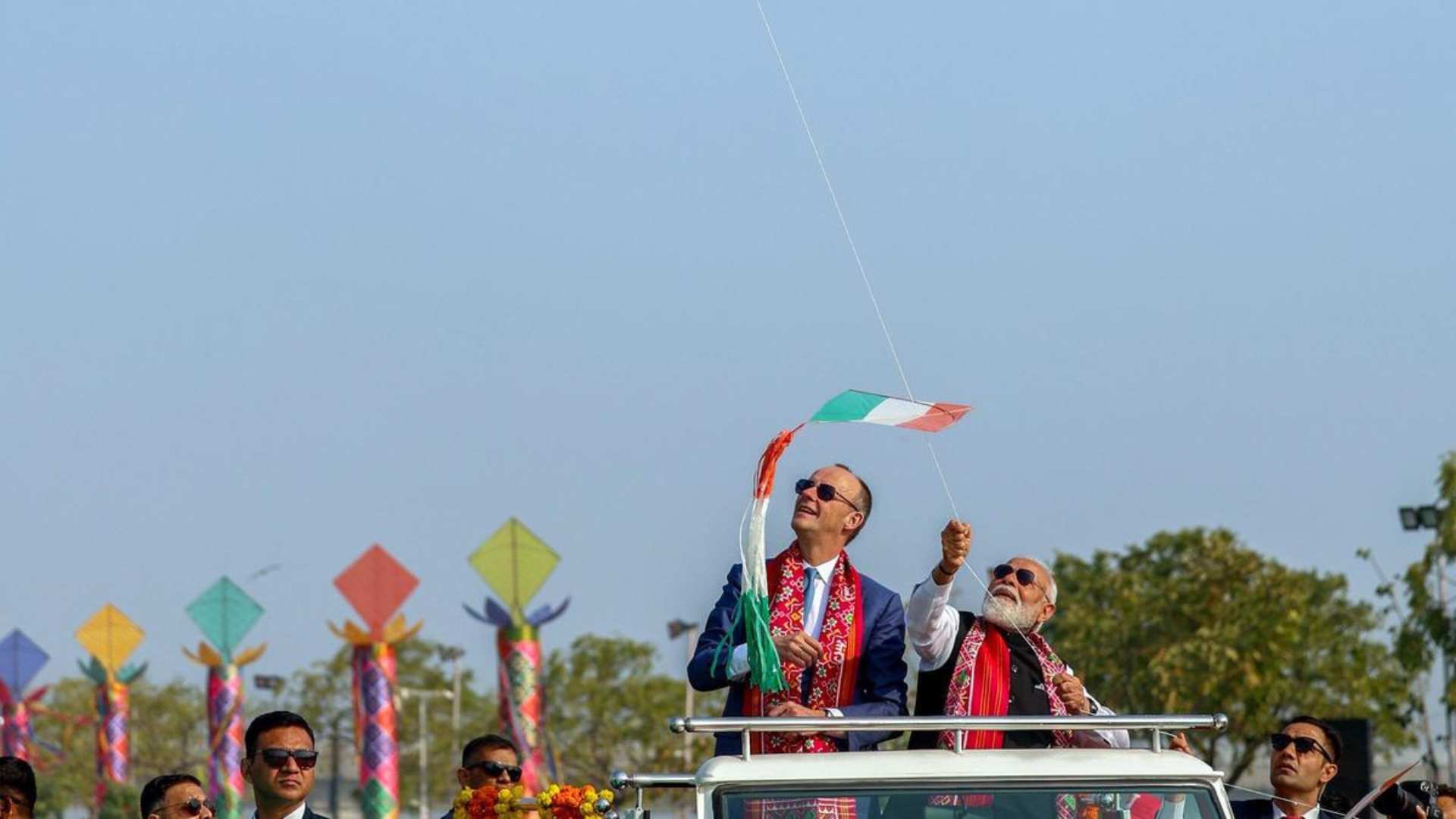
Modi and Merz fly kites in Ahmedabad, symbolising soaring India-Germany ties
Not Started

1. India–Germany Engagement: Symbolism and Strategic Context

The recent India visit of German Chancellor Friedrich Merz, marked by informal imagery such as kite flying with Prime Minister Narendra Modi in Ahmedabad, symbolises a deeper strategic convergence between the two countries. Beyond optics, the visit reflects a conscious effort to project warmth, trust, and long-term partnership amid global uncertainty.

Both India and Germany face common external challenges, including erosion of the multilateral trading system, weakening respect for international law, and disruptions in the rules-based global order. These pressures have heightened the need for predictable and stable international partnerships.

For both economies, prosperity depends on innovation, education, science, and open markets. The partnership is framed as one that can withstand turbulence, much like a kite that demonstrates stability only under strong winds.

If such strategic signalling is ignored, bilateral ties risk remaining transactional rather than transformative.

“In a world of growing uncertainty, partnerships based on trust and rules matter more than ever.” — German Federal Foreign Office (policy statements)

Symbolism in diplomacy reinforces strategic intent; without it, cooperation may lack political momentum and public resonance.

2. Economic Complementarity and Global Standing

India and Germany are currently the fourth- and third-largest economies globally, respectively. The article underscores their shared economic heft and the expectation that India will soon overtake Germany to become the world’s third-largest economy.

Germany views India’s rise not as a threat but as an opportunity, rejecting the notion of the global economy as a zero-sum game. A stronger Indian economy expands markets for German products, while Indian firms in Germany enhance competition and consumer choice.

This framing highlights a cooperative vision of globalisation rooted in mutual gains rather than protectionism.

If economic interdependence is not leveraged, both countries may face reduced competitiveness amid global trade fragmentation.

“International trade is not a zero-sum game; when one country prospers, others can too.” — World Trade Organization (foundational principles)

Economic complementarity strengthens resilience; neglecting it amplifies vulnerability to global shocks.

3. Free Trade Agreement as a Strategic Economic Instrument

A central message of Chancellor Merz’s visit was the urgency of a European Union–India Free Trade Agreement (FTA). Such an agreement is seen as essential for propelling both economies to the next level of growth.

The proposed FTA is framed not merely as a trade facilitation tool but as a strategic hedge against trade wars and supply chain disruptions, which have become increasingly common.

For India, deeper access to European markets supports export growth and industrial upgrading; for Germany, it ensures supply chain diversification and market stability.

Failure to advance the FTA risks leaving both economies exposed to unilateral trade measures and external volatility.

Trade agreements today serve strategic and resilience objectives; delays weaken economic security.

4. Migration Partnership and Human Capital Linkages

The visit highlighted the growing India–Germany migration partnership, built on principles of safe, legal, and predictable migration. Germany continues to welcome skilled Indian professionals and students amid global tightening of migration pathways.

An anecdote involving a young Indian conversing fluently in German after only four months of learning illustrates India’s adaptive human capital and Germany’s openness to skilled migrants.

This partnership supports Germany’s labour market needs while offering Indian youth global professional opportunities, creating a mutually reinforcing human capital cycle.

If migration frameworks weaken, both countries lose demographic and productivity advantages.

“Migration, when well governed, is a powerful driver of sustainable development.” — UN Secretary-General, International Migration Reports

Human mobility strengthens economic and cultural ties; restrictive approaches limit shared growth.

5. Strategic and Defence Cooperation

Beyond economics and migration, the article points to the expansion of defence cooperation between India and Germany. Simplification of defence trade and closer strategic coordination are emerging pillars of the bilateral relationship.

Such cooperation aligns with shared concerns over regional stability and the preservation of the rules-based international order.

Defence collaboration also contributes to technological exchange and strategic autonomy for both partners.

If defence ties remain underdeveloped, broader strategic convergence may remain incomplete.

Security cooperation reinforces trust and complements economic partnerships.

6. Diplomatic Milestones and Long-Term Vision

In 2026, India and Germany will celebrate 75 years of diplomatic relations, marking a significant milestone. The article frames the current visit as an early and meaningful start to this anniversary year.

Over recent years, both countries have articulated a clearer strategic direction, moving beyond ad hoc cooperation to structured engagement, including biennial Intergovernmental Consultations.

These institutional mechanisms provide continuity and predictability, anchoring bilateral relations beyond leadership changes.

Without sustained institutional engagement, strategic momentum risks dissipating.

“Diplomacy is the art of building institutions that outlast individuals.” — Henry Kissinger

Long-term partnerships depend on institutional depth, not episodic engagement.

7. Implications for India’s Global Strategy

The evolving India–Germany partnership fits within India’s broader foreign policy objective of diversifying partnerships and strengthening ties with key European powers.

Closer engagement with Germany enhances India’s position within Europe, complements its strategic autonomy, and supports its aspirations in global governance.

This relationship also bridges economic, technological, and people-to-people dimensions, making it multidimensional rather than narrowly transactional.

If leveraged effectively, it can serve as a model for India’s engagement with other middle and major powers.

Strategic diversification enhances autonomy; narrow alignments constrain foreign policy options.

Conclusion

The India–Germany partnership, highlighted by Chancellor Merz’s visit, reflects a convergence of economic interests, strategic concerns, and shared values in a turbulent global environment. Advancing trade integration, migration cooperation, defence ties, and institutional dialogue will be crucial for translating symbolism into sustained strategic outcomes and for strengthening both countries’ roles in a rules-based international order.

Quick Q&A

Everything you need to know

Context and significance: Chancellor Friedrich Merz's visit to India in 2026 was highly symbolic, marking his first visit outside the Western Alliance and coinciding with the 75th anniversary of India-Germany diplomatic relations. The choice of Ahmedabad, Prime Minister Modi’s home state, for informal and symbolic interactions—such as flying kites together—underscored the personal dimension of the bilateral relationship, enhancing trust and mutual understanding between the two leaders.

Strategic and economic implications: Beyond symbolism, the visit focused on deepening economic, trade, defence, and migration partnerships. Germany and India are among the world’s largest economies, and cooperation has implications for global trade and investment flows. Discussions on a European Union-India Free Trade Agreement, a closer defence partnership, and expanding educational and migration ties exemplify the multi-faceted nature of the relationship.

Broader message: The visit reflects a mature partnership capable of navigating external shocks such as disruptions in the international trade system and regional instability. It signals Germany’s commitment to India's rise as a global economic powerhouse, emphasizing that the growth of one economy can mutually benefit the other, highlighting cooperative globalism rather than zero-sum thinking.

Mutual economic benefit: India and Germany are economic heavyweights—India is projected to surpass Germany as the world's third-largest economy. A stronger Indian economy creates a larger market for German products, technology, and services, while German investment and collaboration in India enhance innovation and competitiveness in sectors like manufacturing, renewable energy, and digital technology.

Resilience to global uncertainties: Both countries face challenges such as the erosion of the rules-based international trade system, trade wars, and regional instability. Strengthening bilateral trade and investment ties provides a buffer against unpredictable disruptions. For example, Germany’s support for a European Union-India Free Trade Agreement is aimed at reducing vulnerability to global supply chain interruptions and fostering a more predictable trading environment.

Long-term strategic importance: The partnership also encourages knowledge exchange, educational collaboration, and technological innovation. Initiatives like joint research programs, vocational training, and student mobility are not only economically beneficial but also build human capital resilience, enabling both nations to thrive in uncertain global conditions. This reinforces the idea that bilateral economic growth is interdependent and mutually reinforcing rather than zero-sum.

Structured pathways: Germany continues to provide safe, legal, and predictable migration opportunities for skilled and educated Indians. During Chancellor Merz’s visit, interactions with young Indians highlighted the emphasis on structured professional pathways and educational programs that facilitate seamless integration into German workplaces.

Skill enhancement and adaptability: The anecdote of a young Indian woman communicating in German after just four months of learning illustrates the adaptability, resilience, and quick learning of Indian professionals. Germany benefits from this highly skilled talent pool, while young Indians gain international exposure, competitive experience, and enhanced career prospects.

Strategic significance: This partnership ensures that both countries benefit from a regulated and mutually advantageous migration framework. For India, it addresses employment and skills development challenges, while Germany secures a workforce capable of supporting innovation-intensive sectors such as engineering, IT, and research. By formalizing migration channels, the partnership reduces brain drain risks, ensures legal compliance, and strengthens people-to-people links between the two nations.

Symbolic diplomacy: The images of Prime Minister Modi and Chancellor Merz flying kites in Ahmedabad serve as a metaphor for the partnership’s ability to navigate complex global challenges. Symbolism in diplomacy reinforces personal rapport, trust, and informal channels of communication, which often complement formal negotiations.

Substance vs. symbolism: While the act of kite flying is symbolic, it underscores a broader point: successful diplomacy requires both strategic substance and relational depth. During the visit, substantive discussions focused on trade, defence, migration, and education. The symbolism of the kite reflects the resilience and flexibility needed to maintain a partnership in turbulent international conditions.

Broader implications: Symbolic gestures can also influence public perception and media narratives, building goodwill and social legitimacy for bilateral initiatives. In the India-Germany context, such actions enhance people-to-people bonds, inspire mutual cultural respect, and complement concrete policy outcomes, thereby creating a durable and multi-dimensional partnership.

Trade and investment: Both nations are pushing for a European Union-India Free Trade Agreement to boost bilateral trade, reduce vulnerability to global supply chain disruptions, and enhance market access for goods and services.

Defence cooperation: The countries are working on strengthening defence ties, including joint research and development, defence procurement, and technology transfer initiatives, ensuring that strategic autonomy and preparedness are enhanced for both nations.

Education and skills development: The migration partnership and educational collaborations aim to provide structured professional pathways, student exchanges, and vocational training. For instance, skilled young Indians moving to Germany benefit from exposure to advanced technical environments while contributing to sectors like IT, engineering, and research.

Broader cooperation: Additional areas include climate change mitigation, renewable energy projects, innovation, and research. These examples illustrate a multi-pronged strategy that integrates economic growth, technological collaboration, and human capital development to strengthen bilateral relations in the long term.

Economic rationale: India is rapidly emerging as the world’s third-largest economy, representing a growing market for German goods, services, and technology. A stronger Indian economy ensures mutually beneficial trade flows, investment opportunities, and industrial partnerships.

Geopolitical considerations: Both countries are concerned about disruptions to the international trade system, regional instability, and the erosion of rules-based global order. A closer partnership provides a stable framework for navigating global uncertainties, including trade wars, supply chain interruptions, and strategic competition.

Long-term strategic goals: Germany aims to leverage India’s demographic advantage, innovation ecosystem, and strategic location to enhance its global footprint. Strengthening cooperation in defence, education, migration, and trade aligns with Germany’s broader objectives of sustainable growth, resilience, and regional stability. The kite-flying gesture and personal rapport between leaders symbolize commitment to a partnership that combines economic pragmatism with strategic foresight.

Attribution

Original content sources and authors

Sign in to track your reading progress

Comments (0)

Please sign in to comment

No comments yet. Be the first to comment!