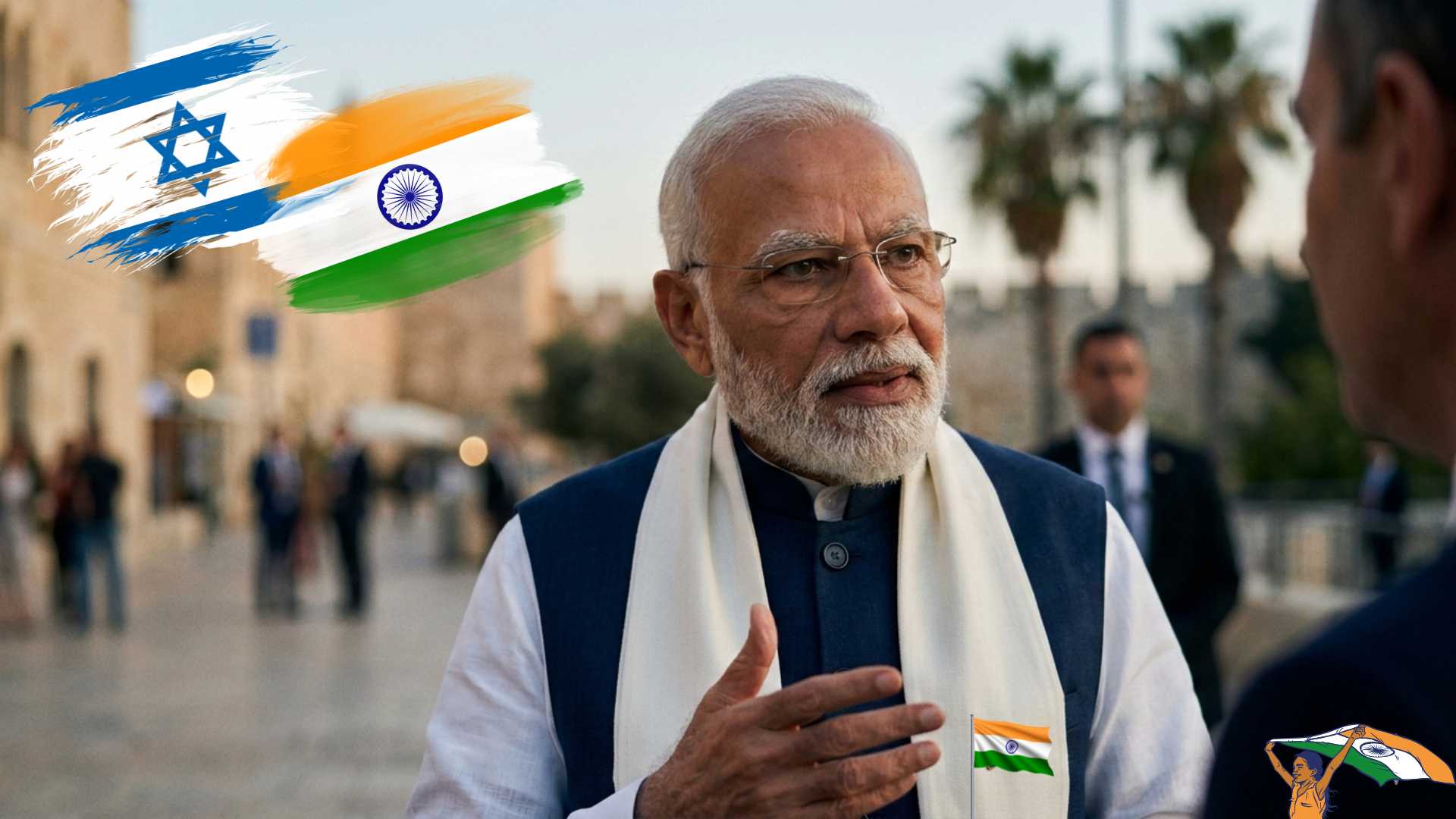
1. Context: PM Modi’s Visit to Israel and Strategic Upgrade
Prime Minister Narendra Modi’s 24-hour visit to Jerusalem marked a significant intensification of India–Israel bilateral relations. The visit culminated in upgrading ties to a “Special Strategic Partnership”, accompanied by over 15 MoUs across artificial intelligence, agriculture, culture, and education, along with a critical technologies partnership.
A major labour mobility decision was also announced, facilitating the employment of 50,000 Indian workers in Israel over five years. Israeli Prime Minister Benjamin Netanyahu’s high-profile personal engagement throughout the visit signalled Israel’s strong diplomatic interest in reinforcing the relationship.
The timing of the visit is geopolitically sensitive. Israel faces growing international scrutiny over high civilian casualties in Gaza and its West Bank settlement proposals. Several countries, including Germany, France, and the U.K., have publicly expressed concerns. Domestically, Mr. Netanyahu is heading into elections amid allegations of corruption and criticism over security lapses in 2023.
Strategic partnerships in volatile regions are not merely bilateral; they signal geopolitical positioning. If timing and optics are not carefully managed, diplomatic outreach can be interpreted as political endorsement, potentially affecting regional equilibrium and India’s long-term strategic interests.
2. The Palestine Question and India’s Traditional Position
In his address to the Knesset, the Prime Minister referred indirectly to Palestinian sovereignty, stating that the U.S.-led Gaza Peace Initiative “holds the promise of a just and durable peace... including by addressing the Palestine Issue.” However, there was no direct reference to the reported over 72,000 casualties in Gaza following Israel’s military response to the October 2023 Hamas attacks.
India has historically maintained a calibrated position—supporting Israel’s security concerns while backing a two-state solution and Palestinian statehood. The absence of a parallel visit to Palestine during this trip contrasts with previous diplomatic balancing efforts.
This shift in emphasis has implications for India’s image as a principled actor rooted in anti-colonial solidarity and strategic autonomy. A perception of tilt may affect India’s standing among Arab nations and the broader Global South.
India’s West Asia policy has long rested on strategic balance. If this equilibrium weakens, it could dilute India’s diplomatic credibility and reduce its maneuvering space in multilateral forums where normative consistency strengthens influence.
3. Regional Geopolitics and Strategic Risks
The visit occurred amid heightened tensions, including the threat of U.S. action against Iran. Travelling at such a juncture carries implicit geopolitical signalling. India has substantial strategic, energy, and diaspora interests across West Asia, including in Iran and the Gulf.
India’s decision to “stand with Israel, firmly” could be interpreted by other regional actors as a shift in alignment. West Asian states expect India to maintain its historically calibrated approach rooted in peace, dialogue, and multilateral engagement.
Geopolitical Sensitivities:
- Rising polarisation in West Asia
- International criticism of Israel’s West Bank settlement proposals
- Israel’s domestic political pressures ahead of elections
- Threat of regional spillover involving Iran
Consequently, India’s diplomatic moves are now assessed not only bilaterally but also in terms of their systemic regional impact.
In geopolitically fragile regions, even symbolic gestures can recalibrate strategic perceptions. If India is seen as abandoning equidistance, it risks complicating relations with energy partners, diaspora-hosting states, and strategic connectivity projects.
4. Regional Initiatives: I2U2 and IMEC
During the visit, India reaffirmed its commitment to regional groupings such as India–Israel–UAE (I2U2) and the expanded India–Israel–UAE–U.S. framework, alongside the India–Middle East–Europe Economic Corridor (IMEC).
These initiatives aim to:
- Enhance economic integration
- Build resilient supply chains
- Promote technology and infrastructure collaboration
- Strengthen connectivity between South Asia, West Asia, and Europe
However, the viability of such multilateral economic corridors depends on regional stability. Deepening fault lines in West Asia could slow implementation and increase political risks for participating states.
Connectivity initiatives require geopolitical stability. If regional polarisation intensifies, economic corridors may face delays, reduced investor confidence, and strategic contestation, undermining India’s long-term trade and energy security objectives.
5. Implications for India’s West Asia Policy
India’s West Asia policy has traditionally rested on three pillars:
- Strategic autonomy
- Balanced engagement with competing regional powers
- Support for a negotiated two-state solution
The present diplomatic posture will be judged globally by whether India continues to uphold this calibrated framework or is perceived as shifting towards strategic alignment with one side.
Potential Impacts:
- Strain in ties with certain Arab and Islamic nations
- Reputational costs in the Global South
- Implications for energy security and diaspora welfare
- Altered diplomatic leverage in multilateral negotiations
Therefore, symbolic balancing measures—such as high-level outreach to Palestine—carry substantial diplomatic weight.
Foreign policy credibility rests on consistency between principle and practice. If India’s stance appears selectively applied, it could weaken its normative authority and reduce its ability to act as a bridge-builder in global conflicts.
6. Way Forward: Calibrated Strategic Engagement
India must pursue a nuanced approach that reconciles strategic partnerships with normative commitments.
Policy Directions:
- Reaffirm commitment to a negotiated two-state solution
- Sustain high-level engagement with Palestine alongside Israel
- Maintain dialogue with Gulf states and Iran
- Ensure regional initiatives like IMEC are insulated from political volatility
- Emphasize humanitarian concerns and civilian protection in diplomatic statements
Such calibrated engagement will preserve India’s strategic flexibility while deepening bilateral cooperation in technology, defence, and labour mobility.
Conclusion
India’s expanding partnership with Israel reflects evolving strategic and technological priorities. However, in a polarised West Asia, diplomacy must balance ambition with prudence. Sustaining regional equilibrium while advancing national interests will determine whether India strengthens its role as a stabilising power or faces avoidable strategic trade-offs in a geopolitically sensitive neighbourhood.