India and New Zealand to Sign Major Free Trade Agreement

Introduction
India has been actively expanding its trade footprint, with FTAs covering ~50% of global GDP partners, while New Zealand maintains one of the lowest average tariffs (~2.2%) globally. The India–New Zealand Free Trade Agreement marks a significant step toward deeper economic integration and supply chain diversification.
“Trade agreements are instruments of growth when aligned with national priorities.” — WTO principle
Background & Context
-
Negotiations launched: March 2025; concluded: December 2025 (fast-track FTA).
-
Reflects India’s shift toward targeted, interest-based FTAs.
-
Bilateral trade (2024–25):
- Exports: $711.1 million (+32.1%)
- Imports: $587.1 million (+75.2%)
Key Features of the FTA
| Feature | Details |
|---|---|
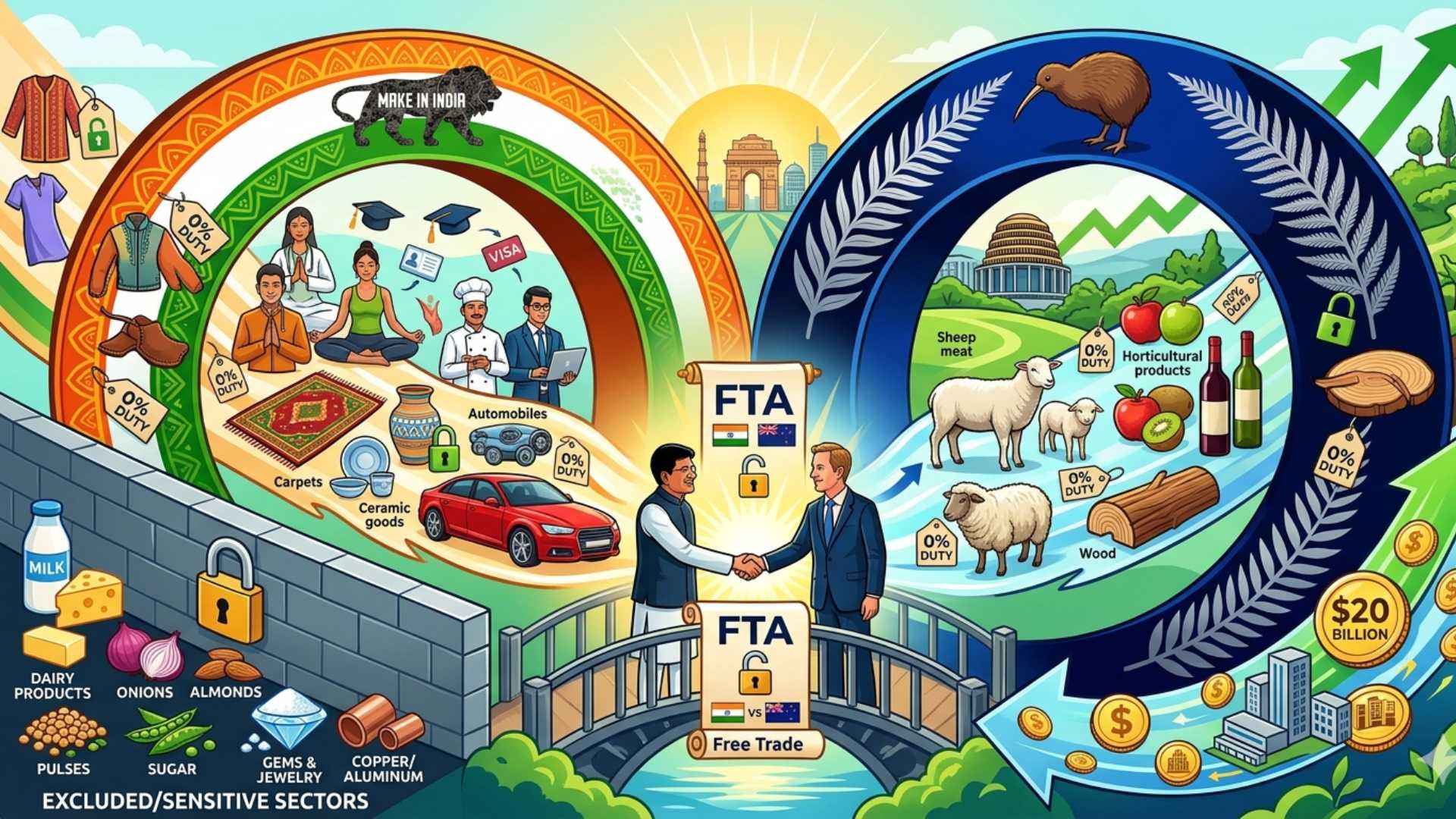
| Market Access (India) | Duty-free access on 100% tariff lines in New Zealand |
| Market Access (NZ) | Access to 70.03% tariff lines in India |
| Tariff Reduction | 95% of NZ exports see tariff reduction/elimination |
| Sensitive Sectors | Dairy, agriculture, sugar, metals excluded |
| Investment | $20 billion investment commitment over 15 years |
| Mobility | Work visas, student mobility, working holiday scheme |
Key Concepts
1. Free Trade Agreement (FTA)
- Agreement between countries to reduce/eliminate tariffs and barriers.
- Enhances trade, investment, and economic cooperation.
2. Tariff Liberalisation vs Protection
-
India balances:
- Export promotion (textiles, auto components)
- Domestic protection (dairy, agriculture)
Trade & Economic Implications
1. Gains for India
-
Full duty-free access boosts exports:
- Textiles, leather, carpets, automobiles
-
Increased competitiveness in developed markets.
-
Investment inflow ($20B) strengthens infrastructure and jobs.
2. Gains for New Zealand
-
Greater access to Indian markets (70% tariff lines).
-
Export expansion in:
- Sheep meat
- Agricultural products (non-sensitive)
Mobility & Services Dimension
-
5,000 skilled visas (3-year stay):
- Sectors: IT, healthcare, engineering, AYUSH, education
-
Student benefits:
- Work up to 20 hours/week
- Extended post-study work visas
-
Working Holiday Visa:
- 1,000 युवाओं per year (12 months stay)
👉 Reflects India’s push for services-led trade diplomacy.
Strategic Significance
1. Diversification of Trade Partners
- Reduces dependence on traditional markets (US, EU, China).
- Strengthens Indo-Pacific economic engagement.
2. Template for Future FTAs
-
Similar to:
- EFTA investment-linked model
-
Combines:
- Trade + Investment + Mobility
3. Supply Chain Resilience
- Enhances integration into global value chains (GVCs).
Safeguards & Sensitive Areas
| Sector | India’s Approach |
|---|---|
| Dairy | Fully excluded (protect farmers) |
| Agriculture | Key crops excluded |
| Metals | Strategic industries protected |
| Future Clause | “Most Favoured Nation-like” provision for services |
Challenges & Concerns
- Trade Imbalance Risk if imports rise faster.
- Domestic Industry Pressure from foreign competition.
- Implementation Complexity (rules of origin, compliance).
- Dependency on Commitments (investment may not fully materialise).
Comparative Insight
| Aspect | India–NZ FTA | Earlier FTAs (e.g., ASEAN) |
|---|---|---|
| Approach | Selective, cautious | Broad liberalisation |
| Focus | Trade + Mobility + Investment | Mostly goods trade |
| Protection | Strong safeguards | Relatively weaker |
Case Insight
- Similar to EFTA FTA, where investment commitments are tied to trade access.
- Shows India’s evolving “FTA 2.0 strategy”—calibrated openness.
Conclusion
The India–New Zealand FTA represents a balanced trade strategy, combining openness with protection of core sectors. It signals India’s transition toward strategic trade diplomacy, where economic integration is aligned with domestic priorities. Its success will depend on effective implementation, investment realisation, and maintaining equilibrium between global competitiveness and local resilience.
Attribution
Original content sources and authors


Syllabus classification
How this article maps to GS papers
Main syllabus
GS2Bilateral RelationsQuick Q&A
What are the key features of the India–New Zealand Free Trade Agreement (FTA) and how does it differ from previous FTAs signed by India?
Another notable feature is the careful exclusion of sensitive sectors by India, including dairy products, certain agricultural commodities (like onions and pulses), and strategic goods such as metals and defence-related items. This reflects India’s calibrated approach to trade liberalisation, balancing domestic interests with global integration. Additionally, the agreement includes a $20 billion investment commitment from New Zealand over 15 years, aligning with India's broader strategy of linking trade deals with investment inflows.
Compared to earlier FTAs, such as those with ASEAN or EFTA, this agreement stands out due to its speed of negotiation (concluded within a year) and its focus on mobility provisions, including student visas and skilled worker quotas. It also incorporates forward-looking clauses like automatic extension of better future trade terms. Thus, the India–New Zealand FTA reflects a modern, flexible, and strategic template for India’s evolving trade policy.
Why is the India–New Zealand FTA considered strategically important for India’s economic and trade policy?
Economically, the agreement is significant because it integrates trade, investment, and mobility into a single framework. The $20 billion investment commitment is expected to support infrastructure, technology, and employment generation in India. Additionally, provisions for professional mobility, including visas for skilled workers and students, help India leverage its demographic dividend and skilled workforce globally.
From a policy perspective, the FTA reflects India’s shift towards high-quality, balanced trade agreements. Unlike earlier agreements that faced criticism for harming domestic industries, this FTA carefully protects sensitive sectors like dairy. It also introduces modern elements such as automatic extension of favourable terms, making it dynamic and future-ready. Overall, the agreement strengthens India’s position in global trade negotiations and signals its readiness to engage in mutually beneficial economic partnerships.
How does the India–New Zealand FTA address the issue of mobility of professionals and students, and what are its implications?
The agreement also introduces a quota of 5,000 visas for skilled Indian professionals, allowing them to work in sectors such as IT, healthcare, engineering, education, and even niche areas like AYUSH and yoga instruction. Additionally, the Working Holiday Visa programme enables 1,000 young Indians annually to live and work in New Zealand for up to 12 months, fostering cultural exchange and skill development.
These provisions have far-reaching implications. Economically, they facilitate remittances and skill enhancement. Socially, they promote cross-cultural understanding and global integration of Indian talent. However, challenges remain, such as ensuring equitable access and preventing brain drain. Overall, the mobility provisions reflect a forward-looking approach that integrates human capital into trade policy, making the FTA more comprehensive and inclusive.
Critically analyse the benefits and potential risks of the India–New Zealand FTA for India.
However, the agreement is not without risks. One major concern is the impact on domestic industries, especially if tariff reductions lead to increased imports of competitive goods from New Zealand. Although India has excluded sensitive sectors like dairy, other sectors may still face pressure. The clause on automatic extension of better future trade terms could also limit India’s flexibility in negotiating with other countries.
Another challenge lies in implementation. Trade agreements often face issues such as non-tariff barriers, regulatory hurdles, and lack of awareness among exporters. Without effective monitoring and support mechanisms, the potential benefits may not fully materialise. Thus, while the FTA is a progressive step, its success will depend on careful implementation, continuous evaluation, and complementary domestic reforms to enhance competitiveness.
Provide examples of how specific sectors in India could benefit from the India–New Zealand FTA.
Similarly, sectors like automobiles and auto components and leather goods are likely to see increased demand due to reduced costs. For example, Indian auto component manufacturers can tap into New Zealand’s demand for cost-effective and high-quality parts. Additionally, the services sector, particularly IT and healthcare, stands to gain from mobility provisions, enabling Indian professionals to access new markets.
A practical example can be seen in the IT sector, where Indian professionals can work in New Zealand under the visa quota, contributing to both countries’ economies. Similarly, Indian students benefiting from post-study work visas can gain international experience and contribute to knowledge transfer. These examples highlight how the FTA can drive sector-specific growth while fostering broader economic integration.
Using the India–New Zealand FTA as a case study, discuss how India is evolving its approach to trade negotiations.
Another key aspect is the integration of non-traditional elements such as investment commitments and mobility provisions. The inclusion of a $20 billion investment pledge and detailed visa arrangements indicates a shift from purely trade-focused agreements to comprehensive economic partnerships. Additionally, clauses like automatic extension of favourable terms demonstrate India’s willingness to adopt innovative and flexible negotiation strategies.
This approach is also characterised by speed and efficiency, with the agreement being negotiated within a year. It reflects India’s growing confidence and capability in global trade diplomacy. However, it also underscores the need for strong domestic institutions to implement and monitor such agreements effectively. Overall, the FTA illustrates India’s transition towards more pragmatic, interest-driven, and future-oriented trade policies.
Practice questions
1 question for mains preparation