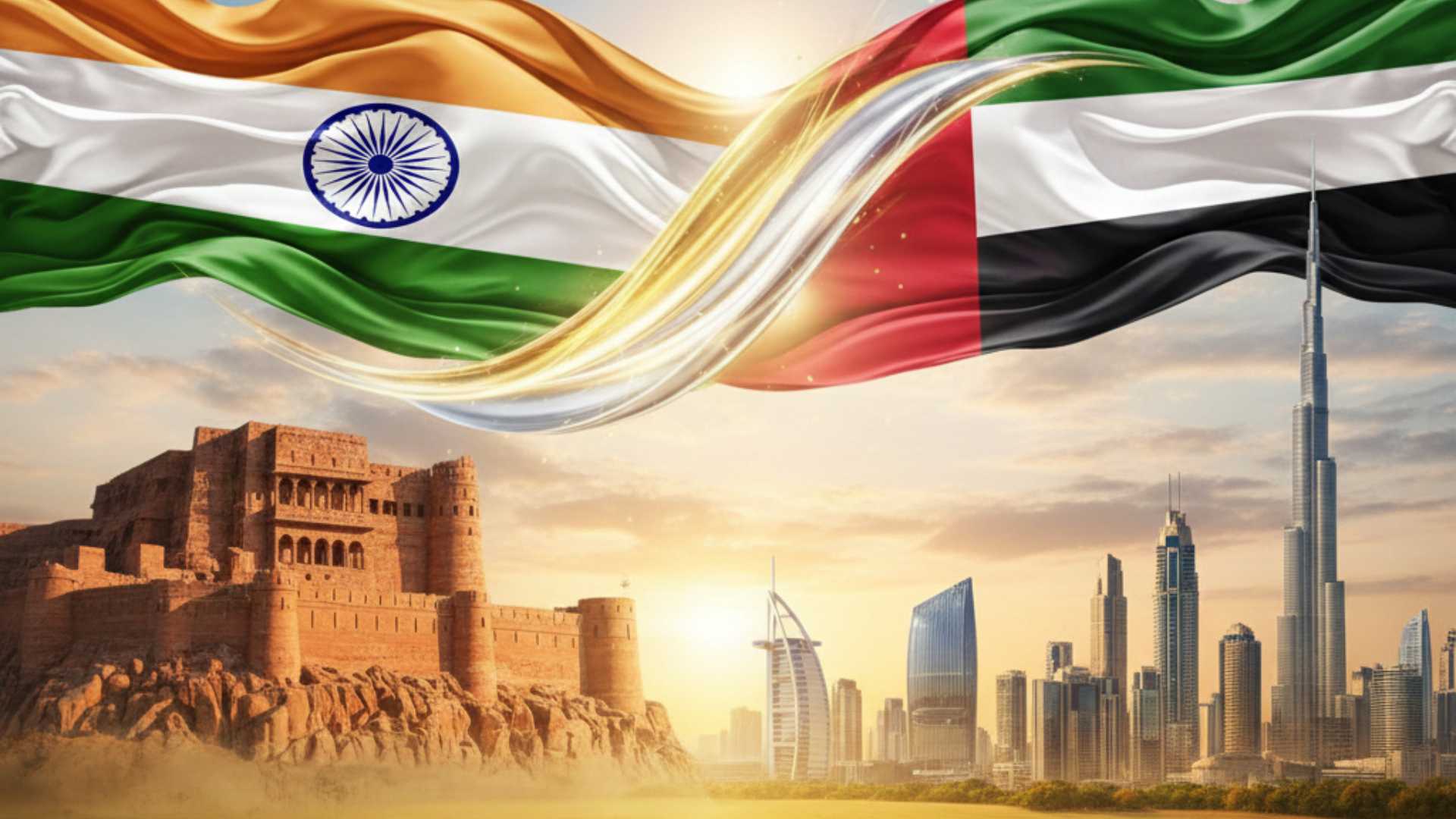
India-UAE Relations: A Strategic Partnership of Stability

1. Context: Stability of India–UAE Relations amid Global Flux
India–UAE relations stand out for their continuity and predictability at a time of significant churn in global geopolitics, marked by great power rivalry, regional conflicts, and economic fragmentation. The January 19, 2026 visit of UAE President Sheikh Mohamed bin Zayed Al Nahyan (MbZ) to India exemplifies this stability.
The visit was brief yet outcome-oriented, reflecting a mature partnership where high-level engagements are focused on concrete deliverables rather than symbolism. It marked the 11th leadership-level visit in 11 years, underscoring institutionalised political trust.
For India’s foreign policy, such stability is critical in West Asia, a region central to India’s energy security, diaspora welfare, trade, and maritime interests. Ignoring such anchor partnerships would weaken India’s capacity to navigate regional volatility through strategic autonomy.
This continuity demonstrates that sustained political trust reduces transaction costs in diplomacy; if neglected, India risks reactive foreign policy responses in a volatile West Asian landscape.
2. Strategic Deepening beyond Symbolism
Since the Comprehensive Strategic Partnership (2017), India–UAE ties have evolved across defence, space, energy, technology, and critical infrastructure. MbZ’s 2026 visit expanded this comprehensiveness into emerging and strategic domains.
Key outcomes included a Strategic Defence Partnership framework, joint space initiatives, collaboration in artificial intelligence, data embassies, supercomputing, and cooperation on small nuclear reactors. A 10-year LNG supply agreement further reinforced energy security linkages.
The unequivocal joint condemnation of terrorism and emphasis on denying safe havens signal convergence on regional security norms. If such alignment weakens, India’s counter-terror diplomacy in West Asia could face fragmentation.
Strategic depth ensures partnerships remain resilient to leadership or regional changes; ignoring this risks reducing relations to transactional engagement.
3. Role of Leadership Continuity and Next-generation Engagement
The active engagement of the next generation of Emirati leadership has added durability to the partnership. Visits by the Crown Prince of Abu Dhabi and the Crown Prince of Dubai, at India’s invitation, yielded outcomes in defence, nuclear cooperation, education, and economic engagement.
This continuity across generations transforms bilateral ties from leader-centric to systemic and institutional. It ensures predictability for long-term investments and strategic planning.
For India, such continuity enhances confidence in aligning long-horizon projects like infrastructure, nuclear energy, and advanced manufacturing. Absence of leadership continuity could disrupt implementation momentum.
Leadership succession planning in partnerships prevents policy discontinuity; ignoring it may expose long-term projects to political risk.
4. Infrastructure Investment and Economic Integration
The UAE has emerged as a long-term infrastructure partner for India. Early signals included ADIA’s $1 billion commitment to the National Investment and Infrastructure Fund (NIIF) in 2017, followed by sustained sovereign and institutional investments.
Current discussions on UAE participation in the Dholera Special Investment Region highlight a shift from portfolio to strategic asset-based investment, covering airports, ports, rail, energy, smart cities, and logistics.
Key economic indicators:
- Bilateral trade rose 37% since FY 2022–23 under CEPA
- India’s exports to UAE: $36 billion (+28%)
- India’s imports from UAE: $64 billion (+41%)
- Trade target: $200 billion by 2032
Such integration supports India’s manufacturing, export diversification, and infrastructure financing. Without credible investor trust, large-scale infrastructure ambitions would face financing constraints.
Infrastructure partnerships convert diplomatic trust into growth outcomes; neglecting investor confidence risks slowing India’s industrial transformation.
5. Trade, Logistics, and Connectivity Corridors
The Comprehensive Economic Partnership Agreement (CEPA) has moved beyond tariff reduction to building business-to-business trust and logistics integration. Initiatives like Bharat Mart at Jebel Ali aim to boost Indian MSME exports.
The proposed Bharat–Africa Setu, leveraging DP World’s logistics footprint, connects Indian exporters to African markets. The near-operational Virtual Trade Corridor strengthens digital trade facilitation.
These initiatives also complement broader connectivity visions such as the India–Middle East–Europe Economic Corridor, positioning the UAE as India’s gateway to West Asia, Africa, and Europe. Weakening such corridors would limit India’s role in shaping new trade routes.
Trade corridors multiply economic spillovers; ignoring logistics integration risks India remaining a peripheral player in emerging trade architectures.
6. Energy and Advanced Technology Cooperation
Civil nuclear cooperation has emerged as a new strategic pillar following the September 2024 MoU. The decision to explore large reactors, small modular reactors, operations, and safety reflects complementarities.
With the UAE generating nearly 25% of its electricity from nuclear power, shared learning supports India’s clean energy transition. Cooperation in LNG supply, nuclear, AI, and supercomputing aligns energy security with technological sovereignty.
Failure to leverage such complementarities could delay India’s clean energy ambitions and technological upgrading.
Energy–technology convergence ensures sustainable growth; ignoring it risks energy insecurity and technological dependence.
Conclusion
The India–UAE partnership represents a stable strategic pillar in an uncertain West Asian order, anchored in trust, institutional depth, and economic integration. By combining strategic autonomy with multi-alignment, India can leverage this partnership to secure energy, trade, and regional stability outcomes over the long term.
Attribution
Original content sources and authors


Syllabus classification
How this article maps to GS papers
Main syllabus
GS2Bilateral RelationsQuick Q&A
What is the strategic significance of India-UAE relations in the current geopolitical context?
Geopolitical Context: The UAE’s engagement assumes particular importance amid regional uncertainties, including intra-GCC political dynamics, the evolving Iran-Saudi relations, and shifting U.S. influence in West Asia. By maintaining strong bilateral ties, India strengthens its strategic autonomy and multi-alignment approach, ensuring that it is not entangled in regional rivalries while simultaneously protecting its interests.
Examples: Sheikh Mohamed bin Zayed’s visit in January 2026 produced a defence cooperation framework, joint space initiatives, and a 10-year LNG supply agreement, reflecting how bilateral engagements translate into tangible outcomes. The relationship also allows India to project soft power in the Gulf and gain leverage in broader West Asian geopolitics.
Why is the UAE considered a crucial partner for India’s economic and energy security?
Energy Security: The UAE’s long-term commitment to LNG supply agreements and investment in India’s energy infrastructure ensures predictable access to critical energy resources. This complements India’s diversified energy sourcing strategy, reducing reliance on volatile markets and enhancing energy security.
Case Study: UAE investments in the Special Investment Region in Dholera, covering ports, rail connectivity, and energy infrastructure, exemplify how economic and energy partnerships are intertwined. These strategic investments not only support industrial growth but also reinforce India’s position in the India-Middle East-Europe Economic Corridor.
How have India-UAE collaborations in defence and nuclear energy evolved in recent years?
Nuclear Energy Collaboration: Building on the MoU on civil nuclear cooperation signed in 2024, both countries are exploring partnerships in large and small modular reactors, advanced nuclear technologies, and safety operations. The UAE, generating nearly a quarter of its electricity from nuclear power, provides both technological and operational insights that complement India’s clean energy goals.
Strategic Implications: Such collaborations strengthen India’s energy security, enhance technological know-how, and bolster its regional influence. Combined with defence cooperation, they create a multi-layered partnership that addresses both hard and soft security challenges.
What factors explain the robustness and continuity of India-UAE relations?
Trust and Credibility: India-UAE ties are anchored in mutual trust and respect. The UAE has consistently demonstrated long-term commitment through investments in India’s infrastructure, financial markets, and strategic sectors, while India has reciprocated through favourable policies and institutional engagement.
Shared Interests: Converging priorities such as counter-terrorism, regional stability, economic growth, and energy security have sustained the partnership. Joint condemnation of terrorism, collaborative defence frameworks, and shared technological initiatives exemplify how alignment of interests fosters resilience against geopolitical fluctuations.
Give examples of recent India-UAE initiatives in trade, investment, and technology cooperation.
Infrastructure and Smart Cities: UAE participation in Dholera Smart City, including international airports, ports, rail connectivity, and urban infrastructure, demonstrates long-term strategic investment. These initiatives also focus on high-tech sectors such as semiconductors, EVs, and logistics hubs.
Technology Cooperation: Bilateral collaboration now extends to artificial intelligence, supercomputing clusters, and joint space initiatives. Such projects reflect a comprehensive approach where economic, technological, and strategic interests intersect, enhancing India’s global competitiveness.
Critically analyse the potential challenges India faces in maintaining strategic autonomy while deepening ties with the UAE.
Over-dependence Risk: Rapid expansion of UAE investments and infrastructure partnerships, though beneficial, could inadvertently lead to over-dependence on a single partner for trade, energy, or technology transfer. Diversification across multiple partners is therefore crucial.
Balancing Interests: As India deepens defence, nuclear, and technological collaborations, it must ensure that these partnerships do not conflict with other regional relationships, such as with Israel, Iran, or Saudi Arabia. The multi-alignment strategy must continuously balance competing interests while safeguarding India’s independent policy choices.
Discuss India-UAE relations as a case study in long-term strategic partnership and economic diplomacy.
Economic Diplomacy: Investments in smart cities, infrastructure, and financial hubs highlight how economic diplomacy can drive mutual growth. Initiatives like Dholera Smart City, Bharat Mart at Jebel Ali, and Virtual Trade Corridors illustrate India’s use of strategic partnerships to enhance global trade connectivity.
Strategic Lessons: The partnership shows that sustained trust, leadership continuity, alignment of security and economic interests, and inclusion of next-generation leaders are crucial for building resilient bilateral relations. It also underscores the role of multi-dimensional engagement—combining defence, energy, technology, and trade—in achieving a long-term strategic vision, offering valuable insights for other emerging partnerships.
Practice questions
1 question for mains preparation