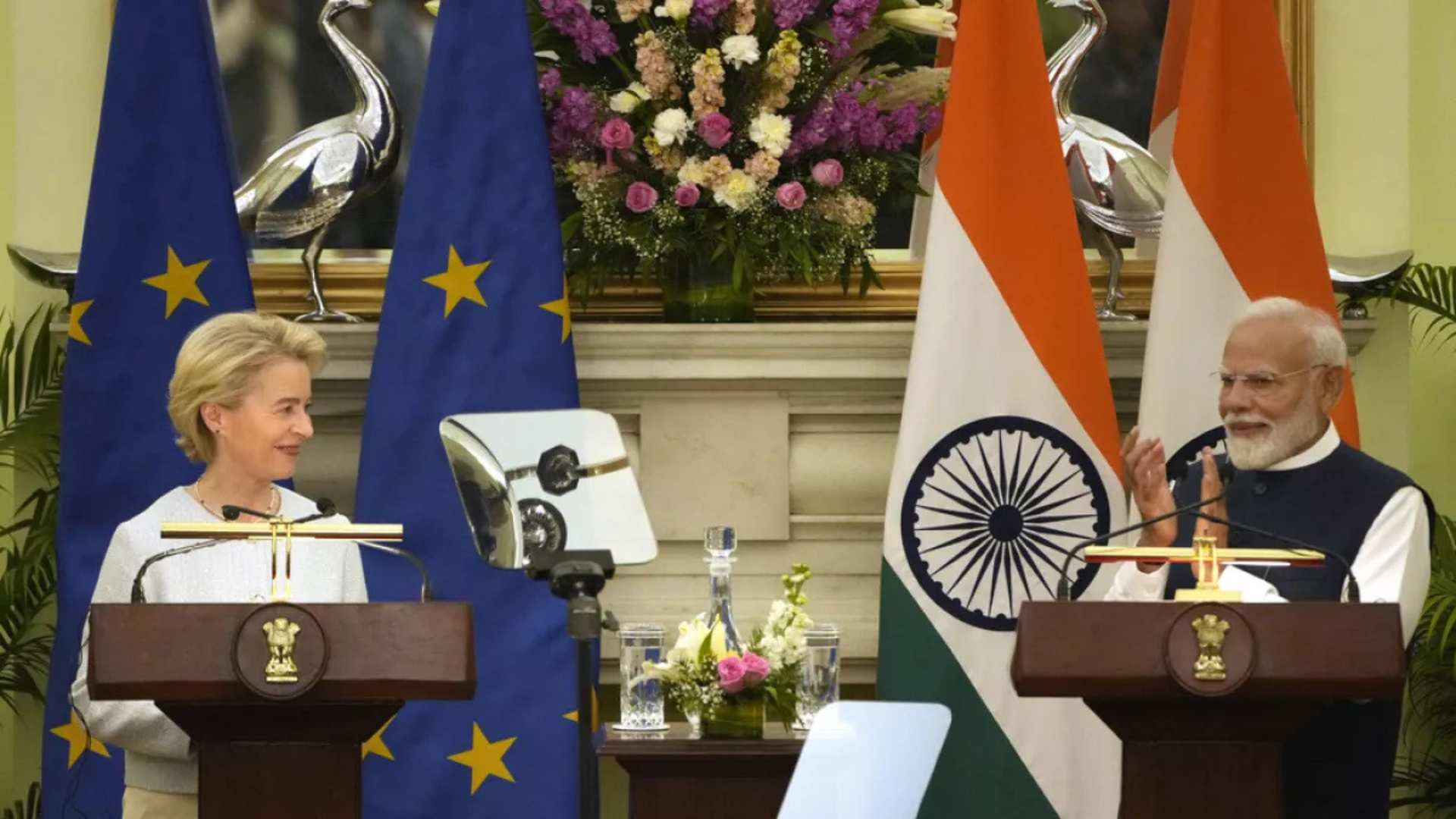
India-EU Trade Deal: A Strategic Turning Point

Exploring how the India-EU trade agreement reshapes international relations and economic stability.
4 mins read
India-EU FTA marks shift from trade deal to strategic alignment
Not Started

1. Context: India-EU Trade Agreement Breakthrough

India and the European Union (EU) concluded a long-elusive trade agreement after nearly 25 years of negotiation, marking a historic commercial and strategic milestone. Beyond tariffs, the deal represents a strategic inflection point in India’s engagement with a bloc that shares democratic values and global influence.

The breakthrough reflects decade-long summit diplomacy, beginning with Prime Minister Modi’s Brussels visit in 2016 and reinforced by the India-EU leaders’ summit in 2021. This high-level engagement facilitated mutual trust, enabling negotiators to navigate domestic protectionist pressures and institutional rigidity in Brussels.

Persistent diplomatic engagement and political capital are essential in achieving complex international agreements, particularly in risk-averse multilateral contexts.


2. Drivers of the Agreement

The India-EU deal is shaped by two key drivers: political and geopolitical. Politically, both sides leveraged leadership-level engagement to overcome domestic and bureaucratic obstacles, with India coordinating with stakeholders to emphasize the EU’s distinct economic partnership compared to China. Geopolitically, the deal is a response to global uncertainty, including U.S. commercial policies under Trump, China’s economic coercion, and Russia’s assertive actions, necessitating stronger partnerships among middle powers.

Impacts:

  • Built mutual political trust and enabled high-stakes compromise.
  • Strengthened India’s global economic positioning relative to China.
  • Signalled a coordinated approach to respond to geopolitical disruptions.

Ignoring the geopolitical dimension in trade negotiations risks agreements that are tactical rather than strategic, limiting long-term impact.


3. Beyond Trade: Strategic Partnership Potential

While the agreement covers tariffs and market access, its significance lies in enabling a broader EU-India strategic alignment across multiple sectors: defence, energy, technology, and mobility.

In defence and security, cooperation can include joint exercises, information sharing, and capacity development, especially in the Indo-Pacific, ensuring maritime stability and freedom of navigation. Energy collaboration aligns Europe’s decarbonisation goals with India’s need for affordable, scalable renewable solutions, including green hydrogen and resilient energy infrastructure.

Impacts:

  • Defence: Institutionalised collaboration beyond ad hoc engagement.
  • Energy: Shared investment in renewable technologies and decarbonisation.

Strategic convergence requires institutionalised engagement across sectors; trade alone cannot cement long-term partnership.


4. Technology and Innovation Cooperation

Technology represents a critical frontier for India-EU collaboration. Fragmentation in global technology governance and rising geopolitical competition demand cooperative frameworks in:

  • Semiconductors
  • Digital public infrastructure
  • Artificial intelligence and data governance

Such cooperation can reduce vulnerabilities, enhance strategic autonomy, and shape global norms that balance innovation with values-based governance. Mobility of students, researchers, and skilled workers is integral to deepening societal and economic ties, enhancing human capital and innovation ecosystems.

Failing to integrate technology and human capital cooperation risks a superficial partnership limited to trade metrics.


5. Implications for International Order

The India-EU trade agreement signals a shift toward multipolarity and the emergence of issue-based coalitions beyond traditional alliance blocs. Coordinated action by India, the EU, and other middle powers can:

  • Strengthen growth and security frameworks in the Indo-Pacific.

  • Offer reliable development partnerships across the Global South.

  • Counterbalance coercive strategies by China and Russia, contributing to international stability.

Comparative perspective:

  • In contrast to tactical trade adjustments, the India-EU alignment reflects durable strategic interests, fostering resilience in a volatile global system.

Ignoring strategic dimensions risks the partnership being reactive rather than proactive in shaping global norms and stability.


6. Way Forward

To translate the economic deal into a durable strategic partnership, India and the EU must:

  • Institutionalise cooperation in defence, energy, and technology.
  • Facilitate mobility of talent to strengthen innovation and societal linkages.
  • Coordinate with middle powers to advance shared democratic values and multipolarity.
  • Ensure the partnership delivers tangible public goods across regions, avoiding dependence solely on external pressures.

The durability of India-EU relations will depend on multi-sectoral engagement and the capacity to integrate political alignment with practical cooperation.


Conclusion

The India-EU trade agreement is both a commercial and strategic milestone, setting the foundation for a broader geopolitical partnership. Sustaining this convergence through defence, energy, technology, and mobility initiatives will help establish interdependence rooted in shared values, contributing to global stability, multipolarity, and resilient international governance.

Quick Q&A

Everything you need to know

Historical and strategic significance: The India-EU trade agreement represents a milestone in a negotiation process that has spanned over 25 years. Beyond the technical breakthrough on tariffs, it signals a strategic inflection point in global geopolitics, particularly as the international order experiences uncertainty and conflict.

Economic and political drivers: The agreement is the product of sustained summit diplomacy, high-level engagement, and mutual political trust, allowing both sides to overcome domestic political obstacles and protectionist impulses. It demonstrates India's emergence as a credible alternative economic partner to China for the EU.

Broader implications: The deal lays the foundation for deeper collaboration in defence, energy, technology, and mobility, moving beyond simple trade to foster multi-sectoral interdependence. By aligning interests in strategic sectors, the agreement strengthens the potential for India-EU partnership to shape regional and global stability.

Political trust between India and the EU was pivotal because it enabled leaders to invest significant personal and political capital in overcoming entrenched domestic and institutional obstacles. India’s engagement with stakeholders domestically, including industries and parliament, helped mitigate protectionist concerns and build momentum for ratification.

On the EU side, coordination between the Commission and the Council provided clear political direction, encouraging bureaucratic negotiators to move beyond rigid FTA templates. This trust was essential to bridging differences over market access, regulatory standards, and tariff reductions, ensuring that compromises were acceptable to both partners.

In essence, political trust allowed sustained dialogue and risk-taking, demonstrating that high-level diplomacy and mutual confidence are key enablers of complex trade agreements, particularly in partnerships involving asymmetrical economies or divergent regulatory philosophies.

Geopolitical drivers: The trade agreement is not just an economic instrument but also a response to global geopolitical turbulence, including U.S. commercial offensives and the strategic assertiveness of China and Russia. By strengthening economic ties, India and the EU seek to diversify dependencies and create a resilient, multipolar framework that counters coercive pressures.

Strategic realignment: The agreement lays a foundation for cooperation in sectors critical to security and technological autonomy, such as defence, maritime stability, and green energy. Enhanced collaboration in these areas signals a shared interest in regional stability across the Indo-Pacific and the Global South, where both India and the EU have growing stakes.

Soft power and norms: Beyond trade and security, the agreement allows India and the EU to project common values of openness, resilience, and democracy in global governance. It exemplifies how economic agreements can simultaneously serve as instruments of strategic realignment, reducing vulnerabilities and increasing influence in a complex international order.

Summit diplomacy and sustained engagement: High-level meetings, including Modi’s visit to Brussels in 2016 and the India-EU leaders’ summit in 2021, enabled frank exchanges and mutual understanding. These interactions built trust and facilitated risk-taking in negotiations.

Domestic preparation and stakeholder management: India leveraged previous FTA experience with countries like the UK and Australia to anticipate roadblocks and generate industry support. The EU provided political direction through coordination between the Commission and the Council, enabling negotiators to move beyond conventional FTA frameworks.

Geopolitical urgency: The destabilizing effects of U.S. trade policies and Chinese economic assertiveness created urgency for both partners to diversify trade and strengthen strategic ties. The combination of political, economic, and geopolitical incentives ultimately catalyzed the breakthrough.

Defence and security: Joint military exercises, maritime stability initiatives, and capacity-building programs in the Indo-Pacific could institutionalize security collaboration.

Energy and climate: Cooperation on renewable technologies, green hydrogen, and resilient energy infrastructure aligns European decarbonization goals with India’s energy affordability needs.

Technology: Collaboration on semiconductors, AI, digital governance, and public infrastructure enhances mutual technological autonomy while shaping global standards.

Mobility and human capital: Facilitating student, researcher, and skilled worker mobility strengthens innovation ecosystems and people-to-people ties, translating strategic alignment into societal and economic depth.

Sectoral coordination challenges: Expanding cooperation to defence, energy, and technology requires harmonization of regulatory frameworks, standards, and industrial policies, which may encounter bureaucratic resistance or differing domestic priorities.

Geopolitical pressures: Both India and the EU must navigate external pressures, such as China’s economic assertiveness, U.S. trade policy shifts, and regional conflicts, which could divert attention or create tensions in strategic alignment.

Implementation and domestic buy-in: Ensuring that the benefits of the agreement reach relevant stakeholders, industries, and citizens is critical. Protectionist impulses, political opposition, or slow legislative ratification could stall deeper strategic cooperation. Without rapid follow-through in multi-sectoral initiatives, the partnership risks remaining a tactical adjustment rather than a durable strategic realignment.

The India-EU agreement exemplifies how sustained, high-level diplomacy over decades can overcome persistent obstacles. Starting with Modi’s 2016 Brussels visit and continuing with regular summits, leaders invested time, trust, and political capital to cultivate mutual understanding. This long-term engagement allowed negotiators to tackle complex issues, including market access, regulatory alignment, and tariff reductions.

The case demonstrates that strategic patience, institutional continuity, and domestic stakeholder engagement are essential to translating negotiations into tangible agreements. By coordinating with industry, bureaucracies, and political actors, both India and the EU managed to overcome internal opposition and external uncertainties.

Ultimately, the agreement highlights that durable economic outcomes in international relations often require more than transactional negotiations; they demand a long-term, strategic vision aligned with geopolitical realities and mutual trust.

Attribution

Original content sources and authors

Sign in to track your reading progress

Comments (0)

Please sign in to comment

No comments yet. Be the first to comment!