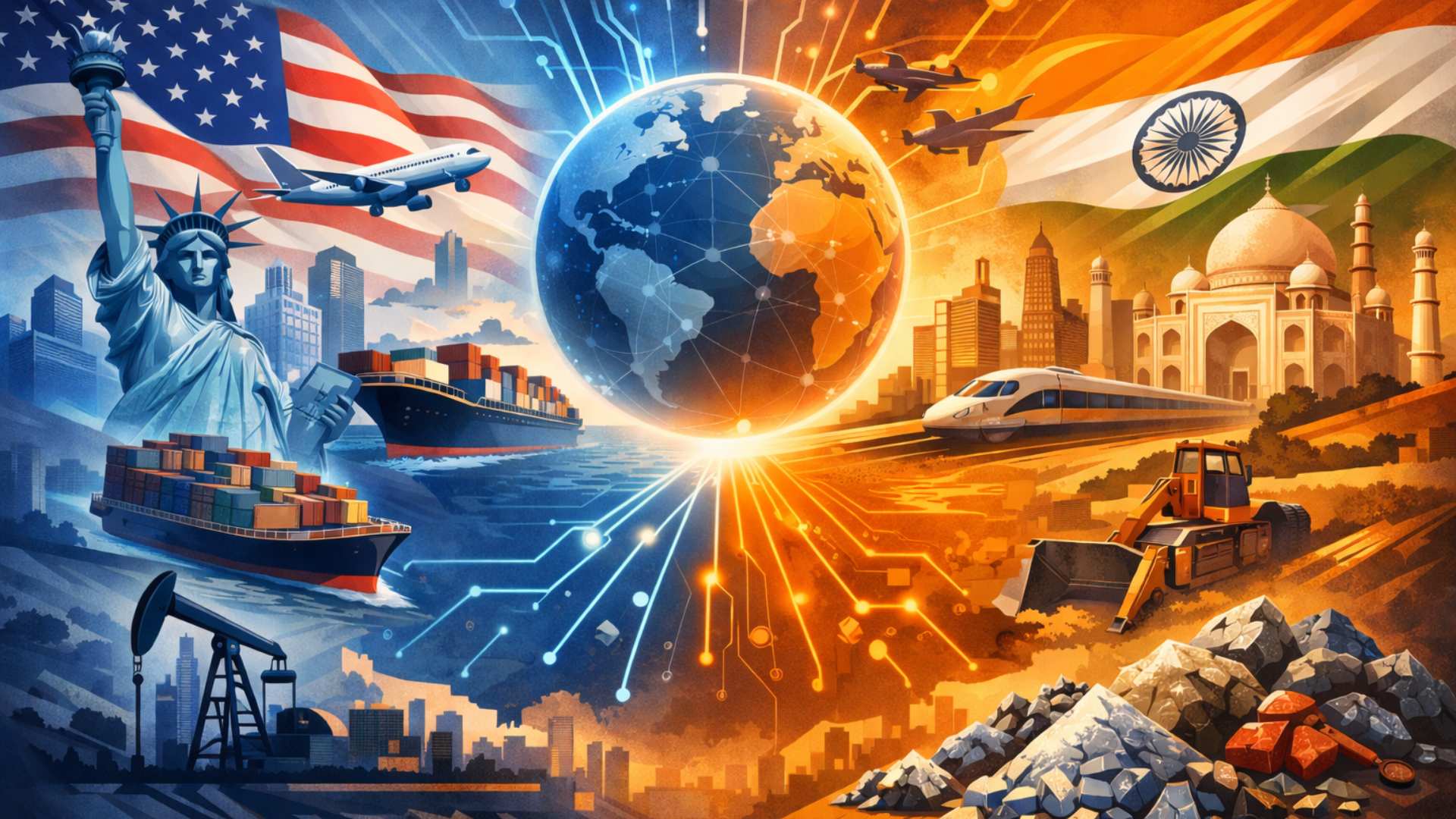
1. Context: India–US Interim Trade Framework and Strategic Reset
India’s interim trade agreement framework with the United States marks an attempt to stabilise bilateral economic relations after nearly 12 months of uncertainty. It coincides with Washington’s invitation to New Delhi to join the Pax Silica initiative, aimed at securing critical mineral and technology supply chains in the Indo-Pacific.
This convergence reflects the US intent to reposition India as a central pillar in its Indo-Pacific strategy, particularly as global supply chains seek to reduce dependence on China. For India, the framework offers an opportunity to enhance strategic relevance while diversifying access to minerals, energy, and advanced technology.
However, the agreement also raises concerns about India’s long-term commitments, particularly the proposed plan to purchase $500 billion worth of US goods over five years. Questions over feasibility, trade balance impacts, and strategic autonomy have emerged in domestic policy debates.
If not carefully calibrated, such frameworks risk converting strategic partnerships into asymmetric economic dependencies.
Trade agreements increasingly function as instruments of geopolitics; ignoring this linkage can constrain policy flexibility.
2. Issue: Strategic Autonomy vs Deepening Economic Alignment
Observers have flagged that large-scale import commitments — 45 billion trade surplus with the US. Political parties and trade experts have questioned whether this surplus could erode.
A more sensitive concern relates to energy security. The possibility that India may be pressured to halt oil imports from Russia has triggered debate on whether economic incentives are being used to influence sovereign foreign policy choices.
US actions — including the rollback of a 25% tariff on Indian imports linked to reduced Russian oil purchases — signal a shift where energy sourcing is treated as a geopolitical signal rather than a commercial decision.
If strategic autonomy is compromised, India risks narrowing its foreign policy options in a volatile global order.
Autonomy is not isolation; it is the capacity to choose without coercive economic pressure.
3. Context: Energy Security and Diversification Strategy
India’s official position, reiterated by the Ministry of External Affairs, places energy security of 1.4 billion people as the supreme national priority. Diversification, rather than substitution, remains the guiding principle.
While cheaper Russian oil once yielded significant gains, these benefits have declined. According to estimates cited, the price differential has narrowed from 5, reducing annual savings from 1 billion.
India has also kept channels open with other suppliers, including Venezuela, from which oil was purchased in 2019–20 and 2023–24. Recent reports indicate purchases of 2 million barrels of Venezuelan crude by Indian firms.
Ignoring diversification imperatives could expose India to supply shocks and political conditionalities.
Energy policy becomes strategic when markets intersect with diplomacy.
4. Pax Silica and Critical Minerals: Strategic Implications
The Pax Silica initiative, launched in December, focuses on securing supply chains for critical minerals and advanced manufacturing inputs. Although India was not an original signatory, the US has explicitly invited India to participate.
US officials have highlighted India’s large mining and processing base and its unmatched human capital, positioning it as the only plausible peer competitor to China in scale. Participation could reduce India’s dependence on China for coking coal, high-end technology, and critical minerals.
India’s engagement aligns with its broader objective of becoming a reliable node in trusted global supply chains. However, integration must preserve policy space and domestic industrial priorities.
Impacts:
- Reduced dependence on China for strategic inputs
- Enhanced role in Indo-Pacific supply chain architecture
- Greater scrutiny of domestic mining and processing capacity
Supply chain security is the new frontier of national security.
5. Challenges: Trade, Technology, and Geopolitical Trade-offs
Despite optimism, unresolved issues persist. Concerns include closer US–Pakistan ties, continued restrictions on H-1B visas, and India’s hesitation in hosting the Quad Summit, which was postponed last year.
These factors indicate that strategic convergence with the US does not automatically translate into alignment across all domains. Conditionality embedded in trade incentives also creates monitoring pressures on India’s policy choices.
Failure to address these frictions could limit the long-term credibility of the partnership.
Challenges:
- Risk of trade imbalance from large import commitments
- Strategic conditionality linked to energy choices
- Unresolved people-to-people mobility issues
Partnerships endure when interests converge without coercion.
6. Way Forward: Calibrated Engagement with Strategic Prudence
India’s path forward lies in maintaining issue-based alignment rather than bloc-based loyalty. Trade commitments must remain flexible, framed as intent rather than binding pledges.
Participation in initiatives like Pax Silica should be leveraged to strengthen domestic manufacturing, mineral processing, and technological capabilities. At the same time, India must continue diversifying energy sources to avoid vulnerability to geopolitical leverage.
A balanced approach allows India to extract strategic value from partnerships while preserving decision-making autonomy.
Strategic autonomy today lies not in non-alignment, but in multi-alignment with safeguards.
Conclusion
India’s interim trade framework with the US and engagement with initiatives like Pax Silica signal a recalibration of strategic and economic priorities. While these steps can enhance India’s Indo-Pacific relevance and reduce dependence on China, sustaining strategic autonomy will depend on cautious commitments, diversified energy sourcing, and balanced diplomacy. Long-term gains will flow from alignment that strengthens, rather than constrains, sovereign policy choices.