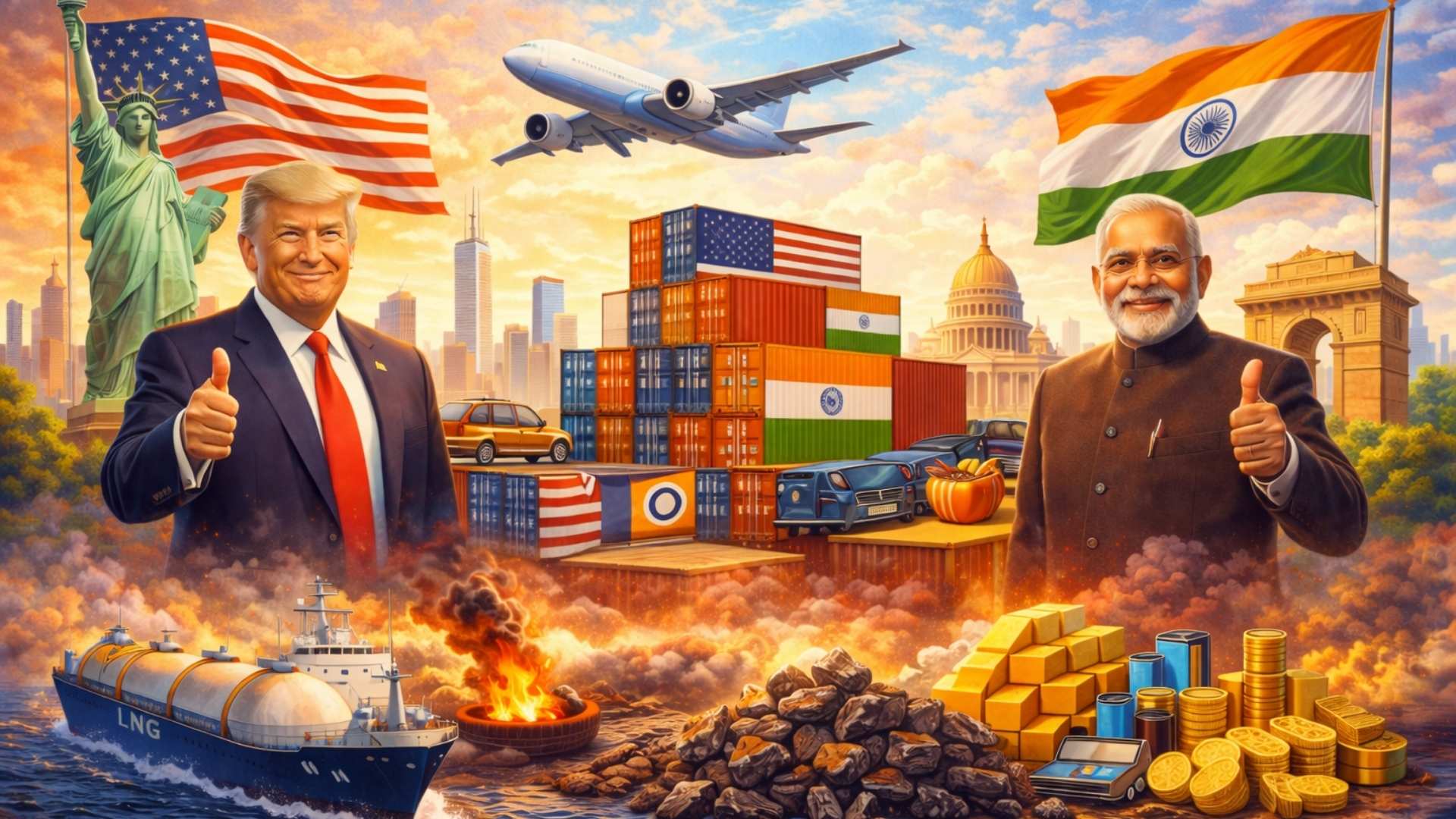
1. Context: India–US Trade Talks and the $500 Billion Projection
The proposed India–US free trade agreement (FTA) remains under negotiation, yet public discourse has prematurely linked its outcome to a headline figure of $500 billion in Indian purchases from the US over five years. This linkage emerged from a statement by US President Donald Trump, lending political visibility to what is essentially an aspirational economic projection.
The February 7 joint statement clarified that India intends to purchase US goods including energy products, aircraft, technology products, precious metals, and coking coal. The language is indicative rather than contractual, reflecting diplomatic signalling rather than enforceable commitments.
Such projections matter for governance because they shape expectations of trade policy, negotiating leverage, and domestic debates on economic sovereignty. Treating aspirational figures as firm obligations risks misalignment between diplomacy and economic capacity.
This highlights the governance logic that trade agreements function best when political ambition is tempered by economic realism; ignoring this balance can constrain policy autonomy and credibility.
2. Energy at the Core of the Challenge
Energy products appear first in the proposed $500 billion basket, making them central to feasibility. These include crude oil, LPG, and LNG, which are critical inputs for transport, industry, and household energy consumption.
India is structurally dependent on energy imports, sourcing 90% of crude oil, 60% of LPG, and over 50% of LNG from abroad. In FY2025, these three products together constituted 22% of India’s total imports by value, amounting to around $175 billion.
However, India’s energy imports are deliberately diversified, with primary sourcing from West Asia and Russia. This diversification underpins energy security and price stability, making large-scale redirection towards any single supplier complex.
The development logic is that energy security depends on diversification and affordability; disregarding this can expose the economy to price shocks and supply disruptions.
3. Scale Mismatch in India–US Energy Trade
Despite political emphasis, the US currently plays a limited role in India’s energy import basket. In FY25, the US exported just over $12 billion worth of energy products to India, including coking and steam coal.
Petroleum fuels from the US were valued at around **500 billion target through energy trade.
Key statistics:
- Energy imports by India in FY25: $175 billion
- US energy exports to India in FY25: ~$12 billion
- US share of India’s petroleum imports (value): 5%
The governance takeaway is that numerical targets detached from baseline trade realities risk distorting policy priorities and expectations.
4. Aspirational Nature of the $500 Billion Target
The joint statement does not provide a sectoral breakup of the $500 billion figure. Even if 20% of this target were to come from energy products, India would need to raise US energy imports nearly eight-fold within five years, according to officials from Gail Ltd and Petronet LNG Ltd.
This challenge is amplified by global conditions of ample supply and moderating oil and gas prices, which intensify competition among exporters rather than encourage buyer lock-in.
“Analysts would be wise to ignore some of the numbers in the deal, or at least treat them as aspirational.” — Evan Feigenbaum, Carnegie Endowment for International Peace
The policy logic is that aspirational targets can guide intent but should not substitute for market-driven outcomes; failure to recognise this may lead to diplomatic friction.
5. Broader Trade Expansion Requirement
Meeting the 41.5 billion**, while services exports were $41.8 billion.
This implies a dramatic acceleration across multiple sectors, not just energy. However, such rapid scaling is constrained by domestic demand patterns, pricing competitiveness, and institutional procurement norms.
From a governance perspective, sustainable trade growth depends on incremental market integration rather than abrupt numerical escalation.
6. Pricing Dynamics and Competitive Constraints
Energy trade differs from sectors like civil aviation, where supplier concentration limits buyer choice. Petroleum and LNG markets are highly competitive, with India sourcing crude from over 40 countries and LNG from over 10 countries.
India’s sharp increase in Russian crude imports—from ~50 billion in FY25—was enabled by discounts exceeding $10 per barrel, a pricing advantage US suppliers cannot match.
Comparative sourcing realities:
- Russian crude imports FY25: >$50 billion
- Discount-driven price advantage: >$10/barrel
- US crude purchases FY25: $6.5 billion (+30% YoY)
The development logic is that competitive pricing safeguards affordability and industrial competitiveness; ignoring price signals can raise systemic energy costs.
7. LNG Economics and the Henry Hub Constraint
US LNG contracts are largely indexed to the Henry Hub (HH) benchmark. While attractive during periods of low HH prices, recent winter spikes to over $50 per million Btu have eroded their appeal for Indian buyers.
Indian public sector companies have emphasised that LNG prices must remain below $9 per million Btu for demand to scale. At current HH-linked costs, delivered US LNG exceeds this threshold, prompting a reassessment of contracts.
LNG-related data:
- US LNG share in India’s imports (2025): 12% (down from 19% in 2024)
- Long-term US LNG contracts held by Gail: 5.8 million tonnes
- Affordability threshold cited by PSUs: <$9 per million Btu
The governance implication is that energy transition and access depend on affordability; ignoring cost structures can slow industrial growth and energy adoption.
8. Diversification Strategy and Alternative Suppliers
India continues to deepen ties with alternative energy suppliers. Brazil and Colombia have emerged as new crude sources, with Brazilian supplies tripling year-on-year. In LNG, the UAE supplies nearly 20% of its output to India.
India has also secured long-term LNG through equity participation in Mozambique LNG, where Indian PSUs hold a 30% stake, offering a geographically closer and potentially cheaper source.
This reflects the strategic logic that diversified sourcing enhances resilience and bargaining power in global energy markets.
9. Institutional Constraints and Import Governance
State-run oil companies operate under strict procurement and oversight rules that prohibit preferential sourcing unless explicitly mandated. As a result, imports fluctuate with market conditions rather than diplomatic signalling.
US crude shipments illustrate this volatility, rising to 319,000 bpd in 2025 (6.5% share) but declining sharply in early 2026.
Shipment trends:
- Peak US crude imports (2021): 415,000 bpd (10% share)
- Average Dec 2025–Jan 2026: 180,000 bpd
- Early 2026 decline: –18% vs 2025
The governance logic is that institutional safeguards preserve transparency and efficiency; weakening them risks fiscal and operational inefficiencies.
Conclusion
The proposed $500 billion India–US trade projection reflects strategic ambition but faces structural, pricing, and institutional constraints, particularly in energy trade. India’s emphasis on diversification, affordability, and market-based procurement limits rapid scaling of US energy imports. Going forward, aligning diplomatic ambition with economic feasibility will be essential to deepen India–US ties while safeguarding energy security, fiscal prudence, and strategic autonomy.