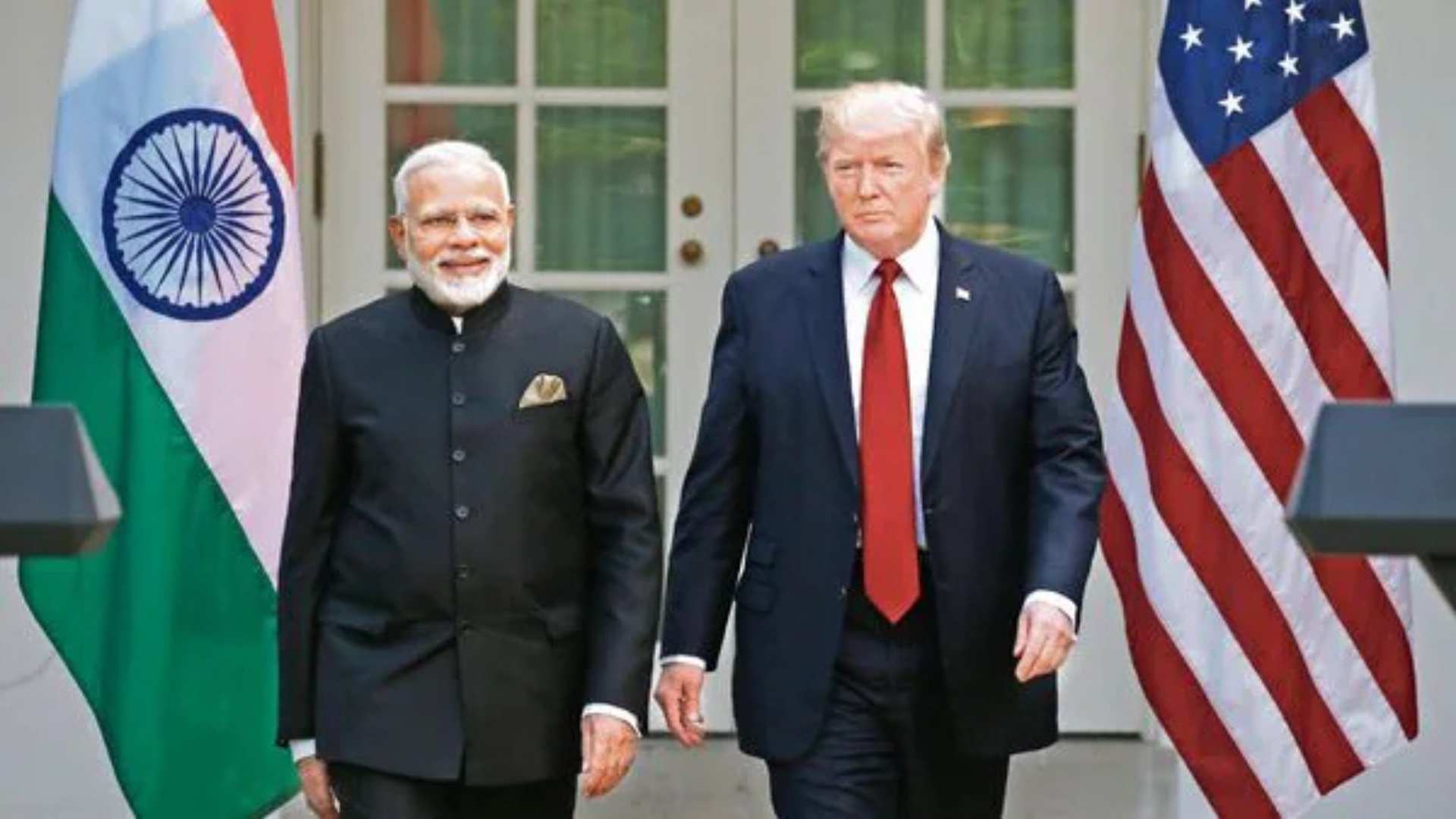
1. Context: Political Economy of the India–US Trade Agreement
The recent India–US trade agreement has generated domestic political criticism. Concerns range from alleged “surrender” of national interest to fears of compromised strategic autonomy, particularly regarding commitments affecting Russian oil purchases and agricultural tariffs.
Such reactions reflect a long-standing mercantilist mindset in trade debates, where exports are perceived as gains and imports as concessions. However, modern trade economics views imports not as a loss but as access to better inputs, technology, and consumer goods that enhance productivity and welfare.
The agreement is described as an “interim” arrangement, emphasising intent rather than legally binding obligations. While it signals deeper integration with advanced economies, it also raises questions about implementation capacity and consistency with India’s multilateral stance at the World Trade Organization (WTO).
“The division of labour is limited by the extent of the market.” — Adam Smith, The Wealth of Nations
Trade agreements expand markets and access to inputs. If policy remains constrained by mercantilist thinking, India risks limiting productivity growth and global supply chain integration.
2. Rethinking Trade: Imports, Productivity and Growth
The central economic argument advanced is that the true gains from trade lie in access to imports and improvements in firm-level productivity. High tariffs on intermediate goods and machinery increase production costs for domestic firms, thereby reducing competitiveness.
By protecting inefficient sectors through tariffs, the economy imposes implicit costs on more efficient sectors. The commitment to eliminate or reduce tariffs on US industrial goods can lower landed costs for Indian manufacturers importing high-tech machinery and intermediate inputs.
The Lerner Symmetry Theorem reinforces this logic: a tax on imports is effectively a tax on exports. Therefore, reducing import barriers enhances export competitiveness by lowering input costs and improving efficiency.
“The gains from trade arise from specialization and the division of labour.” — Paul Samuelson
Lowering tariffs reallocates labour and capital from protected, low-productivity sectors to competitive ones. Without such reallocation, India may remain trapped in a high-cost, low-competitiveness equilibrium.
3. Food Tariffs, Distributional Effects and Welfare
Tariffs on food function as regressive taxes, disproportionately affecting poorer households who are net buyers of food. While food protection may benefit large land-owning farmers, it raises consumer prices for urban and rural poor populations.
This raises a political economy question: how should policymakers balance the interests of land-owning farmers against food security and affordability for the broader population?
The positive externalities of improved nutrition among the poor—better health, productivity, and human capital formation—strengthen the case for lowering food trade barriers.
If tariff policy prioritises producer interests without accounting for consumer welfare, particularly of the poor, it may undermine inclusive growth and nutritional outcomes.
4. Bilateral Liberalisation vs Multilateral Inconsistency
India has signed or is negotiating trade agreements with the US, European Union (EU), and United Kingdom (UK), reflecting a shift toward bilateral liberalisation. However, this appears inconsistent with India’s stance at the WTO.
For instance:
- India has blocked the WTO Agreement on Investment Facilitation for Development (IFD), which seeks to streamline investment procedures.
- India opposes making permanent the moratorium on customs duties on electronic transmissions.
At the same time, India seeks to attract foreign capital and technology and has signalled intent to purchase $500 billion in US goods over five years, including energy, aircraft, and technology products.
This divergence between bilateral openness and multilateral resistance creates policy incoherence.
“Consistency is the virtue of small minds.” — Ralph Waldo Emerson
While flexibility in diplomacy is necessary, excessive inconsistency may undermine credibility in global trade negotiations.
If India promotes investment and digital trade bilaterally but blocks facilitation multilaterally, it risks weakening its negotiating credibility and long-term integration into global trade regimes.
5. Digital Trade, Non-Tariff Barriers and Regulatory Reform
Modern trade agreements increasingly focus on non-tariff barriers (NTBs), regulatory harmonisation, and digital trade rules. The India–US agreement currently provides only for a “six-month review” of standards in sectors such as medical devices and information and communication technology (ICT).
However, non-tariff measures often act as de facto protectionism. Testing requirements, certification procedures, and regulatory discretion can create significant friction even when tariffs are low.
Similarly, digital trade provisions remain non-binding. India has committed to negotiate rules but has not agreed to binding commitments on:
- Cross-border data flows
- Prohibition of mandatory source code disclosure
In advanced agreements such as the US-Mexico-Canada Agreement (USMCA), these are standard provisions.
Without binding digital trade and regulatory harmonisation clauses, bilateral cooperation may remain vulnerable to domestic policy shifts and retaliatory trade actions.
6. Rules of Origin and State Capacity
As global supply chains adjust and decouple from China, rules of origin (RoO) enforcement will intensify. The US may demand stringent verification to prevent transshipment or indirect routing of goods.
This will require Indian firms to comply with higher transparency standards. Effective implementation demands strong administrative capacity to avoid delays, corruption, and regulatory overreach.
There is a risk that complex verification processes could degenerate into a new form of “inspector raj,” increasing compliance costs and reducing competitiveness.
Trade liberalisation without administrative reform can create implementation bottlenecks. State capacity is essential to ensure that compliance mechanisms do not become protectionist tools.
7. Strategic Autonomy and Energy Trade
Concerns have been raised that commitments under the agreement may affect India’s purchases of Russian oil, raising questions of strategic autonomy (GS2 & IR).
However, trade diversification can also enhance strategic flexibility by reducing dependence on any single supplier. The broader issue is not whether India trades with one country or another, but whether its trade architecture supports resilience and growth.
The commitment to purchase $500 billion in US goods over five years raises concerns about centralised targets. Governments do not directly purchase most goods; firms do. Excessive state direction may echo earlier planning-era approaches.
Strategic autonomy in a globalised economy depends on diversified economic relationships and competitive domestic firms. Over-centralisation or politicisation of trade flows may weaken market efficiency.
8. Deep Trade Agreements and Policy Modernisation
The cumulative effect of trade agreements with the US, EU, and UK could mark a new wave of Indian liberalisation. However, to qualify as “deep trade agreements,” they must go beyond tariff cuts and address structural reforms.
The document of the United States Trade Representative (USTR) on Indian trade barriers highlights areas of protectionism and regulatory friction. Rather than viewing it defensively, it can serve as a roadmap for modernising Indian trade policy.
Reforms in trade policy can yield dual benefits:
- Reduced trade friction with major partners
- Higher long-term GDP growth through productivity gains
“Trade policy is growth policy.” — Jagdish Bhagwati
Modernising trade policy enhances competitiveness and integration into global value chains. If reform momentum stalls, India risks missing supply chain reconfiguration opportunities.
Conclusion
The India–US trade agreement represents a shift toward liberalisation focused on productivity gains, input cost reduction, and deeper integration into global supply chains. Political criticism reflects distributional concerns and strategic anxieties, but economic theory suggests that import liberalisation can strengthen export competitiveness and growth.
The key challenge lies in ensuring policy coherence across bilateral and multilateral platforms, strengthening state capacity for implementation, and embedding binding commitments on digital trade and regulatory harmonisation.
If approached strategically, this agreement—alongside those with the EU and UK—can lay the foundation for sustained GDP growth, enhanced competitiveness, and a more sophisticated trade policy architecture aligned with India’s long-term developmental objectives.