GS2 Bilateral Relations

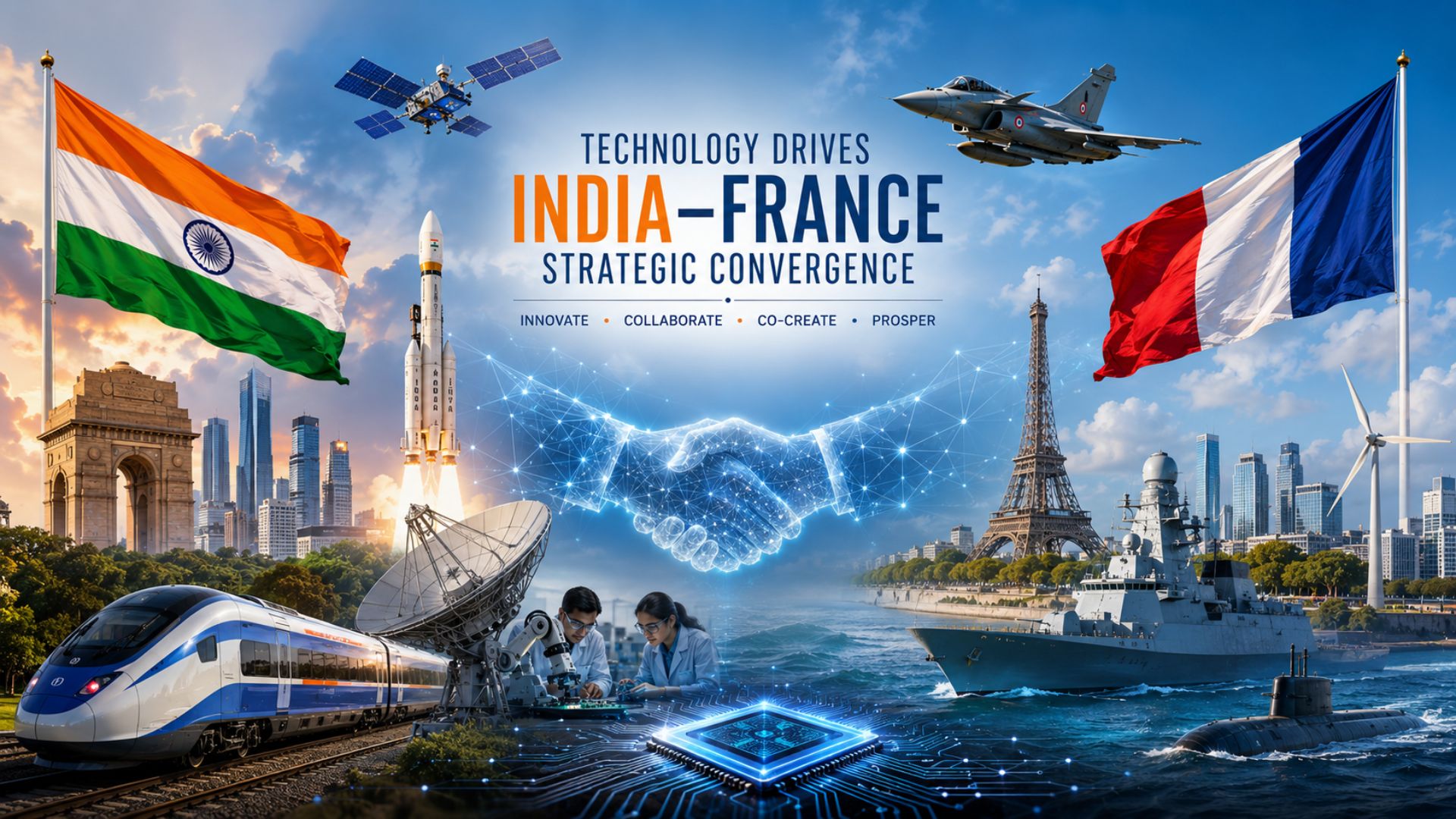
India-France ties deepen through innovation and technology.

Technology as a Catalyst in India-France Strategic Relations

Exploring how technology and innovation are shaping the future of India-France ties in a rapidly changing global landscape
Dhinesh Balasubramanian Dhinesh Balasubramanian
4 mins read

Prime Minister Narendra Modi and French President Emmanuel Macron met in France on the sidelines of the G-7 Summit (Evian, June 15–17, 2026), only months after Mr. Macron's visit to India for the India AI Impact Summit 2026 in New Delhi.

The rapid succession of high-level engagements reflects the importance both leaders attach to the India–France relationship and their commitment to translating diplomatic initiatives into concrete outcomes.


A Fast-Evolving Strategic Partnership

During President Macron's February 2026 visit, the two leaders jointly inaugurated the India–France Year of Innovation 2026.

In a notable departure from the slow pace often associated with diplomatic initiatives, both countries have quickly moved to operationalize technology cooperation.

Recent Initiatives

InitiativeSignificance
India–France Year of Innovation 2026Framework for innovation cooperation
"Bharat Innovates" (Nice, June 14–16)Connects Indian start-ups and venture capital funds
VivaTech Summit (Paris, June 18)Europe's largest technology and start-up event
India AI Impact Summit 2026Expanded cooperation in emerging technologies

The emphasis is increasingly shifting from traditional strategic cooperation to innovation-led collaboration.


New Pillars of the Partnership

India and France recently elevated their ties to a Special Global Strategic Partnership.

Traditional Areas of Cooperation

  • Defence
  • Civil Nuclear Energy
  • Space Cooperation

Emerging Areas of Cooperation

SectorPotential Areas
Artificial IntelligenceResearch, applications, governance
CyberspaceDigital security and resilience
HealthcareBiotechnology and innovation
Education & ResearchAcademic partnerships
Creative EconomyDigital and cultural industries
Sustainable DevelopmentClimate and green technologies
RoboticsIndustrial and defence applications

These new sectors are expected to drive the next phase of bilateral relations.


Why Technology Cooperation Matters

France's Strengths

France possesses advanced capabilities in:

  • Aerospace
  • Artificial Intelligence
  • Robotics
  • Biotechnology
  • Healthcare innovation
  • Green technology
  • Sustainable development
  • Digital economy

India's Strengths

India contributes:

  • Frugal innovation
  • Start-up ecosystem
  • Digital Public Infrastructure (DPI)
  • Biotechnology expertise
  • Large technology talent pool
France
(Advanced Technology)
          +
India
(Innovation + Scale)
          ↓
Co-development
          ↓
Technology Partnership
          ↓
Shared Economic Growth

The expectation is that events such as Bharat Innovates and VivaTech will generate substantive private-sector collaborations.


Strategic Cooperation Beyond Technology

The two leaders are also expected to review progress in traditional strategic sectors.

Defence Cooperation

A major priority is:

  • Co-design and co-production of defence platforms.

This aligns with India's emphasis on defence indigenization and strategic autonomy.

Emerging Strategic Areas

  • Small Modular Reactors (SMRs)
  • Joint satellite development
  • Human spaceflight programmes

These areas represent the next frontier of bilateral cooperation.


The Africa Dimension

India and France have considerable but underutilized potential for cooperation in Africa.

Why Africa Matters?

  • Development partnerships
  • Capacity building
  • Infrastructure projects
  • Maritime security
  • Energy cooperation

The issue gains greater significance following the postponement of the India–Africa Forum Summit (May 2026) due to the Ebola outbreak in Africa.

Both countries may explore new avenues for joint engagement on the continent.


Convergence on Global Issues

The two leaders are expected to exchange views on major international conflicts, including:

  • Ukraine conflict
  • Iran conflict

These crises have disproportionately affected countries of the Global South through:

  • Energy insecurity
  • Supply-chain disruptions
  • Food inflation
  • Economic uncertainty

Both India and France seek to contribute to geopolitical stability amid growing global turbulence.


G-7 Summit and the Emerging D10 Debate

France, as the current G-7 Chair, is hosting the summit in Evian.

India's repeated invitations to the G-7 underline its growing global importance.

Emerging Discussion: Expansion of G-7

Recent debates have revived the idea of transforming the G-7 into a:

D10 (Democracy 10)

Potentially involving:

  • Existing G-7 members
  • Additional major democratic powers

While such a transformation remains uncertain, it is a development India will need to monitor closely.

G-7
   ↓
Discussion on Expansion
   ↓
Possible D10 Framework
   ↓
Greater Role for Major Democracies
   ↓
Implications for Global Governance

Strategic Autonomy and the Multipolar World

A key feature of India–France relations is their shared commitment to:

  • Strategic autonomy
  • Independent foreign policy
  • Multipolar world order

Both countries are often described as influential middle powers capable of balancing competing geopolitical interests.

Shared Objectives

  • Strengthening global stability
  • Reforming global governance
  • Promoting strategic balance
  • Supporting multipolarity

India and France increasingly see themselves as partners in managing global transitions rather than merely bilateral stakeholders.


Way Forward

  • Accelerate technology and innovation partnerships.
  • Expand defence co-design and co-production initiatives.
  • Deepen cooperation in AI, cybersecurity, and space technologies.
  • Promote joint start-up and venture capital ecosystems.
  • Enhance collaboration in Africa.
  • Advance cooperation in clean energy and SMRs.
  • Coordinate on global governance reforms and multipolarity.

Conclusion

The India–France relationship is evolving from a traditional strategic partnership centered on defence, nuclear energy, and space into a broader technology-driven collaboration. With growing convergence on innovation, strategic autonomy, Africa, emerging technologies, and global governance, both countries are positioning themselves as important partners in shaping a stable and multipolar international order.

Attribution

Original content sources and authors
Mohan Kumar Author Mohan Kumar The Hindu Source The Hindu

Syllabus classification

How this article maps to GS papers

Main syllabus

GS2Bilateral Relations

Quick Q&A

What are the emerging dimensions of the India-France Special Global Strategic Partnership and why are they significant in the contemporary world order?
The India-France Special Global Strategic Partnership represents one of India's most stable and multifaceted bilateral relationships. Traditionally, cooperation focused on defence, civil nuclear energy and space collaboration, but in recent years the partnership has expanded into new domains such as Artificial Intelligence, cyberspace, healthcare, education, biotechnology, sustainable development and the digital economy. In February 2026, Prime Minister Narendra Modi and President Emmanuel Macron inaugurated the India-France Year of Innovation 2026, followed by the Bharat Innovates event in Nice and participation in the VivaTech Summit in Paris, reflecting the growing importance of technology diplomacy. France is a leader in aerospace, robotics, green technology and advanced manufacturing, while India contributes strengths in digital public infrastructure, start-ups and frugal innovation. This complementary relationship provides mutual economic and strategic benefits. Historically, France has supported India's strategic autonomy and maintained independent positions on several international issues. Major examples include cooperation on the Rafale fighter aircraft, Scorpene submarines and the International Solar Alliance launched in 2015. For UPSC aspirants, this topic is relevant to GS Paper II on international relations and GS Paper III on science and technology. The partnership also illustrates the emergence of middle powers in shaping a multipolar world. Analysts view India-France ties as an example of balanced diplomacy that combines strategic interests with technological collaboration. As geopolitical uncertainties increase, the evolving partnership is expected to contribute to global stability and strengthen India's engagement with Europe.
Why is technology and innovation becoming a central pillar of India-France relations in the twenty-first century?
Technology and innovation have emerged as central pillars of India-France relations because both countries recognize that future economic growth, strategic competitiveness and geopolitical influence will increasingly depend on technological capabilities. While defence and nuclear cooperation have traditionally defined bilateral ties, recent initiatives indicate a shift toward knowledge-driven sectors. The India-France Year of Innovation 2026 and events such as Bharat Innovates and VivaTech highlight this transition. France possesses advanced expertise in aerospace, artificial intelligence, robotics, biotechnology, healthcare and green technologies. India, meanwhile, has developed strengths in digital public infrastructure, software services, start-up ecosystems and cost-effective innovation. The combination creates opportunities for mutually beneficial partnerships. This cooperation supports India's objectives under Atmanirbhar Bharat, Digital India and Startup India. It also helps diversify India's technological partnerships beyond traditional powers. From France's perspective, engagement with India provides access to one of the world's largest markets and a rapidly expanding innovation ecosystem. Such cooperation has implications for employment generation, industrial competitiveness and sustainable development. It also contributes to global challenges such as climate change, cybersecurity and healthcare resilience. For UPSC preparation, this topic is linked to GS Paper II and GS Paper III, particularly science and technology, international relations and economic development. There are debates regarding technology transfer, intellectual property rights and strategic dependencies. Nevertheless, most experts agree that technological cooperation represents a defining feature of twenty-first century diplomacy. The India-France experience demonstrates how bilateral relations are increasingly shaped by innovation ecosystems rather than merely traditional security concerns.
How can defence, space and emerging technologies strengthen the strategic partnership between India and France in the coming decades?
Defence, space and emerging technologies are likely to remain the backbone of the India-France strategic partnership. France has long been one of India's most reliable defence partners. Cooperation has included the acquisition of Rafale fighter aircraft and Scorpene-class submarines, along with regular naval exercises such as Varuna. The current emphasis, however, is shifting from simple procurement to co-design and co-production of defence platforms. Such collaboration aligns with India's Make in India and Atmanirbhar Bharat initiatives. In the space sector, the two countries have cooperated through ISRO and CNES for decades. Future areas include joint satellite development and human spaceflight programmes. Another promising area is small modular reactors, which are considered important for achieving clean energy goals and supporting energy security. Emerging technologies such as artificial intelligence, quantum computing, biotechnology and cybersecurity are also becoming critical domains of cooperation. These technologies have applications not only in civilian sectors but also in defence and strategic industries. Collaboration in these areas can enhance innovation, create employment and improve technological self-reliance. From a geopolitical perspective, deeper cooperation strengthens India's engagement with Europe and contributes to balancing power equations in the Indo-Pacific. For UPSC aspirants, the issue connects with GS Paper II and GS Paper III themes relating to defence modernization, science and technology and international relations. Some challenges include technology transfer restrictions, funding constraints and regulatory issues. Nevertheless, the partnership offers a model of strategic cooperation based on shared interests and strategic autonomy.
What lessons can be drawn from India-France cooperation as a case study of strategic autonomy and middle-power diplomacy?
India and France provide an important case study of middle-power diplomacy and strategic autonomy in an increasingly fragmented international system. Both countries have historically emphasized independent foreign policies and resisted excessive alignment with competing power blocs. France under Charles de Gaulle pursued strategic autonomy within the Western alliance, while India traditionally followed the principles of non-alignment and strategic independence. Their convergence has produced a relationship based on mutual respect and shared geopolitical objectives. Over the years, the partnership has expanded beyond defence cooperation to include nuclear energy, space, climate action and technological innovation. One notable example is the International Solar Alliance launched in 2015 by Prime Minister Narendra Modi and President Emmanuel Macron. The initiative aimed to promote renewable energy and enhance climate cooperation among developing countries. Another example is France's consistent support for India's aspirations in multilateral institutions and strategic forums. In 2026, the two leaders inaugurated the Year of Innovation and promoted start-up and technology partnerships through Bharat Innovates and VivaTech. Their cooperation also extends to issues concerning the Global South and the transition to a multipolar world. For UPSC aspirants, this case study illustrates themes under GS Paper II relating to international relations and global governance. It demonstrates how middle powers can exercise influence through partnerships rather than alliances. Some analysts argue that strategic autonomy faces challenges due to intensifying geopolitical rivalries, but the India-France example suggests that flexible and issue-based cooperation remains a viable diplomatic approach in the twenty-first century.
What is the significance of the debate surrounding the possible transformation of the G7 into a D10 grouping for India?
The debate regarding the possible expansion of the G7 into a D10 grouping has gained attention amid concerns about the declining effectiveness of existing multilateral institutions. The G7 traditionally consists of advanced industrial economies, but recent geopolitical developments and the perceived loss of momentum in the G20 have revived discussions on creating a broader coalition of major democracies. A D10 arrangement would potentially include countries such as India, Australia and South Korea alongside the existing G7 members. For India, such a transformation carries strategic significance. Participation would enhance India's role in global governance and strengthen its position among leading democratic powers. It could provide opportunities for greater cooperation in areas such as technology, trade, supply chains and security. India's invitation to the G7 Summit in Evian in 2026 reflects its growing international importance. However, several uncertainties remain. Critics argue that a D10 framework could deepen geopolitical polarization and undermine inclusive institutions like the G20, where developing countries have a stronger voice. Others contend that India must avoid being perceived as part of any exclusive bloc, given its emphasis on strategic autonomy. The issue is also linked to the broader debate about reforming global governance institutions to reflect changing power realities. For UPSC aspirants, this topic is relevant to GS Paper II and international relations. It highlights themes such as multilateralism, democratic cooperation and emerging geopolitical alignments. Ultimately, India's approach is likely to balance participation in democratic forums with its commitment to a multipolar and inclusive world order.
What are the reasons behind the increasing convergence between India and France in promoting a multipolar world order?
India and France have increasingly converged in their support for a multipolar world order because both countries attach great importance to strategic autonomy and independent decision-making. Unlike alliance-based approaches, both nations prefer flexible partnerships that preserve their freedom of action. This common philosophy has created a strong foundation for cooperation. Historically, France has often pursued independent policies within the Western bloc, while India has maintained a tradition of non-alignment and strategic autonomy since independence. Geopolitical developments, including the rise of China, the Russia-Ukraine conflict and instability in West Asia, have reinforced the importance of diversified partnerships. Both countries view multipolarity as essential for maintaining global stability and preventing excessive concentration of power. Economic considerations also contribute to convergence. Cooperation in technology, defence, energy and innovation provides mutual benefits and reduces overdependence on any single partner. Shared concerns regarding climate change, maritime security and the interests of the Global South further strengthen bilateral engagement. The postponement of the India-Africa Forum Summit in 2026 due to the Ebola crisis has also highlighted the importance of joint engagement in Africa, where both countries have complementary strengths. From the perspective of UPSC preparation, this topic relates to GS Paper II and themes concerning international relations and global governance. There are debates about whether multipolarity will increase stability or create new rivalries. Nevertheless, many scholars believe that cooperation between influential middle powers such as India and France can facilitate a smoother transition to a more balanced international order and contribute positively to geopolitical stability.

Practice questions

1 question for mains preparation

Discuss the importance of bilateral technology cooperation between India and France in addressing global challenges such as climate change, healthcare, and cybersecurity. What mutual benefits can both countries realize from an innovation-driven strategic partnership?

10 marks · 150 words · 8 mins
