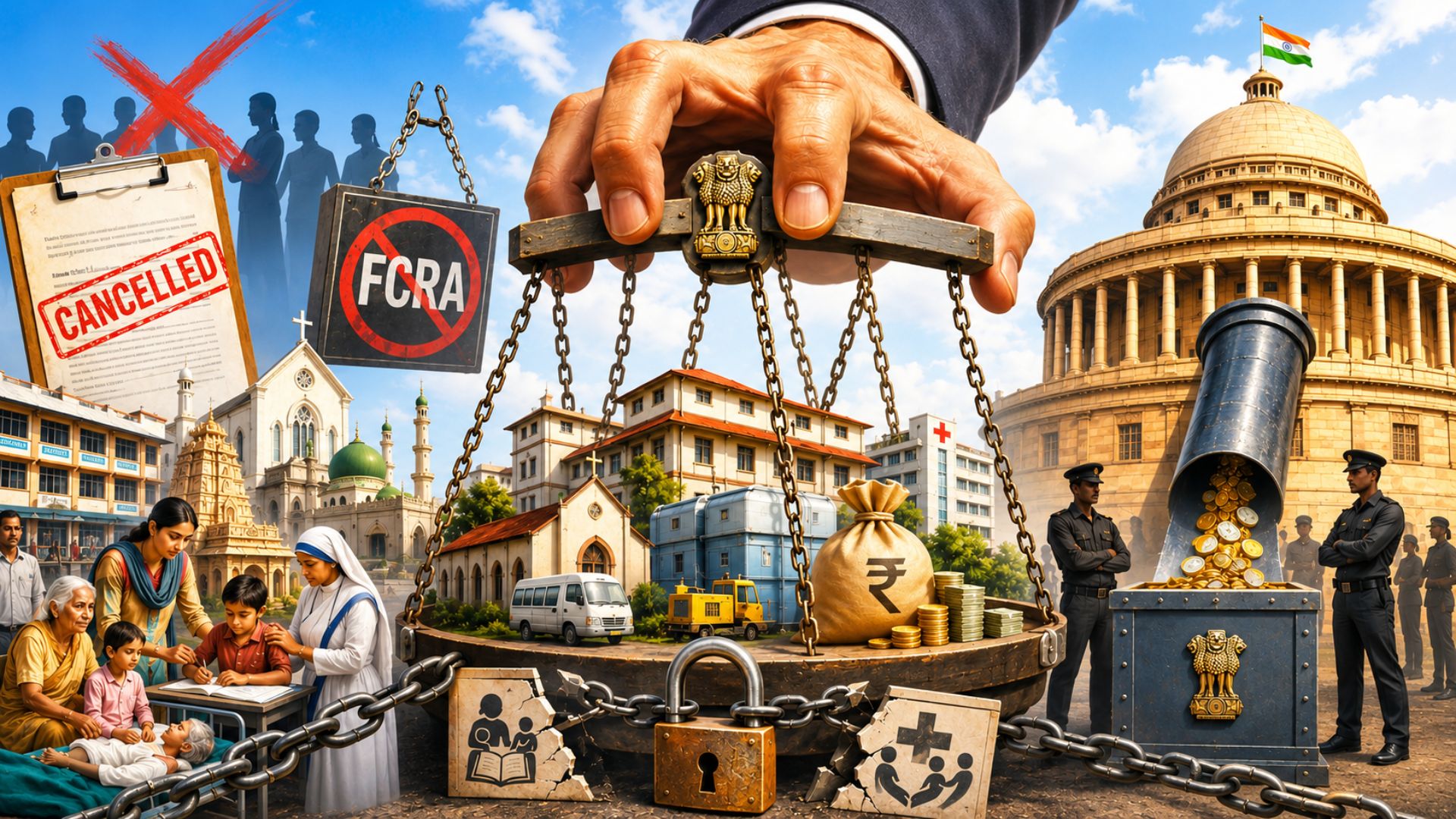
FCRA (Amendment) Bill, 2026: Regulation or Expansion of State Control?

"The strength of a democracy is measured not only by the power of its government but also by the freedom of its civil society."
The proposed Foreign Contribution (Regulation) Amendment Bill, 2026 seeks to enhance transparency and national security in the regulation of foreign funds. However, critics argue that the Bill marks a shift from regulatory oversight to extensive executive control over NGOs, charitable trusts, educational institutions, and religious organisations.
Why is the Bill Significant?
The FCRA framework was already stringent after the 2020 amendments, which:
- Mandated routing of foreign funds through a single SBI branch in New Delhi.
- Reduced administrative expenditure limits from 50% to 20%.
- Prohibited sub-granting to smaller NGOs.
- Expanded suspension powers.
The 2026 Bill introduces a new Chapter IIIA and significantly strengthens government authority over organisations receiving foreign contributions.
Key Provisions of the 2026 Amendment
| Provision | Implication |
|---|---|
| Section 14B | Automatic cessation of FCRA registration due to non-renewal, delayed application, or pending renewal |
| Section 16A | Automatic provisional vesting of assets in a government-designated authority |
| Amended Section 13 | Restricts management of assets during suspension without approval |
| Amended Section 43 | Centralises investigations by requiring Union Government approval |
| Removal of Section 22 | Eliminates existing provisions on disposal of assets of defunct organisations |
What is Section 16A?
The most debated provision is Section 16A.
When an FCRA registration is:
- Cancelled,
- Surrendered, or
- Deemed to have ceased,
all foreign contributions and assets derived from them automatically vest in a government-designated authority, even before judicial review.
NGO Registration Cancelled
          ↓
Section 16A Triggered
          ↓
Assets Provisionally Vest
          ↓
Designated Authority Takes Control
          ↓
Possible Transfer / Sale of Assets
          ↓
Proceeds Credited to Consolidated Fund of India
Why Are Critics Concerned?
Broad Grounds for Action
Cancellation can occur on vague grounds such as:
- "Public interest"
- Alleged violations
- Procedural non-compliance
This raises concerns regarding due process and administrative discretion.
Risk of Asset Takeover
The provisions may affect:
- Schools
- Colleges
- Hospitals
- Orphanages
- Charitable trusts
- Churches
- Mosques
- Temples
even if these institutions were built over decades and serve large communities.
Extraordinary Powers of Designated Authority
The authority may:
- Take possession of assets.
- Manage institutions.
- Oversee finances.
- Alter operations.
- Transfer or sell assets.
If registration is not restored within the prescribed period, vesting may become permanent.
Impact on Civil Society
The amendments could create a climate of uncertainty for NGOs and charitable institutions.
Potential Consequences
- Reduced donor confidence.
- Fear among trustees and volunteers.
- Disruption of welfare programmes.
- Closure of community institutions.
- Increased compliance burden.
Affected Sectors

✓ Child protection
✓ Healthcare & immunisation
✓ Nutrition programmes
✓ Early childhood education
✓ Skill development
✓ Tribal welfare
✓ Human rights initiatives
✓ Access to government schemes
Impact on Minority Institutions
Christian organisations, particularly in states such as Kerala, Tamil Nadu, Nagaland, Mizoram, and Meghalaya, operate:
- Schools and colleges
- Mission hospitals
- Orphanages
- Tribal welfare institutions
Many depend on foreign funding from churches, diaspora groups, and humanitarian agencies.
Critics argue that procedural lapses or delayed renewals could expose such institutions to government control under Section 16A.
Economic and Social Significance of NGOs
| Indicator | Contribution |
|---|---|
| Share in GDP | Around 2% |
| Employment Generated | 27 lakh jobs |
| Full-Time Volunteers | 34 lakh |
| Local Employment Impact | 47% of surveyed NGOs were primary employers in many localities |
The sector therefore represents both a social and economic pillar.
Constitutional Concerns
The Bill has generated debate regarding its compatibility with:
- Article 14 – Equality before law
- Article 19(1)(c) – Freedom of association
- Articles 25 & 26 – Religious freedom
- Articles 29 & 30 – Rights of minorities and educational institutions
- Article 300A – Right to property
Critics argue that concentration of power in the executive may weaken institutional autonomy and procedural safeguards.
Way Forward
- Establish independent oversight before asset vesting.
- Define clear timelines for registration and renewal decisions.
- Introduce judicial review prior to takeover of assets.
- Differentiate procedural lapses from serious violations.
- Ensure transparency in cancellation orders.
- Protect institutions providing essential public services.
- Balance national security concerns with civil society autonomy.
Conclusion
The FCRA (Amendment) Bill, 2026 represents one of the most consequential changes to India's foreign funding regime. While greater accountability and transparency are legitimate objectives, regulatory powers must be accompanied by due process, independent oversight, and safeguards against arbitrary action. A balanced framework is essential to protect national interests without undermining the role of civil society, charitable institutions, and constitutional freedoms.
Attribution
Original content sources and authors

Syllabus classification
How this article maps to GS papers
Main syllabus
GS2Development StakeholdersQuick Q&A
What are the key provisions and broader implications of the Foreign Contribution (Regulation) Amendment Bill, 2026, for civil society organisations in India?
Why are non-governmental organisations considered important stakeholders in governance and socio-economic development in India?
How do the proposed provisions relating to asset vesting and registration under the FCRA Amendment Bill, 2026 affect the functioning of NGOs?
What are the major constitutional and democratic concerns raised by critics regarding the FCRA Amendment Bill, 2026?
What are the major reasons behind the increasing regulatory scrutiny and tightening of foreign funding laws in India?
How can the role and contribution of NGOs in India be understood through their impact on employment generation and welfare delivery?
Practice questions
1 question for mains preparation