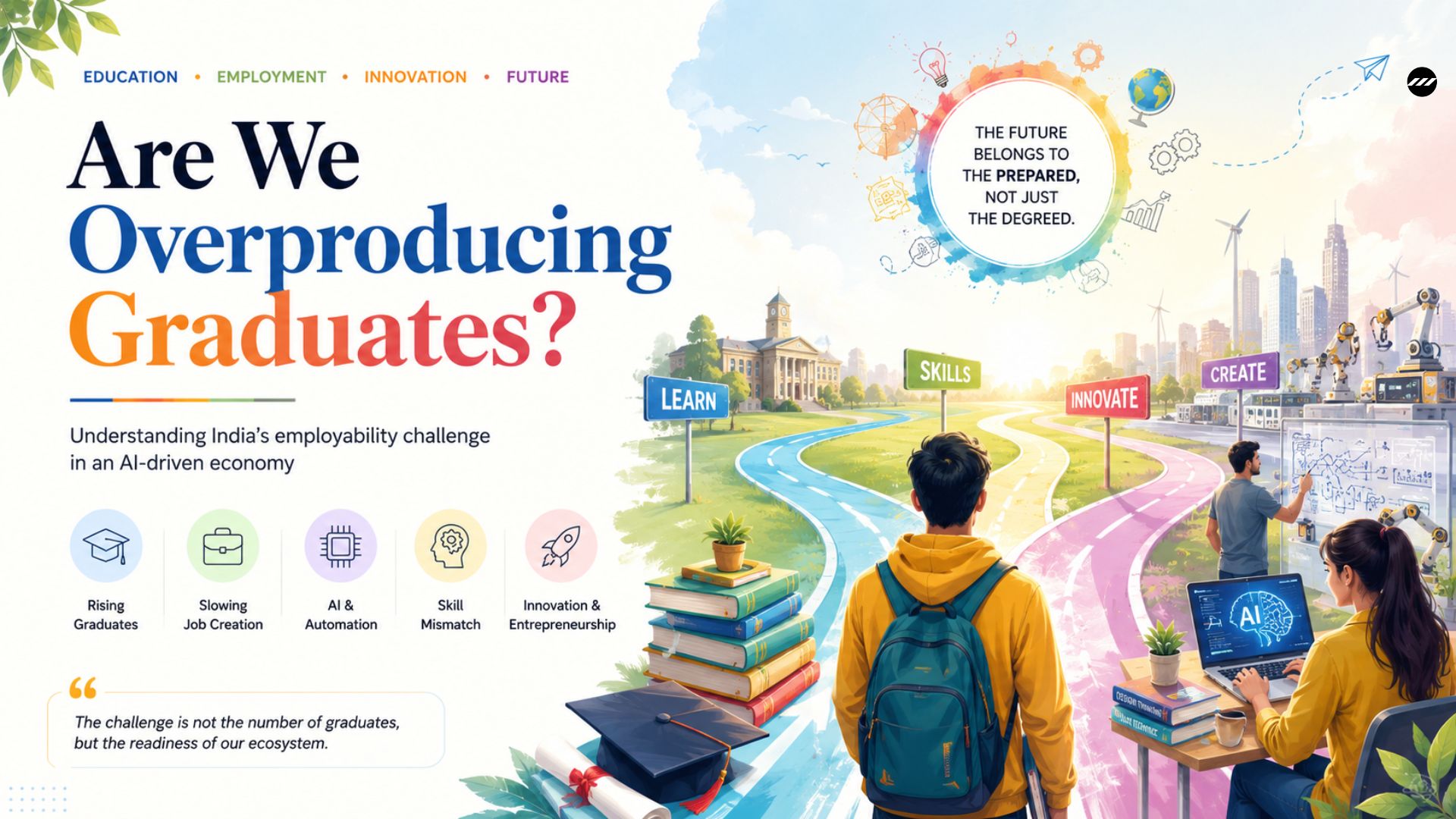
Are We Overproducing Graduates in India?

“The challenge today is not merely creating more graduates, but creating graduates who can thrive in a rapidly changing economy.”
India is witnessing a growing disconnect between the number of graduates entering the workforce and the number of suitable jobs available. While higher education enrolment has expanded significantly, technological change, automation and evolving industry requirements have created a mismatch between academic training and labour market needs.
Is India Producing More Graduates Than Jobs?
The growth in graduates has outpaced the growth in employment opportunities.
Emerging Trend
| Aspect | Current Situation |
|---|---|
| Engineering graduates | Rapid increase |
| Job creation | Slower growth |
| IT services hiring | Moderating |
| New sectors hiring | Expanding but insufficient |
Traditionally, the IT services sector absorbed a large share of engineering graduates. However, slower hiring in recent years has exposed structural weaknesses in the employment ecosystem.
The Nature of New Investments
India is attracting investments in:
- Semiconductors
- Advanced manufacturing
- Defence technologies
- Space technologies
However, many of these sectors are highly capital-intensive.
Large Investment
        ↓
Advanced Technology
        ↓
Higher Productivity
        ↓
Limited Direct Employment
As a result, economic investment does not automatically translate into proportional job creation.
The Impact of Artificial Intelligence
AI has accelerated changes in workplace requirements.
New Skills in Demand
Employers increasingly seek graduates who can:
- Work with AI systems.
- Validate AI-generated outputs.
- Understand ethical AI use.
- Solve complex technology-driven problems.
Challenge for Higher Education
Student enters college (2022)
            ↓
AI adoption accelerates
            ↓
Industry requirements change
            ↓
Graduate enters job market
with outdated skill set
Universities often struggle to revise curricula as rapidly as technological change occurs.
Employability Versus Educational Qualification
A major concern is not merely employment, but employability.
Key Mismatch
| Academic System | Industry Requirement |
|---|---|
| Theoretical knowledge | Practical skills |
| Classroom learning | Real-world problem solving |
| Examination performance | Teamwork and adaptability |
| Academic credentials | Industry readiness |
Many employers continue to invest heavily in post-recruitment training to bridge this gap.
Manufacturing and the Automation Challenge
Manufacturing remains important but is undergoing technological transformation.
Industry 4.0 Trends
- Automation
- Robotics
- Smart factories
- Digital production systems
Historically, factories required large numbers of engineers in supervisory roles.
Today:
- Production is increasingly automated.
- Fewer workers oversee larger operations.
- Output can rise without proportional employment growth.
This phenomenon contributes to concerns regarding "jobless growth."
Beyond Manufacturing: The Innovation Imperative
“The real value lies not only in manufacturing but in research, development and design.”
For many years, India excelled at producing products designed elsewhere.
However, long-term competitiveness depends on:
- Research and Development (R&D)
- Intellectual Property (IP)
- Product innovation
- Indigenous technologies
Recent restrictions on access to strategic technologies such as semiconductors have reinforced the importance of technological self-reliance.
Progress in Indigenous Design
India has made notable advances in design and engineering capabilities.
Examples
Indian Companies:
• Tata Motors
• Mahindra

Capabilities:
• Vehicle design
• Platform development
• Engineering systems
• Transmission technologies
The challenge lies not in capability but in the limited number of advanced design and R&D opportunities relative to the growing graduate population.
Entrepreneurship as a Job Multiplier
Neither government nor industry alone can generate jobs for all graduates.
Need for Entrepreneurship
Graduates must increasingly become:
- Innovators
- Startup founders
- Job creators
However, barriers remain:
- Limited access to risk capital.
- Preference of lenders for established businesses.
- Difficulties in funding early-stage innovation.
Deep-technology ventures require stronger financial and institutional support.
India's Opportunity in the AI Era
Experts argue that India should move beyond infrastructure creation towards product development.
Strategic Priorities
- Sovereign AI systems.
- Indigenous technology platforms.
- Global digital products.
- High-value innovation ecosystems.
The success of UPI demonstrates India's ability to build scalable, globally relevant digital solutions.
Strengthening Higher Education
Greater collaboration between academia and industry is essential.
Areas of Cooperation
- Curriculum design.
- Internships.
- Skill development.
- Industry-led training.
- Applied research.
Such collaboration can improve graduate readiness and reduce skill mismatches.
Way Forward
- Increase national investment in R&D.
- Align curricula with emerging technologies.
- Strengthen industry-academia partnerships.
- Promote practical and experiential learning.
- Support deep-tech startups through risk capital.
- Encourage innovation-led entrepreneurship.
- Build indigenous capabilities in AI, semiconductors and advanced technologies.
- Expand opportunities in product design and intellectual property creation.
Conclusion
India's challenge is not simply one of graduate unemployment but of aligning education, technology and economic transformation. As automation and AI reshape labour markets, future growth will depend on strengthening innovation ecosystems, enhancing employability, promoting entrepreneurship and building globally competitive indigenous technologies. Sustainable employment generation will require a shift from a job-seeking economy to a knowledge- and innovation-driven economy.
Attribution
Original content sources and authors


Syllabus classification
How this article maps to GS papers
Main syllabus
GS2EducationAlso covers
Quick Q&A
What explains the widening gap between the growth of graduates in India and the economy’s capacity to absorb them effectively?
Why has the emergence of artificial intelligence intensified concerns regarding employability and skills among Indian graduates?
How can stronger industry-academia collaboration improve employability and bridge the skill mismatch in higher education?
Critically analyse whether manufacturing-led growth alone can provide sufficient employment opportunities for India’s expanding graduate population.
What lessons do India’s indigenous design capabilities and digital platforms provide for building a knowledge-driven economy?
What are the major reasons behind the growing emphasis on entrepreneurship and deep-technology startups in India?
What policy priorities should India pursue in the AI era to ensure inclusive growth and productive employment generation?
Practice questions
2 questions for mains preparation