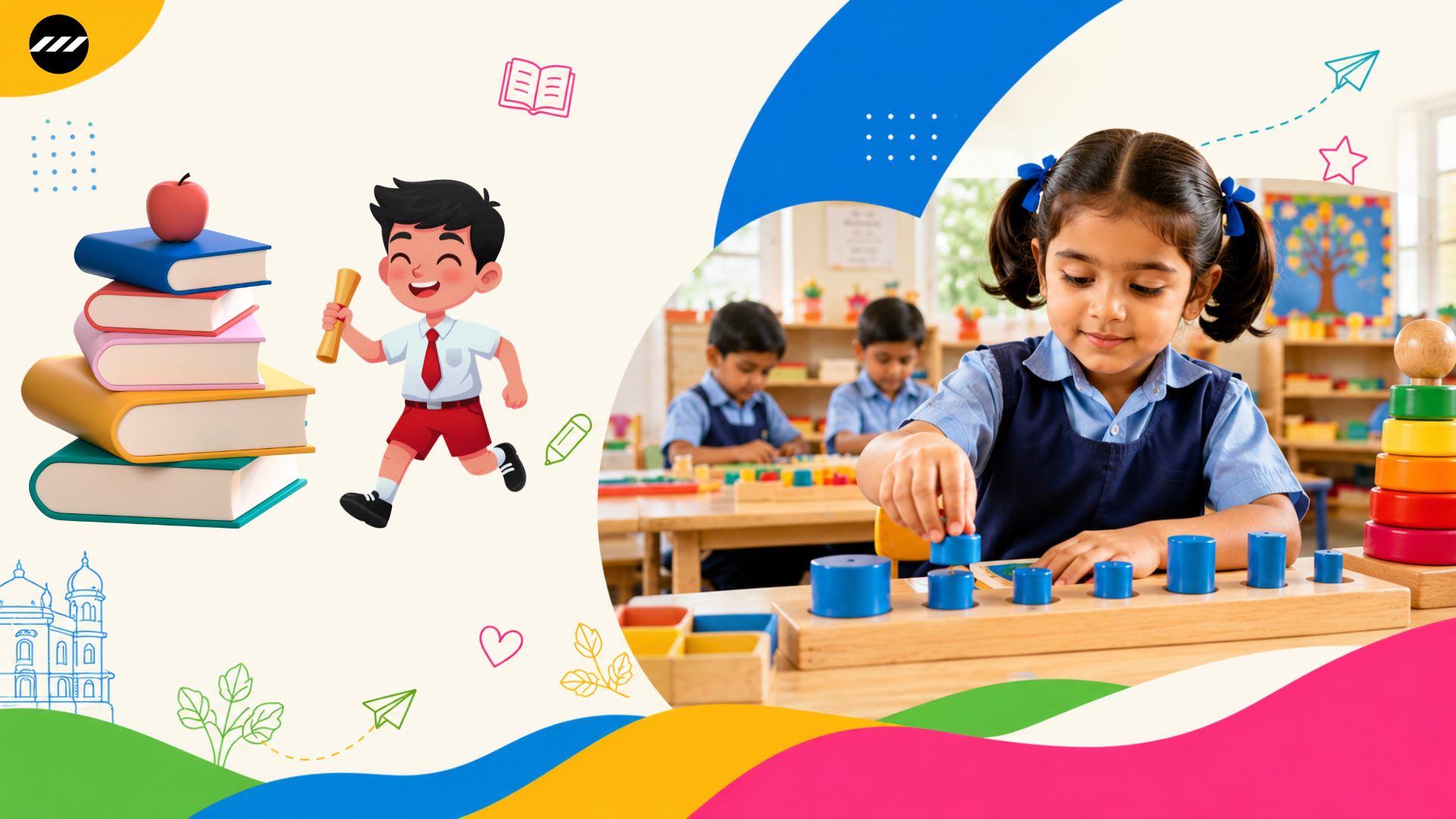
Bringing Montessori to Government Schools: Reimagining Early Childhood Education in Punjab

Why in News?
Punjab has launched its first Montessori education initiative in government Anganwadis and pre-primary schools in Hoshiarpur district. Implemented in collaboration with the Vivek High Montessori Institute (VHMI), Chandigarh, the project aims to transform early childhood education through experiential, child-centred, and activity-based learning.
"The child is naturally curious. The teacher's role is not to control, but to guide."
What is the Initiative?
The programme was launched in January 2026 through a partnership involving:
- Hoshiarpur District Administration
- Indian Red Cross Society
- Vivek High Montessori Institute (VHMI)
Core Objective
To integrate Montessori teaching methodologies into the government education system and improve the quality of early childhood education in rural and semi-urban areas.
Understanding the Montessori Approach
The Montessori method focuses on:
- Child-centred learning.
- Self-directed exploration.
- Practical activities.
- Learning through experience.
- Development of independence.
Unlike conventional classrooms where teachers largely instruct, Montessori classrooms encourage children to actively engage with their surroundings.
Traditional Model:
Teacher teaches → Child listens

Montessori Model:
Child explores → Teacher guides
Transformation Inside Classrooms
The initiative has led to significant changes in classroom environments.
Key Changes
| Earlier Practice | Montessori Approach |
|---|---|
| Teacher-directed learning | Child-led exploration |
| Fixed classroom setup | Accessible learning spaces |
| Book-based instruction | Hands-on activities |
| Repetition and memorisation | Discovery and experimentation |
| Teacher control | Guided learning |
Classroom Innovations
- Child-sized furniture.
- Accessible books and toys.
- Practical learning materials.
- Activity-based learning stations.
Teachers now encourage children to:
- Choose activities independently.
- Learn through play.
- Develop self-confidence and decision-making skills.
Capacity Building of Educators
A major focus of the initiative is teacher training.
Training Components
- Theoretical understanding of Montessori philosophy.
- Practical classroom application.
- Child psychology and observation.
- Activity-based pedagogy.
The training is conducted under the Community Rooted Education Practitioners Programme of VHMI.
Educator Perspective
Teachers report that the programme has helped them:
- Develop greater patience.
- Understand children's natural curiosity.
- Shift from instruction to facilitation.
- Encourage self-learning among children.
Pilot Implementation
The project has been designed as a district-wide pilot.
Institutional Coverage
| Institution Type | Number Selected |
|---|---|
| Anganwadis | 25 |
| Pre-primary Schools | 25 |
| Total Centres | 50 |
Selection Strategy
- Five institutions chosen from each development block.
- Balanced geographical representation.
- Creation of model learning centres.
These centres are expected to serve as demonstration sites for future expansion.
Continuous Mentoring System
The initiative goes beyond one-time training.
Support Mechanism
- 19 Anganwadi supervisors have completed intensive training.
- Three-phase training programme continues until September 2026.
- VHMI facilitators conduct monthly classroom visits.
- Continuous mentoring ensures practical implementation.
Training → Classroom Practice →
Mentoring → Feedback →
Improved Learning Outcomes
The focus is on embedding Montessori principles into everyday teaching practices.
Expected Impact
Short-Term Impact
- Around 2,000 children expected to benefit initially.
Long-Term Vision
- Expansion to all Anganwadis in Hoshiarpur district.
- Potential coverage of nearly 20,000 children.
Educational Benefits
- Improved cognitive development.
- Greater self-reliance.
- Enhanced creativity.
- Better problem-solving skills.
- Increased engagement with learning.
Why is it Significant?
The initiative challenges the perception that innovative pedagogies are limited to elite private schools.
Broader Significance
- Democratization of quality early childhood education.
- Improved learning opportunities in rural areas.
- Strengthening foundational literacy and numeracy.
- Alignment with child-centric educational reforms.
- Greater equity in educational access.
Earlier Belief:
Montessori is for elite urban schools.

Emerging Reality:
Montessori can strengthen government schools
and Anganwadis as well.
The project demonstrates how global educational practices can be adapted to local contexts.
Way Forward
- Expand Montessori-based learning to more districts.
- Strengthen continuous teacher training programmes.
- Integrate experiential learning into foundational education.
- Develop locally relevant learning materials.
- Increase community participation in early childhood education.
- Monitor learning outcomes and best practices.
- Scale successful models through state-wide adoption.
Conclusion
Punjab's Montessori initiative represents an innovative shift in early childhood education by moving from rote instruction to experiential learning. By empowering teachers, redesigning classrooms, and placing children's curiosity at the centre of learning, the programme seeks to build stronger educational foundations. If successfully scaled, it could become a model for transforming government-run Anganwadis and pre-primary schools across India.
Attribution
Original content sources and authors


Syllabus classification
How this article maps to GS papers
Main syllabus
GS2EducationQuick Q&A
What is the Montessori method of education and why is its integration into government Anganwadis significant for early childhood development in India?
Why is the introduction of Montessori pedagogy in rural and semi-urban government schools important from a policy and developmental perspective?
How does the Hoshiarpur Montessori initiative function and what institutional mechanisms support its implementation?
What are the potential advantages and limitations of adopting Montessori education within India's public education system?
How can the Hoshiarpur Montessori project be examined as a case study of innovative governance and educational reform in India?
What practical examples from the Hoshiarpur initiative demonstrate the transformation from rote learning to experiential education?
Practice questions
1 question for mains preparation