
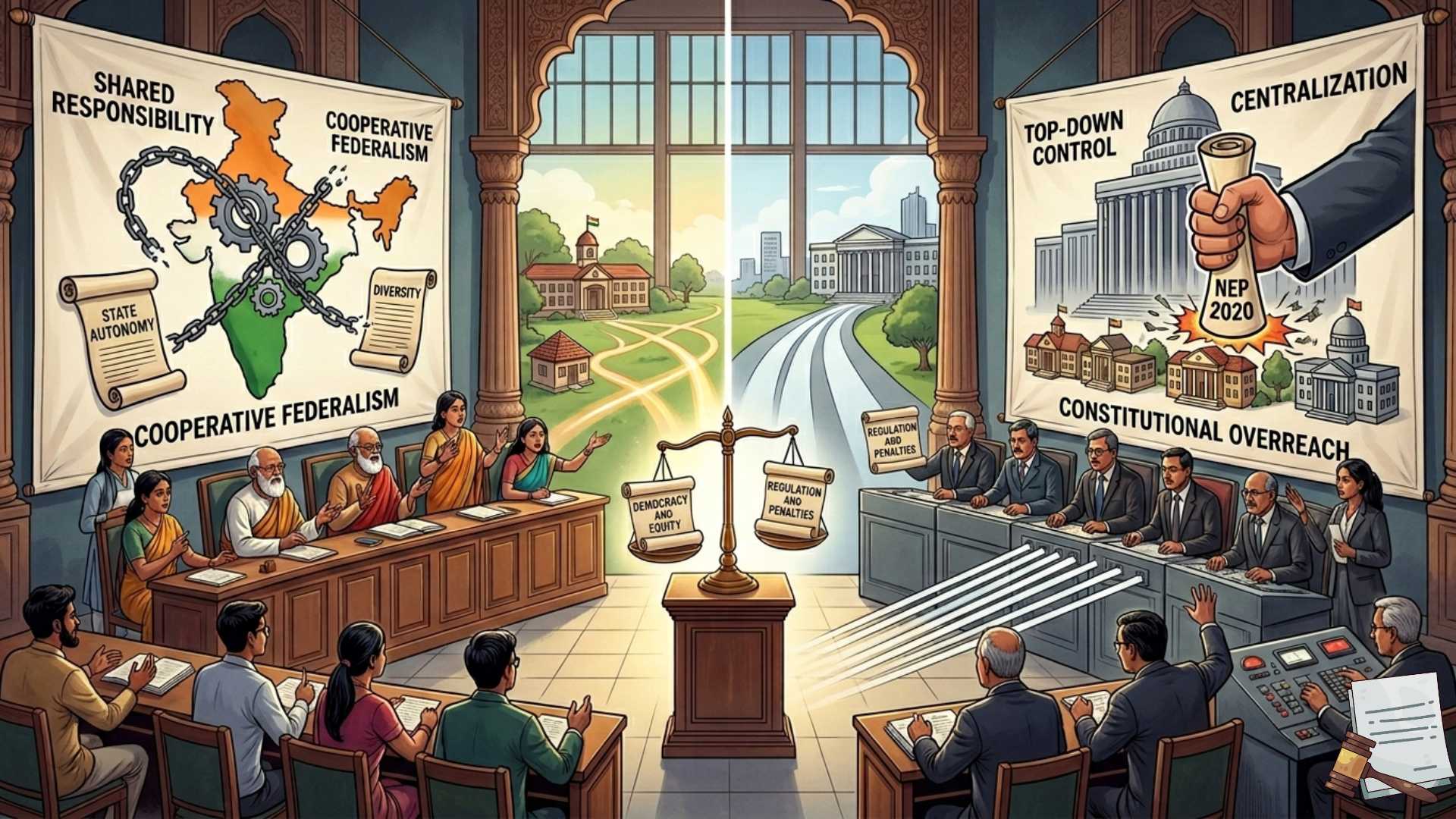
Viksit Bharat Shiksha Adhisthan (VBSA) Bill

Centralisation vs. Cooperative Federalism in Higher Education Governance
GopiGopi
4 mins read
VBSA Bill: Centralisation concerns and call for cooperative, equitable higher education governance

Introduction

Education in India occupies the Concurrent List (Entry 25, List III) — a constitutional arrangement that mandates shared responsibility between the Centre and States. Yet, higher education regulation has historically tilted toward central control, a trend the proposed Viksit Bharat Shiksha Adhisthan (VBSA) Bill seeks to deepen significantly. Introduced to statutorily implement the National Education Policy (NEP) 2020 — itself adopted without formal consultation with State governments — the Bill is currently under examination by a Joint Parliamentary Committee (JPC). With India enrolling over 43 million students in higher education (Gross Enrolment Ratio of 28.4% as per AISHE 2021-22), the governance architecture of this sector has direct consequences for equity, innovation, and federal balance.

"Education is not the filling of a pail, but the lighting of a fire." — W.B. Yeats


Key Structural Features of the VBSA Bill

Proposed BodyFunction
Viniyaman Parishad (Regulatory Council)Primary enforcer of governance and institutional norms; recognition, authorisation, closure of institutions
Gunvatta Parishad (Accreditation Council)Technology-driven quality assessment; outsources accreditation to third-party institutions
Manak Parishad (Standards Council)Determines standards for all types of higher education nationally from Delhi
National Research Foundation (NRF)Research funding — currently without block grant provisions for State universities

Constitutional Concerns

The Bill's critics argue it exceeds the Centre's legislative mandate:

  • Entry 66, Union List grants Parliament authority only for coordination and determination of standards in higher education — a limited, specific power
  • The VBSA Bill goes beyond coordination to give Union-controlled councils sole discretionary power over standards, inspection, and fund allocation
  • Education as Concurrent subject (Entry 25, List III) means States have co-equal legislative competence — the Bill effectively converts a concurrent subject into a Union subject by design
  • The Bill covers Central, State-funded, and private universities alike — including IITs, IIMs, and Inter-University Centres — stripping their governing bodies of statutory autonomy
  • The UGC Act, Section 13 currently requires inspections only after consultation with the university concerned — the VBSA Bill removes this consultative requirement

Federalism Concerns

IssueCurrent PositionVBSA Bill Position
Standards determinationUGC with consultationCentral council — unilateral
AccreditationNAAC (consultative)Third-party outsourced
Institutional closureRequires due processCentre has unilateral power
Fund allocationMinistry + UGCMinistry alone
State rolePartial through SHECsNo guaranteed representation
Reservation enforcementUGC guidelines applyNo explicit provision

States are currently the primary financers of their own higher education systems, yet the Bill gives them no guaranteed role in regulation, accreditation, or standards determination — a fundamental federal asymmetry.


Equity and Social Justice Gaps

  • The Bill contains no explicit provision for enforcement of reservations for SC, ST, and OBC communities in higher education institutions
  • No inter-regional equity framework — historically disadvantaged States and institutions receive no structural support
  • The National Research Foundation has no block grant mechanism for State universities — research funding would remain concentrated in central institutions
  • Output-based evaluation metrics (patents, publications, global rankings) systematically favour well-resourced urban institutions over regional and rural universities
  • Private sector institutions under the Bill have no equity or social justice obligations built in

Academic Autonomy Concerns

  • Bureaucrats — not academics — are placed in charge of transforming higher education under the Bill
  • The Standards Council (Manak Parishad), sitting in Delhi, is expected to define standards across all types of education — academic, vocational, Bharatiya knowledge systems — for the entire country
  • Accreditation outsourced to third-party networks bypasses deliberative institutional processes
  • Technology-driven assessment cannot capture qualitative outcomes — civic engagement, critical thinking, social mobility — that universities are expected to deliver
  • Senates, academic councils, student and teacher associations have no mandated role in governance under the Bill

Recommendations for Amendment

  • 50:50 weightage to State Higher Education Councils (SHECs) and Union councils in regulation, accreditation, and standards determination
  • Establish a separate Higher Education Grants Council (HEGC) to disburse funds — with generous allocations to laggard State institutions to bridge historical gaps
  • No institutional closure without State government consent where the institution is located
  • SHECs must be represented on all three councils — Viniyaman, Gunvatta, and Manak Parishads
  • Standards determination must be sector-wise and State-wise — not a single Delhi-centric prescription
  • Shift from output-based to outcome-and-impact-based evaluation
  • Explicit constitutional affirmation of reservation enforcement across all covered institutions
  • Provision for regional councils to address ecological, linguistic, and socio-technical diversity

Conclusion

The VBSA Bill, as drafted, risks converting India's higher education system into a centrally administered monolith — bypassing the constitutional design of concurrent jurisdiction, the diversity of 28 States with distinct linguistic and developmental needs, and the academic autonomy that is the lifeblood of genuine universities. NEP 2020's vision of transformative, holistic education cannot be realised through bureaucratic control and prescriptive regulation. The JPC process offers a critical window to redesign the Bill as a genuine instrument of cooperative federalism — one that balances national standards with State autonomy, global excellence with social justice, and institutional accountability with academic freedom.


Quick Q&A

Everything you need to know

The Viksit Bharat Shiksha Adhisthan (VBSA) Bill aims to provide a statutory framework for implementing the National Education Policy (NEP) 2020. It proposes the creation of centralised regulatory councils for standards (Manak Parishad), regulation (Viniyaman Parishad), and accreditation (Gunvatta Parishad). These bodies are envisaged to have wide-ranging powers over higher education institutions (HEIs), including inspection, accreditation, and governance.

The Bill also expands the Union government’s role by granting it authority over funding allocation, institutional recognition, and regulatory oversight across Central, State, and private universities. It seeks to replace the consultative and relatively autonomous functioning of bodies like the University Grants Commission (UGC) with a more centralised and bureaucratic model. Additionally, it promotes output-based evaluation metrics such as global rankings, patents, and publications.

However, critics argue that the Bill undermines institutional autonomy and federal principles. It does not adequately provide for stakeholder participation, such as faculty, students, or State governments. Thus, while the Bill aims at standardisation and global competitiveness, it raises concerns about centralisation, academic freedom, and inclusivity in India’s higher education system.

The criticism of constitutional overreach stems from the division of powers under the Indian Constitution. While Entry 66 of the Union List allows the Centre to coordinate and determine standards in higher education, education as a whole falls under the Concurrent List, implying shared responsibility between the Centre and States.

The VBSA Bill expands the Union’s role beyond coordination into areas such as regulation, accreditation, and funding, thereby reducing the role of State governments. This centralisation is seen as undermining the autonomy of States, especially since they are the primary funders of many higher education institutions. The Bill also limits the role of State Higher Education Councils (SHECs), which are crucial for addressing region-specific needs.

From a federalism perspective, such concentration of power may lead to a ‘one-size-fits-all’ approach, ignoring India’s diversity in language, culture, and developmental priorities. Critics argue that this could weaken cooperative federalism, making the Bill inconsistent with the spirit of the Constitution. Therefore, the demand is for a more balanced framework that ensures shared governance and participatory decision-making.

The VBSA Bill significantly alters institutional autonomy by transferring decision-making powers from universities and academic bodies to centralised regulatory councils. Institutions such as IITs, IIMs, and Inter-University Centres may lose control over governance, curriculum, and internal administration, as these functions become subject to external oversight.

Another major concern is the dilution of consultative mechanisms. For example, under the UGC Act, universities are consulted before inspections are conducted. The VBSA Bill removes such provisions, allowing regulatory bodies to conduct inspections and impose penalties without institutional input. This shift indicates a move towards bureaucratic control rather than academic self-governance.

In practice, this could stifle innovation and academic freedom, as institutions may prioritize compliance over creativity. Global examples, such as highly autonomous universities in the US and UK, show that academic freedom is key to excellence. Thus, the Bill’s approach may hinder India’s aspiration to build world-class universities unless autonomy and accountability are balanced effectively.

The centralised regulatory framework proposed in the VBSA Bill aims to ensure uniform standards and improve global competitiveness. Output-based evaluation metrics such as publications, patents, and rankings can provide measurable indicators of institutional performance and align Indian universities with global benchmarks.

However, this approach has significant limitations. Overemphasis on quantifiable outputs may neglect broader educational outcomes such as critical thinking, social responsibility, and community engagement. It may also encourage a ‘publish or perish’ culture, leading to compromised research quality. Additionally, global rankings often favor well-funded institutions, thereby exacerbating inequalities between elite and State universities.

From a critical standpoint, centralised regulation may ignore regional diversity and local priorities. For instance, a university in a rural area may focus on local development issues rather than global rankings. Therefore, a more balanced approach is needed, combining process-oriented evaluation, stakeholder participation, and context-specific standards to ensure holistic development of higher education.

The VBSA Bill illustrates the complexities of translating policy vision into legislative action in a federal system. While the NEP 2020 emphasizes flexibility, inclusivity, and multidisciplinary education, the Bill’s centralised approach appears to contradict these principles by limiting State and institutional participation.

This case highlights the tension between national standardisation and regional autonomy. For example, States have diverse educational priorities based on socio-economic conditions, language, and culture. A centralised framework may fail to address these variations effectively. Similar challenges have been observed in other sectors, such as GST implementation, where balancing uniformity and flexibility has been critical.

As a case study, the VBSA Bill underscores the importance of consultative policymaking, stakeholder engagement, and adaptive governance. It suggests that successful implementation of NEP 2020 requires not just legislative backing but also institutional trust, capacity building, and cooperative federalism.

Concerns about social justice arise from the Bill’s limited focus on affirmative action and equitable access. It does not explicitly ensure the enforcement of reservation policies for SCs, STs, and OBCs, which have been central to India’s higher education framework. This omission raises fears of marginalisation of disadvantaged groups.

Another issue is the increasing emphasis on privatisation and reduced public funding. By encouraging dependence on loans and private investment, the Bill may make higher education less accessible to economically weaker sections. Private institutions often prioritize profitability, which may conflict with the goals of inclusivity and social equity.

Furthermore, the lack of inter-regional equity mechanisms could widen disparities between developed and underdeveloped States. For instance, State universities with limited resources may struggle to compete under output-based evaluation systems. Therefore, ensuring inclusive growth, equitable funding, and targeted support is essential to address these concerns.

To make the VBSA Bill more balanced, several reforms can be introduced. First, the role of State Higher Education Councils (SHECs) should be strengthened, with equal representation in decision-making processes related to regulation, accreditation, and standards. A 50:50 power-sharing model between the Centre and States can promote cooperative federalism.

Second, institutional autonomy must be safeguarded by involving universities’ senates, academic councils, and faculty bodies in governance. The regulatory framework should shift from a prescriptive to a deliberative and consultative approach. Additionally, accreditation processes should not rely solely on third-party agencies but include peer review and societal impact assessment.

Third, the establishment of a Higher Education Grants Council (HEGC) can ensure equitable funding, especially for State universities. This body should prioritize social justice, regional balance, and research development. Examples from countries like Germany, where federal and state governments jointly fund universities, demonstrate the effectiveness of shared responsibility in higher education governance.

Attribution

Original content sources and authors

Sign in to track your reading progress

Comments (0)

Please sign in to comment

No comments yet. Be the first to comment!