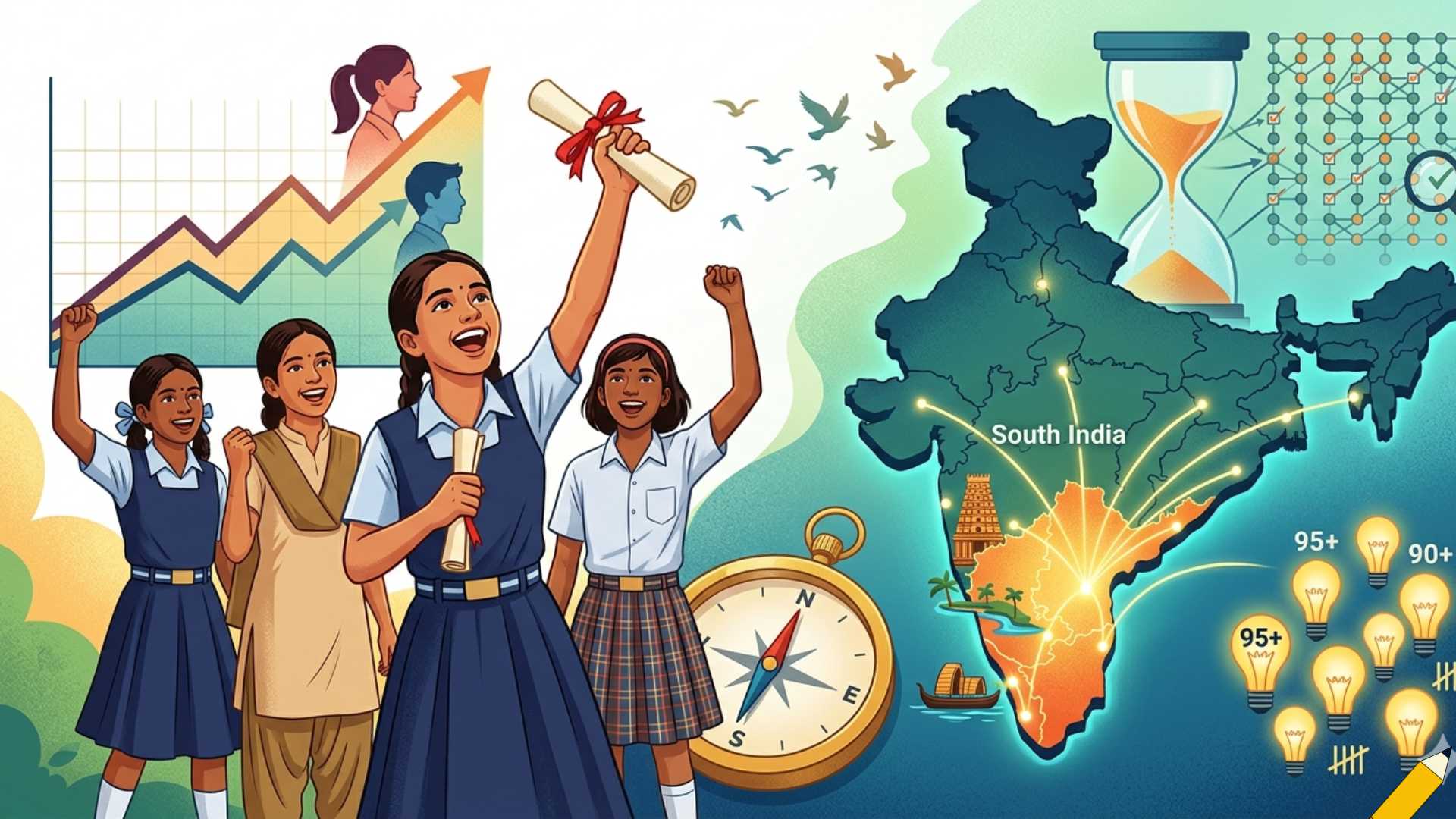
"A single examination does not define one's potential." — Dharmendra Pradhan, Union Education Minister
| Indicator | Data |
|---|---|
| Overall pass percentage (2026) | 93.7% |
| Girls pass percentage | 94.99% |
| Boys pass percentage | 92.69% |
| Gender gap | +1.3 pts (girls over boys) |
| Total appeared | 24,71,777 |
| Total passed | 23,16,008 |
| Scored above 95% | 55,368 |
| Scored above 90% | 2,21,574 |
| Schools involved | 27,339 |
| Exam centres | 8,074 |
| Answer books evaluated | ~1.6 crore |
Background & Context
CBSE Class 10 results 2026 carry special significance — this cycle marks the first rollout of the two-exam system, a structural reform allowing students a second attempt within the same academic year. Results were declared nearly a month ahead of the earlier mid-May schedule, enabled by deploying 7 lakh evaluators, 46,000 head examiners, and 2,08,991 invigilators.
Regional Performance
| Region | Pass % |
|---|---|
| Thiruvananthapuram & Vijayawada (joint top) | 99.79% |
| Chennai | 99.58% |
| Bengaluru | 98.91% |
| Delhi West | 97.45% |
| Delhi East | 97.33% |
South India's continued dominance reflects stronger school infrastructure, teacher quality, and state-level investment in secondary education.
Key Themes for UPSC
1. Gender Equity in Education Girls outperforming boys in CBSE Class 10 is a continuing multi-year trend — consistent with national data showing girls' higher retention and performance at secondary level post-SSA (Sarva Shiksha Abhiyan) and RMSA (Rashtriya Madhyamik Shiksha Abhiyan) interventions. GER (Gross Enrolment Ratio) for girls at secondary level has steadily improved — from 57.9% (2010) to 79.4% (2022) per UDISE+ data.
2. Two-Exam System — Policy Significance The new dual-attempt structure addresses a long-standing criticism of board exams as high-stakes single-event assessments. Key implications:
- Reduces examination anxiety + mental health burden
- Aligns with NEP 2020's vision of competency-based, low-stakes assessment
- ~1.47 lakh compartment students + improvement seekers benefit directly
- Second exam scheduled mid-May; registration window April 16–20
3. NEP 2020 Alignment The two-exam reform directly operationalises NEP 2020's recommendation to restructure board examinations to "eliminate the high-stakes nature" of a single annual event, emphasising holistic development over rote performance.
Challenges Remaining
- Regional disparity persists — gap between top-performing South Indian regions and lagging regions not narrowed structurally
- High pass percentage does not reflect learning outcomes — ASER reports consistently flag foundational learning gaps even among passed students
- Gender gap in STEM streams and higher education enrolment remains despite secondary-level parity
- Urban-rural divide in exam infrastructure and teacher quality unaddressed by result data
Conclusion
CBSE Class 10 results 2026 signal incremental progress on two fronts: sustained gender equity at secondary level and structural reform through the two-exam system. However, pass percentage as a metric obscures deeper learning outcome deficits highlighted by ASER and NAS assessments. True educational reform requires moving beyond enrolment and pass rates toward competency measurement — the NEP 2020 framework provides the architecture, but implementation at state and school level remains the critical variable.