INTRODUCTION
- Judicial credibility is central to democratic governance; globally, surveys by Transparency International show that nearly 30–40% of citizens perceive the judiciary as corrupt in several countries.
- In India, over 5 crore pending cases (2025) highlight systemic delays, raising concerns about access to justice.
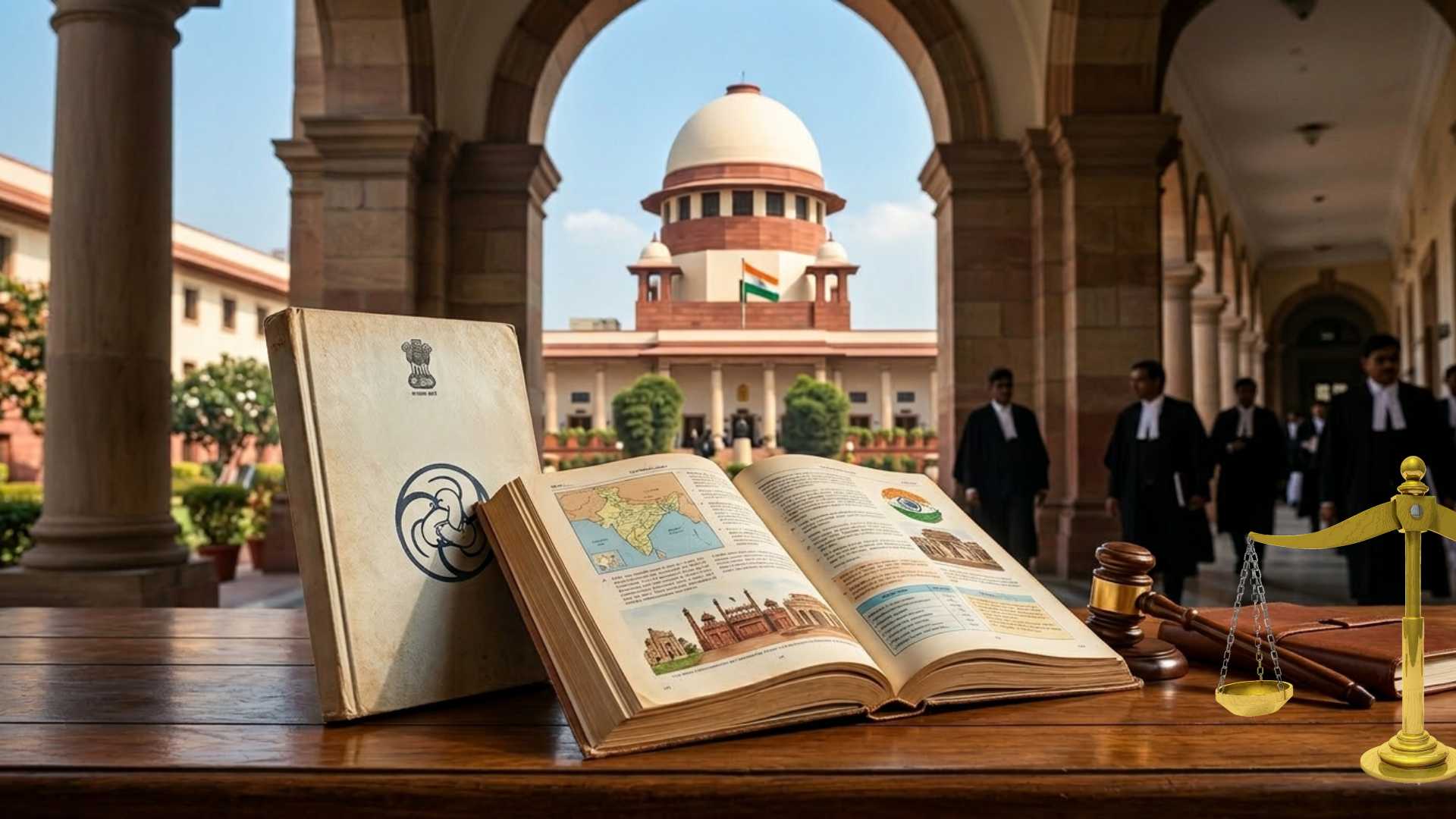
- Recent Supreme Court directions banning an NCERT textbook have reignited debates on judicial accountability, free speech, and institutional transparency.
- The issue underscores the tension between judicial dignity and democratic criticism.
BACKGROUND AND CONTEXT
-
Supreme Court ordered a blanket ban on an NCERT Class 8 textbook citing selective portrayal of judicial corruption and delays.
-
Directed disassociation of authors, raising concerns of lack of due process.
-
The textbook included:
- Case backlog data
- Reference to Bangalore Principles of Judicial Conduct
- Mechanisms for judicial accountability (removal, in-house procedures)
KEY CONSTITUTIONAL AND LEGAL ISSUES
Freedom of Speech (Article 19)
-
Article 19(1)(a) guarantees freedom of speech and expression.
-
Restrictions under Article 19(2) must be:
- Imposed by law, not judicial orders alone
- Based on specific grounds (public order, defamation, contempt, etc.)
Judicial Orders vs ‘Law’
| Aspect | Explanation |
|---|---|
| Judicial Orders | Case-specific directions |
| Law (Art. 19 context) | Legislation enacted by the state |
| Key Case | Naresh Shridhar Mirajkar (1966) – judicial orders ≠ law under Article 19 |
CONTEMPT OF COURT: LEGAL THRESHOLD
-
Defined under Section 2(c), Contempt of Courts Act, 1971
-
Includes:
- Scandalising the court
- Interference with justice delivery
Key Issue
-
Mere discussion of:
- Judicial delays
- Corruption concerns may not meet the high threshold of criminal contempt.
KEY CONCERNS ARISING FROM THE BAN
Impact on Fundamental Rights
- Curtails academic freedom and free expression
- Sets precedent for judicial censorship
Violation of Natural Justice
- Punitive directions (disassociation) issued without hearing authors
Judicial Overreach
- Courts acting as censors rather than constitutional adjudicators
- Reduces scope for judicial review remedies
Chilling Effect
-
Discourages:
- Academic critique
- Public discourse on institutional reforms
NEED FOR JUDICIAL ACCOUNTABILITY AND TRANSPARENCY
-
Judiciary itself has acknowledged:
- Presence of “bad apples”
- Need for high ethical standards
Important Case
-
K. Veeraswami vs Union of India (1991)
- Judges classified as public servants under Prevention of Corruption Act
- Emphasized absolute integrity standards
Quote
- “A single dishonest judge… jeopardises the integrity of the entire judicial system.”
GLOBAL BEST PRACTICES
| Country | Reform Measures | Outcome |
|---|---|---|
| Kenya | Judicial ombudsman, user committees, performance tracking | Trust rose from 27% (2009) to 61% (2013) |
| Global Trend | Transparency & accountability mechanisms | Improved institutional credibility |
Key Insight
- Reform succeeds through acknowledgment, not suppression of criticism.
ROLE OF MEDIA AND CIVIL SOCIETY
-
Essential for:
- Democratic accountability
- Exposing systemic issues
-
Max Boot’s thesis highlights:
- Media scrutiny as a corrective force for judiciary
BALANCING JUDICIAL DIGNITY AND DEMOCRATIC CRITICISM
Judicial Perspective
- Protect institutional legitimacy
- Prevent misinformation
Democratic Perspective
-
Allow:
- Criticism
- Academic debate
- Public awareness
Core Principle
- Dissent strengthens institutions; suppression weakens them
WAY FORWARD
-
Promote institutional self-reform rather than censorship
-
Strengthen:
- Judicial accountability frameworks
- Transparency mechanisms
-
Encourage:
- Academic freedom
- Evidence-based critique
-
Develop clear guidelines on contempt vs criticism
CONCLUSION
- Judicial credibility depends not only on authority but also on public trust and openness to scrutiny.
- Suppressing critical discourse risks weakening democratic foundations.
- A self-correcting, transparent judiciary is essential for sustaining constitutional democracy and rule of law.
UPSC MAINS QUESTION (250 WORDS)
- “Judicial accountability and freedom of expression often come into conflict in a democracy.” Critically examine in the context of recent debates on judicial censorship in India.