What are industrial ammonia gas leaks, and why do they pose significant governance and public safety challenges in India?
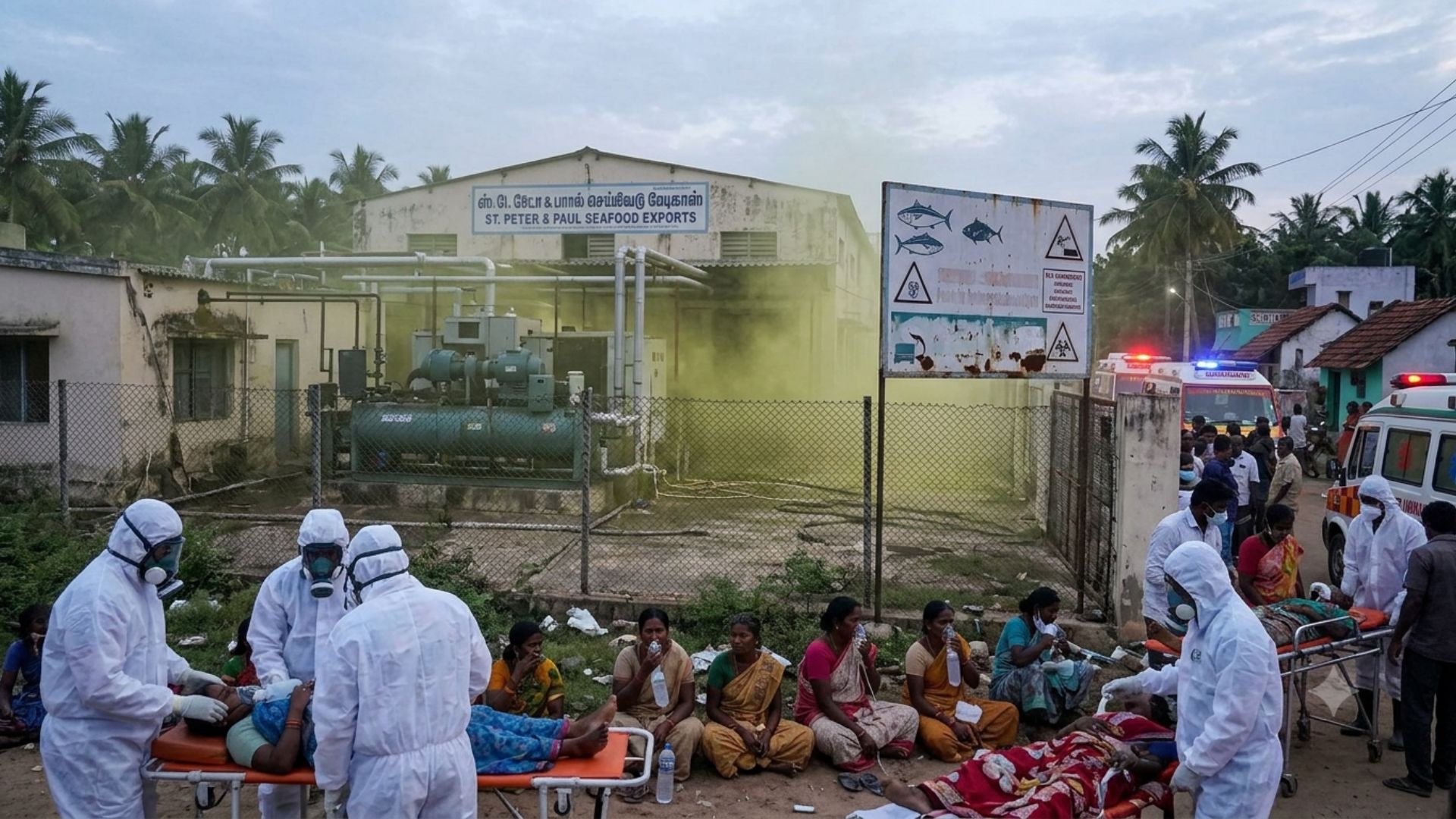
Industrial ammonia gas leaks refer to the accidental release of ammonia, a colourless gas with a pungent odour, widely used in refrigeration, seafood processing, fertilizer production, and chemical industries. At high concentrations, ammonia can cause severe respiratory distress, eye irritation, pulmonary damage, and even death. The recent tragedy in Tiruvallur district of Tamil Nadu, which claimed the lives of eight migrant women workers and hospitalized dozens more, demonstrates the catastrophic consequences of inadequate industrial safety mechanisms.
India has witnessed several ammonia-related incidents since the 1980s, particularly around Chennai. Notable cases include the 2023 Ennore ammonia leak during Cyclone Michaung, involving about 67.638 tonnes of ammonia, and the Thoothukudi leak in 2024. Although earlier incidents caused limited fatalities, the Tiruvallur accident exposed vulnerabilities in enforcement and preparedness.
From a governance perspective, such accidents raise issues of regulatory compliance, occupational safety, labour rights, disaster management, and environmental protection. Existing frameworks, including the Tamil Nadu Control of Industrial Major Accident Hazards Rules, 1994, the Factories Act, 1948, and environmental regulations administered by the Pollution Control Boards, provide safeguards. However, implementation gaps remain.
For UPSC GS-II and GS-III, the issue highlights policy implementation challenges and disaster management. It also connects with welfare of migrant workers and environmental governance. The debate is not merely about creating new laws but ensuring effective enforcement, technological safeguards, and accountability. The incident illustrates that industrial growth and economic development must be accompanied by strong safety standards and responsible governance.
Why is strict enforcement of industrial safety regulations more important than merely introducing new policies and committees?
Strict enforcement of existing regulations is crucial because India already possesses an extensive framework governing hazardous industries. Following the Tiruvallur ammonia leak, Tamil Nadu announced inspections of all 6,669 hazardous industries. However, the core challenge lies not in the absence of rules but in ensuring their implementation.
The Tamil Nadu Control of Industrial Major Accident Hazards Rules, 1994, and various provisions under the Factories Act and environmental laws prescribe safety standards, emergency preparedness, and periodic inspections. Reports indicate that the Tiruvallur factory had previously been warned by the Directorate of Industrial Safety and Health (DISH) about deficiencies such as the absence of suitable alarms, lack of fire hydrants, and unapproved installation of machinery. Failure to rectify these shortcomings points to weaknesses in compliance and oversight.
Historically, India has experienced similar lessons after the Bhopal Gas Tragedy of 1984, which killed thousands and exposed regulatory failures. Despite stronger environmental laws enacted thereafter, implementation challenges continue to persist.
For UPSC aspirants, this issue is highly relevant to GS-II (governance and policy implementation) and GS-III (disaster management and environmental protection). Effective governance requires monitoring mechanisms, inter-agency coordination, periodic audits, transparency, and deterrent penalties. Excessive dependence on committees after disasters often leads to reactive rather than preventive governance.
Critics argue that bureaucratic fragmentation and weak enforcement dilute accountability. Therefore, strengthening institutions, promoting a safety culture, and ensuring political will are more important than creating additional regulatory frameworks. Sustainable industrial development demands that laws on paper translate into actual protection for workers and communities.
How can smart policy implementation and technological interventions reduce the risk of industrial chemical disasters in hazardous industries?
Smart policy implementation involves combining regulatory mechanisms with technological solutions to prevent industrial disasters. The recommendations made by the Directorate of Industrial Safety and Health (DISH) after the Ennore ammonia leak provide valuable insights into such an approach.
DISH recommended installation of ammonia sensors in plants and surrounding areas for early detection, water-curtain systems connected to alarms, and fire-water nozzles near ammonia feed pumps. These measures are based on the principle of real-time monitoring and rapid containment. Had such mechanisms been universally implemented, the impact of the Tiruvallur tragedy could have been substantially minimized.
Globally, countries such as Japan, Germany, and the United States employ advanced sensor technologies, automated shut-off valves, predictive maintenance systems, and emergency response protocols. Industry 4.0 technologies, including artificial intelligence and IoT-based monitoring, have further enhanced industrial safety standards.
In India, smart implementation should include digital compliance platforms, GIS mapping of hazardous industries, periodic safety audits, third-party certification, and integration with district disaster management authorities. Training workers and conducting mock drills are equally important.
The issue is relevant for UPSC GS-II and GS-III, particularly in governance, science and technology, and disaster management. Smart governance emphasizes preventive action rather than post-disaster compensation.
Some critics point out that smaller industries may find advanced technologies expensive. However, the economic and human costs of industrial disasters are far greater. Therefore, technology-driven implementation, combined with strict accountability and institutional coordination, offers a sustainable pathway toward safer industrial growth and improved public confidence.
What are the major reasons behind recurring industrial accidents and hazardous gas leaks despite the existence of regulatory frameworks in India?
Recurring industrial accidents in India are primarily caused by implementation deficits rather than legislative inadequacies. Several factors contribute to these failures.
First, weak enforcement mechanisms allow industries to ignore safety recommendations. Reports indicate that deficiencies identified in the Tiruvallur seafood processing unit, including lack of alarm systems and fire hydrants, remained unresolved. Such non-compliance significantly increases risks.
Second, inadequate inspections and shortage of trained personnel limit regulatory effectiveness. Agencies such as the Directorate of Industrial Safety and Health and Pollution Control Boards often face resource constraints.
Third, economic pressures encourage some firms to compromise on safety investments to reduce costs. This reflects a conflict between profit motives and occupational safety.
Fourth, poor inter-agency coordination among health departments, disaster management authorities, and industrial regulators delays preventive action. The absence of integrated databases and monitoring systems further aggravates the problem.
Fifth, migrant and contract workers frequently receive insufficient training and lack awareness regarding emergency procedures. This raises concerns about labour rights and social justice.
Historical experiences, including the Bhopal Gas Tragedy of 1984, the Visakhapatnam LG Polymers gas leak in 2020, the Ennore leak in 2023, and the Thoothukudi incident in 2024, reveal a recurring pattern of negligence.
For UPSC GS-II and GS-III, the issue demonstrates challenges in governance, disaster management, labour welfare, and environmental administration. Some analysts advocate stricter penalties and criminal liability for repeated violations, while others emphasize capacity building and collaborative regulation.
Ultimately, industrial safety requires a culture of compliance, transparency, and accountability. Preventing accidents demands continuous vigilance rather than episodic responses after tragedies occur.
How does the Tiruvallur ammonia gas leak tragedy serve as a case study in policy failures and lessons for governance reforms?
The Tiruvallur ammonia gas leak tragedy represents an important case study highlighting the gap between policy formulation and implementation. The incident occurred at a private seafood processing unit where workers were resting in factory accommodation. Eight migrant women workers lost their lives, while many others required hospitalization and oxygen support.
Preliminary findings revealed that the factory had earlier been flagged by the Directorate of Industrial Safety and Health for deficiencies such as absence of alarm systems, inadequate fire safety infrastructure, and lack of revised approval for certain machinery. These warnings apparently did not translate into corrective action, exposing weaknesses in regulatory enforcement.
The incident underscores several governance lessons. First, inspections alone are insufficient unless accompanied by follow-up mechanisms and penalties for violations. Second, disaster preparedness must extend beyond production areas to worker accommodation facilities. Third, coordination among health authorities, pollution control agencies, and industrial safety departments is essential.
The case also highlights the vulnerability of migrant workers, thereby linking industrial safety with social justice and labour rights. Similar concerns emerged after the Bhopal Gas Tragedy and the LG Polymers accident in Visakhapatnam in 2020.
From a UPSC perspective, this case study is relevant to GS-II, GS-III, and ethics-related discussions. It demonstrates the importance of accountability, public administration, and citizen-centric governance. Critics argue that governments often respond with new committees after disasters instead of addressing systemic weaknesses.
Therefore, the Tiruvallur tragedy emphasizes the need for preventive governance, technological interventions, stronger penalties, and political commitment. It serves as a reminder that effective implementation is the true measure of policy success.
What is the critical analysis of India's approach toward managing industrial hazards and ensuring effective policy implementation?
India's approach toward industrial hazard management presents a mixed picture characterized by strong legal provisions but uneven implementation. The country has enacted several laws and regulations after major disasters, especially following the Bhopal Gas Tragedy of 1984. These include the Environment Protection Act, 1986, Manufacture, Storage and Import of Hazardous Chemicals Rules, and state-level frameworks such as the Tamil Nadu Control of Industrial Major Accident Hazards Rules, 1994.
On the positive side, institutional mechanisms involving Pollution Control Boards, disaster management authorities, and industrial safety departments have improved regulatory oversight. Increasing awareness regarding occupational safety and environmental protection has also strengthened public scrutiny.
However, recurring incidents such as the Visakhapatnam gas leak in 2020, the Ennore ammonia leak in 2023, the Thoothukudi incident in 2024, and the Tiruvallur tragedy expose persistent shortcomings. These include inadequate inspections, poor enforcement, lack of coordination, and insufficient technological adoption.
One school of thought argues for stricter criminal penalties and greater regulatory powers. Another perspective warns that excessive compliance burdens may discourage investment and affect ease of doing business. Therefore, a balanced approach is required.
For UPSC GS-II and GS-III, this debate reflects broader themes of governance, environmental management, and sustainable development. The challenge is to reconcile industrial growth with worker safety and ecological protection.
A critical assessment suggests that India must move from reactive governance to risk-based regulation supported by digital monitoring, independent audits, and transparent reporting. Ultimately, policy effectiveness depends not on the quantity of laws enacted but on the quality of institutions and their ability to ensure accountability and public trust.
What practical policy measures and international best practices can India adopt to strengthen industrial safety governance and disaster prevention?
India can significantly improve industrial safety by adopting a combination of domestic reforms and international best practices. Countries such as Japan, Germany, and the United States have developed comprehensive risk-management systems that emphasize prevention, technological innovation, and institutional accountability.
One important measure is the mandatory installation of gas sensors, automated shut-off systems, and water-curtain mechanisms in hazardous industries. Such recommendations were made by the Directorate of Industrial Safety and Health after the Ennore ammonia leak in 2023. Their universal implementation could help prevent disasters similar to the Tiruvallur tragedy.
Second, periodic third-party safety audits and digital compliance systems should be introduced to ensure transparency. Use of IoT devices, artificial intelligence, and predictive maintenance technologies can identify vulnerabilities before accidents occur.
Third, industries must conduct regular mock drills and provide safety training to employees, especially migrant and contract workers. Japan's disaster preparedness culture offers valuable lessons in this regard.
Fourth, stronger penalties and public disclosure of non-compliant industries can enhance accountability. The United States' Occupational Safety and Health Administration (OSHA) model demonstrates the importance of strict enforcement.
Fifth, coordination between district administrations, health departments, Pollution Control Boards, and disaster management authorities should be institutionalized.
These reforms are relevant to UPSC GS-II, GS-III, and science and technology topics. They also align with the goals of sustainable development and responsible industrialization.
While implementation costs may initially increase, the long-term benefits in terms of human safety, economic stability, and public confidence far outweigh these expenses. Effective industrial governance is essential for achieving inclusive and sustainable economic growth.