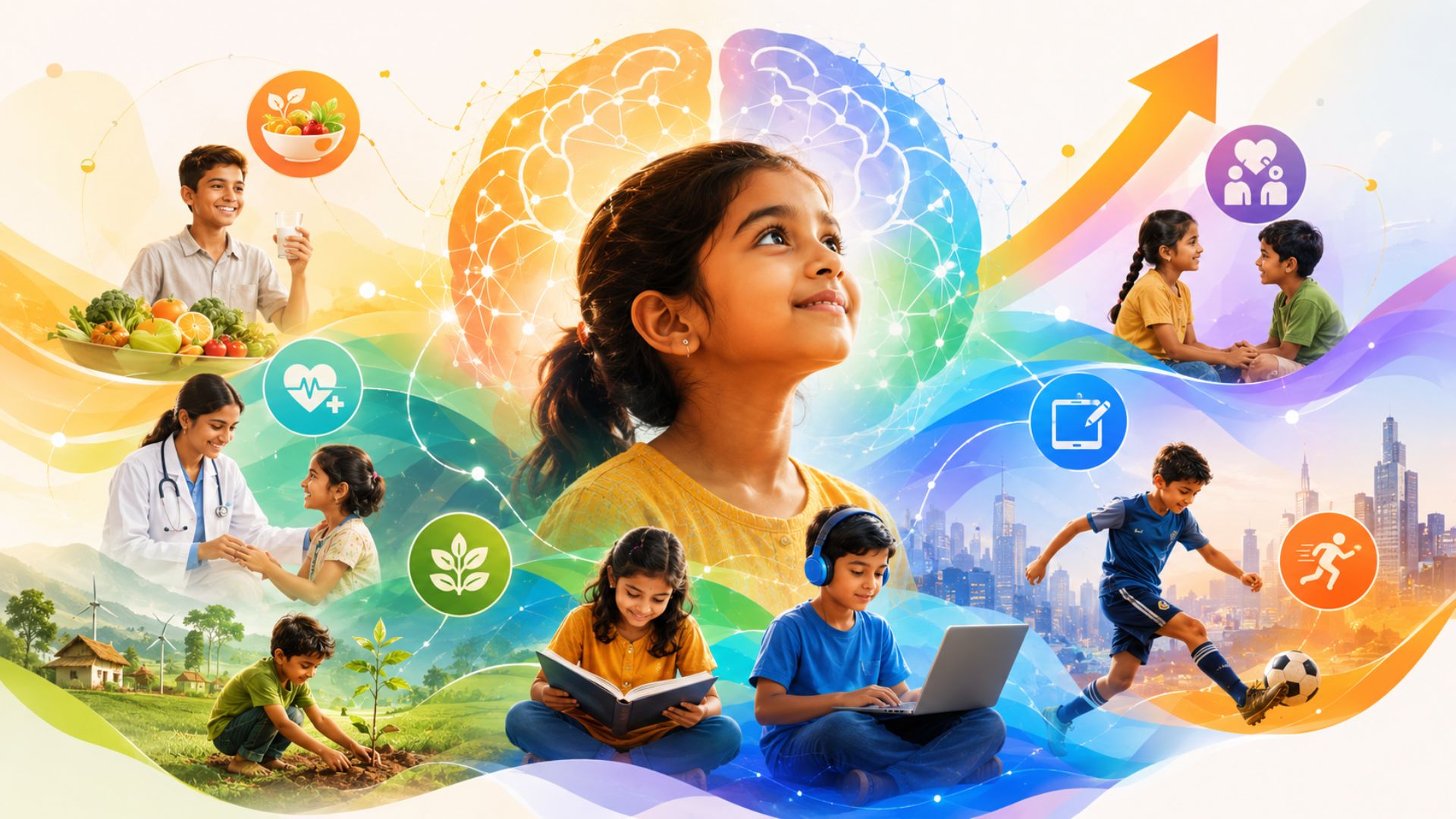
Beyond Nutrition: Why Early Childhood Development Must Become India's Next Human Capital Mission

"The first years of life are not merely about survival; they are about building the foundations of human potential."
India has made remarkable progress in improving child survival outcomes. Under-five mortality declined from 43 (2012) to 32 (2020) according to UNICEF and World Bank estimates. The Anganwadi system supports nearly eight crore children (0-6 years) through nutrition, growth monitoring, health services, counselling and home visits.
However, emerging evidence suggests that nutrition alone is insufficient. Early childhood development is shaped by a combination of nutrition, health, stimulation, learning and caregiving.
Why the Early Years Matter
The human brain develops at an extraordinary pace during early childhood.
| Brain Development Indicators | Significance |
|---|---|
| Brain consumes nearly one-fifth of body's energy at rest | High nutritional demand |
| Grey matter increases by 149% in first year | Rapid cognitive development |
| Cerebellum grows by 240% in first year | Supports movement and learning |
| Millions of synapses formed | Foundation for language, planning and behaviour |
This shows that body and brain development occur simultaneously, not separately.
The Ecological Model of Child Development
Early childhood development is influenced by multiple interacting factors.
Key Determinants
- Adequate nutrition
- Good health and immunisation
- Safe sanitation
- Responsive caregiving
- Early learning opportunities
- Emotional support
- Healthy home environment
A child's development depends not only on what is provided, but also on the environment in which growth occurs.
Two children may receive similar nutrition.
The child who is regularly talked to,
played with and emotionally supported
is more likely to show better cognitive outcomes.
Evidence from Global and Indian Research
Jamaica Study (1980s)
Researchers studying stunted children found:
| Intervention | Outcome |
|---|---|
| Nutrition alone | Better physical health |
| Nutrition + psychosocial stimulation | Stronger cognitive gains |
The study highlighted the importance of love, talk, play and responsive interaction.
Vellore Birth Cohort Study
A cohort of 250 children was followed from birth to age nine.
Key findings:
- Early stunting was linked to poorer cognitive performance.
- Children who recovered physically showed better cognitive outcomes.
- Home stimulation significantly influenced developmental outcomes.
Recovery from early stunting improved not only
physical growth but also later cognitive performance,
showing the interconnected nature of development.
Why Nutrition Alone Cannot Solve the Problem
Research demonstrates that nutrition is mediated by environmental conditions.
Factors Affecting Nutrient Utilisation
- Repeated infections
- Enteric dysfunction
- Poor sanitation
- Inflammation
- Toxic exposures
- Lack of stimulation
Studies in Vellore found that children with:
- Iron deficiency
- High lead exposure
performed worse on cognitive assessments even when height and weight appeared normal.
Thus, growth charts alone cannot fully capture developmental progress.
Preschool Education and Cognitive Gains
Perhaps the most encouraging evidence relates to early education.
Impact of Structured Preschool
| Study | Outcome |
|---|---|
| Vellore Cohort | +7 IQ points among regular preschool attendees |
| Brazilian Cohort | +8 cognition points at age five |
Importantly, these gains persisted even after accounting for:
- Poverty
- Maternal education
- Early childhood stunting
This indicates that nutrition and stimulation produce independent and complementary benefits.
Transforming Anganwadis into Development Centres
India is increasingly adopting a holistic approach to child development.
Major Initiatives
| Initiative | Objective |
|---|---|
| Aadharshila | Strengthen play-based preschool education |
| Navchetana | Promote early stimulation through caregivers |
| Poshan Bhi Padhai Bhi | Integrate nutrition with learning |
| Poshan Pakhwada 2026 | Community awareness on brain development and play-based learning |
These programmes seek to transform Anganwadis from nutrition centres into vibrant early childhood development hubs.
Role of Families
Simple daily interactions can significantly improve outcomes:
- Talking while feeding
- Storytelling
- Playing together
- Reading aloud
- Limiting screen exposure
- Responsive caregiving
The home environment lays the foundation, while Anganwadis reinforce learning through structured activities and peer interaction.
Wider Social Benefits
An ecological approach benefits entire communities.
Positive Spillovers
- Reliable childcare enables women to work.
- Mothers gain opportunities for education and employment.
- Local childcare workers receive livelihood opportunities.
- Communities experience stronger social development.
When childcare support is available,
women can participate in the workforce,
creating a virtuous cycle of care and economic growth.
Way Forward
- Strengthen Anganwadis as integrated child development centres.
- Expand play-based and activity-based learning.
- Mainstream caregiver education programmes.
- Improve sanitation and environmental health conditions.
- Reduce childhood exposure to toxins such as lead.
- Promote community participation through campaigns.
- Strengthen convergence among health, nutrition and education departments.
- Monitor cognitive and developmental indicators alongside nutrition indicators.
Conclusion
For a Viksit Bharat, progress cannot be measured by calories alone. Nutrition, health, learning, emotional support and responsive caregiving must work together. By transforming Anganwadis into centres that nurture both mind and body, India can strengthen human capital, improve cognitive outcomes and unlock the potential of future generations.
Attribution
Original content sources and authors


Syllabus classification
How this article maps to GS papers
Main syllabus
GS2Government PoliciesAlso covers
Quick Q&A
What is the ecological approach to early childhood development and why is it significant for strengthening the Anganwadi system in India?
Why is holistic early childhood development increasingly becoming an important policy priority for India and UPSC aspirants?
How do nutrition, health, sanitation and psychosocial stimulation interact to influence cognitive outcomes among children in India?
What important empirical studies and case examples support the shift towards play-based and stimulation-oriented early childhood policies?
What are the major achievements, challenges and policy debates surrounding the transformation of Anganwadis into holistic early childhood education centres?
How do the Vellore experience and community-based initiatives illustrate the broader developmental impact of early childhood interventions?
Practice questions
1 question for mains preparation