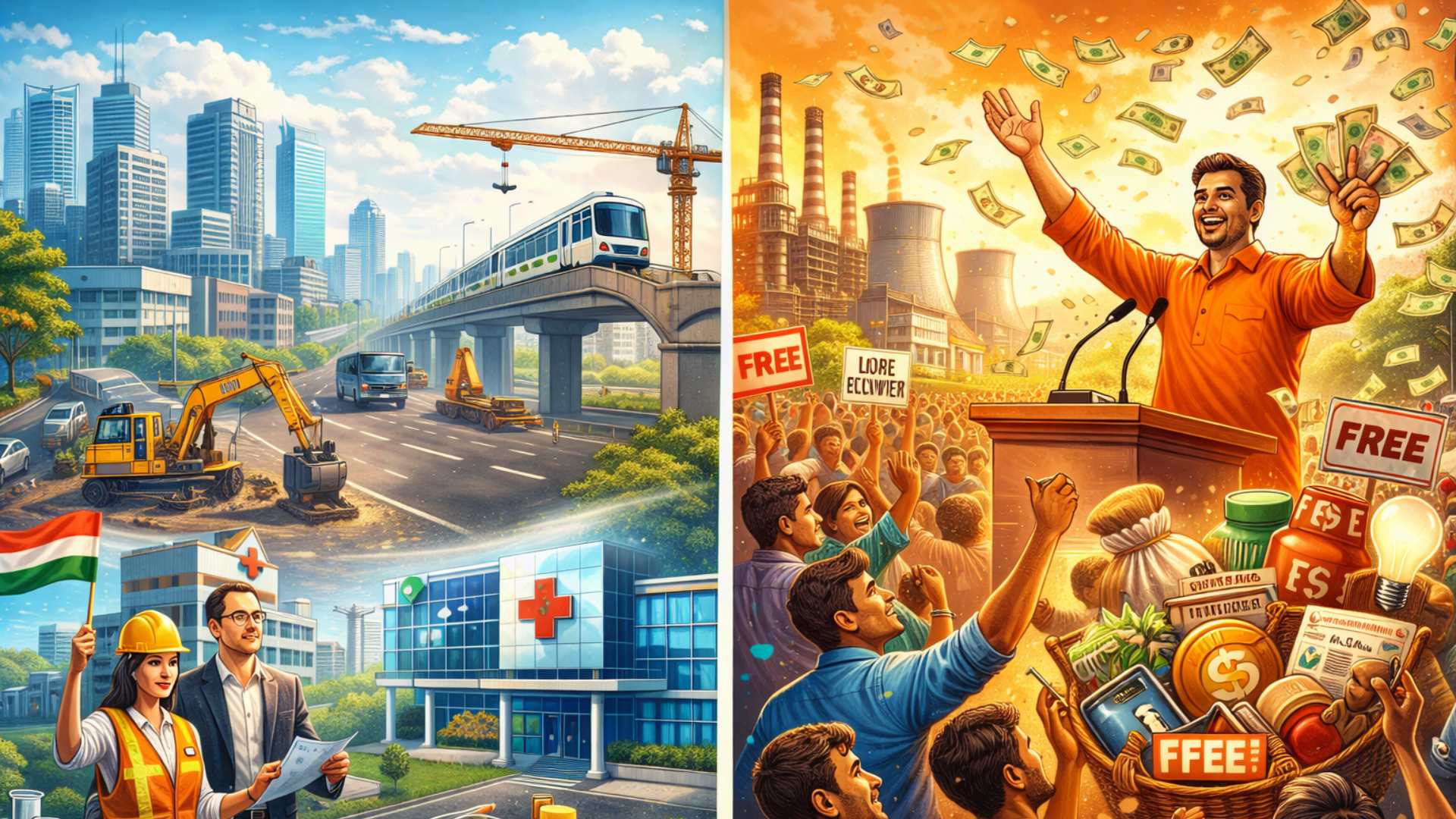
Understanding the Distinction Between Welfare and Development
"The notion of 'quick development' as promised by political parties reflects a persistent fallacy — complex transformations cannot be achieved within short time frames."
Development has become the dominant electoral currency in Indian democracy — invoked across ideological lines, promised in every manifesto, and measured by visible infrastructure rather than structural transformation. Yet the conflation of welfare with development, and short-term populism with long-term growth, represents one of the most consequential distortions in Indian policy discourse today.
| Concept | Welfare | Development |
|---|---|---|
| Time horizon | Short-term | Long-term |
| Orientation | Consumption | Production |
| Objective | Alleviate poverty, reduce vulnerability | Structural transformation, capability expansion |
| Instruments | Cash transfers, food security, subsidies | Infrastructure, education, health systems, institutions |
| Risk if overused | Fiscal strain, crowding out of public investment | Slow to show electoral returns |
Background & Context
India's political economy presents a distinctive tension: large-scale social protection programmes — PM-KISAN, MGNREGA, PDS, free electricity schemes — coexist with ambitions of becoming a USD 5 trillion economy. Both are labelled "development" in electoral discourse, collapsing a crucial analytical distinction that has serious long-term policy consequences.
Amartya Sen's Capability Approach — foundational to understanding development — defines it not as GDP growth but as the expansion of human freedoms through education, health, and social inclusion. This is inherently gradual, requiring sustained public investment across decades, not electoral cycles.
Key Conceptual Distinctions
Welfare vs Development
WELFARE
→ Immediate, redistributive
→ Reduces vulnerability, ensures basic needs
→ Food security, income support, essential services
→ Short-term, consumption-oriented
        ↓
DEVELOPMENT
→ Broad, structural transformation
→ Sustained growth + productivity + human capabilities
→ Long-term, production-oriented
        ↓
CONFUSION arises because:
→ Both use same policy instruments sometimes
→ Both invoked in same electoral promise
→ Boundaries blur in practice
        ↓
CORRECT approach:
→ Welfare and development as COMPLEMENTARY
→ Not interchangeable — not substitutes
Public Goods vs Populist Welfare
PUBLIC GOODS
(Quality schooling, health systems,
infrastructure, rule of law)
        ↓
Non-excludable → Strong positive externalities
→ Raise productivity economy-wide
→ Durable, cumulative, inclusive impact
→ Long-term development outcomes

POPULIST WELFARE
(Free electricity, loan waivers,
cash handouts — politically motivated)
        ↓
Immediate consumption gains
→ Electoral appeal — short-term relief
→ Does NOT expand productive capacity
→ If overused: strains public finances
→ Crowds out investment in public goods
The "Quick Development" Fallacy
Development is path-dependent and incremental — it unfolds through cumulative improvements in productivity, human capital, technological adoption, and governance systems over decades. Political promises of rapid, visible development distort this reality in three ways:
1. Visibility Bias Roads, stadiums, and inaugurations are photographable. Improvements in institutional quality, rule of law, and human capital formation are not. Electoral incentives systematically favour the visible over the transformative.
2. Time Horizon Mismatch
Electoral cycle    →  5 years
Development cycle  →  20–30+ years
        ↓
Politicians optimise for electoral cycle
→ Underinvest in long-gestation public goods
→ Overinvest in visible, short-term transfers
3. Welfare–Development Conflation Labelling consumption-oriented transfers as "development" creates a false impression of structural progress while potentially crowding out the public investment that genuine development requires.
When Welfare Supports Development
The problem is not welfare itself — it is populist, fiscally unsustainable welfare that substitutes for rather than complements development. Well-designed welfare can enhance human capabilities:
| Scheme Type | Developmental Impact |
|---|---|
| Nutrition support (e.g., POSHAN) | Improves human capital formation |
| Employment guarantee (MGNREGA) | Reduces vulnerability, builds rural assets |
| Basic income floors | Reduces distress, enables risk-taking |
| Universal health coverage | Prevents poverty traps from health shocks |
| Free electricity (flat, untargeted) | Fiscal drain, regressive, low productivity impact |
| Loan waivers (blanket) | Moral hazard, banking system stress, no structural fix |
Institutional Dimension
Scholars of institutional economics emphasise that sustainable development depends on the slow consolidation of rules, norms, and state capacity — not on policy announcements. This means:
- Independent judiciary and rule of law
- Effective public service delivery mechanisms
- Bureaucratic capacity and accountability
- Regulatory quality and contract enforcement
These institutions take decades to build and are rarely the subject of electoral promises — yet they are the infrastructure on which all development ultimately rests.
Implications for Indian Democracy
For voters: Development literacy — understanding the difference between a welfare transfer and a structural investment — is a prerequisite for holding governments accountable for genuine long-term progress.
For political parties: Election manifestos that conflate populist transfers with development goals mislead voters and distort policy priorities post-election.
For policymakers: Fiscal sustainability of welfare programmes is non-negotiable. Poorly designed interventions produce leakages, exclusion errors, and limited effectiveness — consuming fiscal space that could fund transformative public goods.
For institutions: The Election Commission and civil society must push for outcome-based accountability in electoral promises — distinguishing between consumption transfers and structural investments in public reporting.
Way Forward
- Reframe electoral discourse — manifestos should explicitly distinguish between welfare commitments and development investments, with measurable long-term indicators
- Fiscal rules for welfare — sustainable welfare spending must be ring-fenced from productive public investment in budgetary architecture
- Outcome indicators beyond GDP — Human Development Index, capability metrics, and institutional quality indices should anchor development assessment
- Long-term policy continuity — development requires insulation of key programmes from electoral cycles through statutory or constitutional protection
- Design quality over quantity — fewer, well-designed welfare programmes with clear capability-enhancing objectives over proliferating populist transfers
Conclusion
India's developmental challenge is not a shortage of ambition — it is a shortage of analytical clarity. When free electricity and a new highway are both called "development," the word loses its meaning and its power to guide policy. Welfare and development are complementary pillars of a just society — but they are not the same thing, do not operate on the same time horizon, and cannot be substituted for each other without cost. A democracy that cannot distinguish between alleviating poverty today and building the productive capacity for tomorrow will find itself doing neither well. The refinement of electoral discourse on this distinction is not merely an academic exercise — it is a democratic necessity.
Attribution
Original content sources and authors
Syllabus classification
How this article maps to GS papers
Main syllabus
GS2Government PoliciesQuick Q&A
What is the conceptual difference between welfare and development in public policy, and why are they often conflated in political discourse?
In contrast, development is a long-term structural process involving economic growth, productivity enhancement, institutional strengthening, and expansion of human capabilities. It includes investments in infrastructure, education, healthcare, and technological innovation. Development is production-oriented and aims at sustainable improvements in living standards over time.
The confusion arises because both welfare and development often coexist in policy frameworks and political narratives. Political actors tend to present welfare schemes as evidence of development due to their visible and immediate impact. For instance, distributing free electricity or loan waivers may be showcased as development achievements, even though they do not necessarily enhance long-term productive capacity.
This conflation has important implications:
- It simplifies complex socio-economic processes into electoral slogans.
- It obscures the distinction between short-term relief and long-term transformation.
- It may lead to policy misalignment, where immediate gains are prioritised over sustainable growth.
A coherent policy approach requires recognising welfare and development as complementary but not interchangeable, ensuring that welfare supports, rather than substitutes, development objectives.
Why is the idea of ‘quick development’ considered a fallacy in democratic politics?
Political narratives, however, tend to emphasise short-term visible outcomes like road construction, housing projects, or welfare distribution. While these are important, they do not capture the full complexity of development. For example, building schools is a visible achievement, but improving learning outcomes requires sustained investments in teacher training, curriculum reform, and governance.
Theoretical perspectives reinforce this view:
- Institutional economics highlights that strong institutions evolve slowly and are crucial for sustainable growth.
- Amartya Sen’s capability approach emphasises expanding human freedoms through long-term investments in health, education, and social inclusion.
The belief in quick development can lead to policy distortions, where governments prioritise projects with immediate electoral returns over those with long-term benefits. For instance, large-scale loan waivers may yield instant political gains but do not enhance agricultural productivity.
Thus, the fallacy lies in equating development with short-term achievements. Sustainable development requires policy continuity, institutional stability, and incremental progress, rather than episodic or populist interventions driven by electoral cycles.
Critically analyse the role of welfare populism in shaping development outcomes in India.
Positive aspects include:
- Social protection: Welfare schemes like MGNREGA and food security programmes reduce vulnerability and poverty.
- Human capital development: Nutrition and health interventions can improve productivity over time.
- Political inclusion: Welfare policies can empower marginalised groups by ensuring minimum living standards.
However, there are significant concerns:
- Fiscal strain: Excessive subsidies and transfers can burden state finances and increase deficits.
- Distorted incentives: Free services may reduce efficiency and discourage productive investments.
- Crowding out: Resources may be diverted from public goods like education and infrastructure.
For example, repeated farm loan waivers in states like Punjab and Maharashtra have provided temporary relief but have not addressed structural issues such as low productivity and market inefficiencies.
Thus, the issue is not welfare per se but its design and intent. Well-targeted and fiscally sustainable welfare can complement development, whereas populist measures that prioritise electoral gains can undermine long-term growth. A balanced approach is essential to ensure that welfare enhances, rather than substitutes, development.
How do public goods contribute more effectively to long-term development compared to populist welfare measures?
Their contribution to development can be understood through:
- Productivity enhancement: Quality education and healthcare improve human capital, leading to higher productivity.
- Economic efficiency: Infrastructure such as roads and ports reduces transaction costs and facilitates trade.
- Institutional strengthening: Rule of law and governance systems create a stable environment for investment.
In contrast, populist welfare measures like free electricity or cash handouts primarily boost short-term consumption without expanding productive capacity. While they may provide immediate relief, their long-term developmental impact is limited.
For instance, investment in India’s highway network under programmes like Bharatmala has had multiplier effects on economic growth, whereas indiscriminate subsidies often lead to fiscal stress without durable benefits.
However, the distinction is not absolute. Certain welfare schemes, such as mid-day meals or employment guarantees, can also contribute to development by improving nutrition and providing income security.
Thus, the key lies in prioritising public goods while designing welfare policies that complement long-term development objectives.
Using India as a case study, examine how the balance between welfare and development can be achieved in policy design.
Examples of this balance include:
- MGNREGA: Provides employment (welfare) while creating rural assets like roads and ponds (development).
- Mid-Day Meal Scheme: Addresses hunger (welfare) and improves educational outcomes (development).
- Digital India and infrastructure projects: Focus on long-term economic transformation.
These examples show that welfare and development can be mutually reinforcing when designed effectively. However, challenges arise when welfare policies become fiscally unsustainable or politically motivated, such as excessive subsidies or loan waivers.
Key principles for achieving balance include:
- Targeting and efficiency: Ensuring benefits reach the intended population.
- Fiscal sustainability: Avoiding excessive burden on public finances.
- Complementarity: Aligning welfare schemes with long-term development goals.
For instance, Direct Benefit Transfer (DBT) has improved efficiency by reducing leakages in welfare delivery.
Thus, India’s experience highlights that the challenge is not choosing between welfare and development, but integrating them through coherent and well-designed policies.
What are the risks associated with conflating welfare populism with long-term development goals?
The key risks include:
- Fiscal stress: Excessive subsidies and transfers can lead to budget deficits and reduced fiscal space.
- Policy distortion: Governments may prioritise politically attractive schemes over necessary but less visible investments.
- Reduced growth potential: Lack of investment in infrastructure and human capital can hinder long-term economic growth.
For example, states offering free electricity to farmers often face financial strain in their power sectors, affecting service quality and investment capacity.
Additionally, such conflation undermines institutional credibility. When development is reduced to short-term benefits, it weakens public understanding of complex economic processes and reduces accountability for long-term outcomes.
From a governance perspective, this can lead to a cycle where political competition encourages more populist promises, further straining public finances.
Therefore, it is crucial to maintain a clear distinction between welfare and development, ensuring that welfare policies are designed to support, rather than replace, long-term development strategies.
Practice questions
1 question for mains preparation