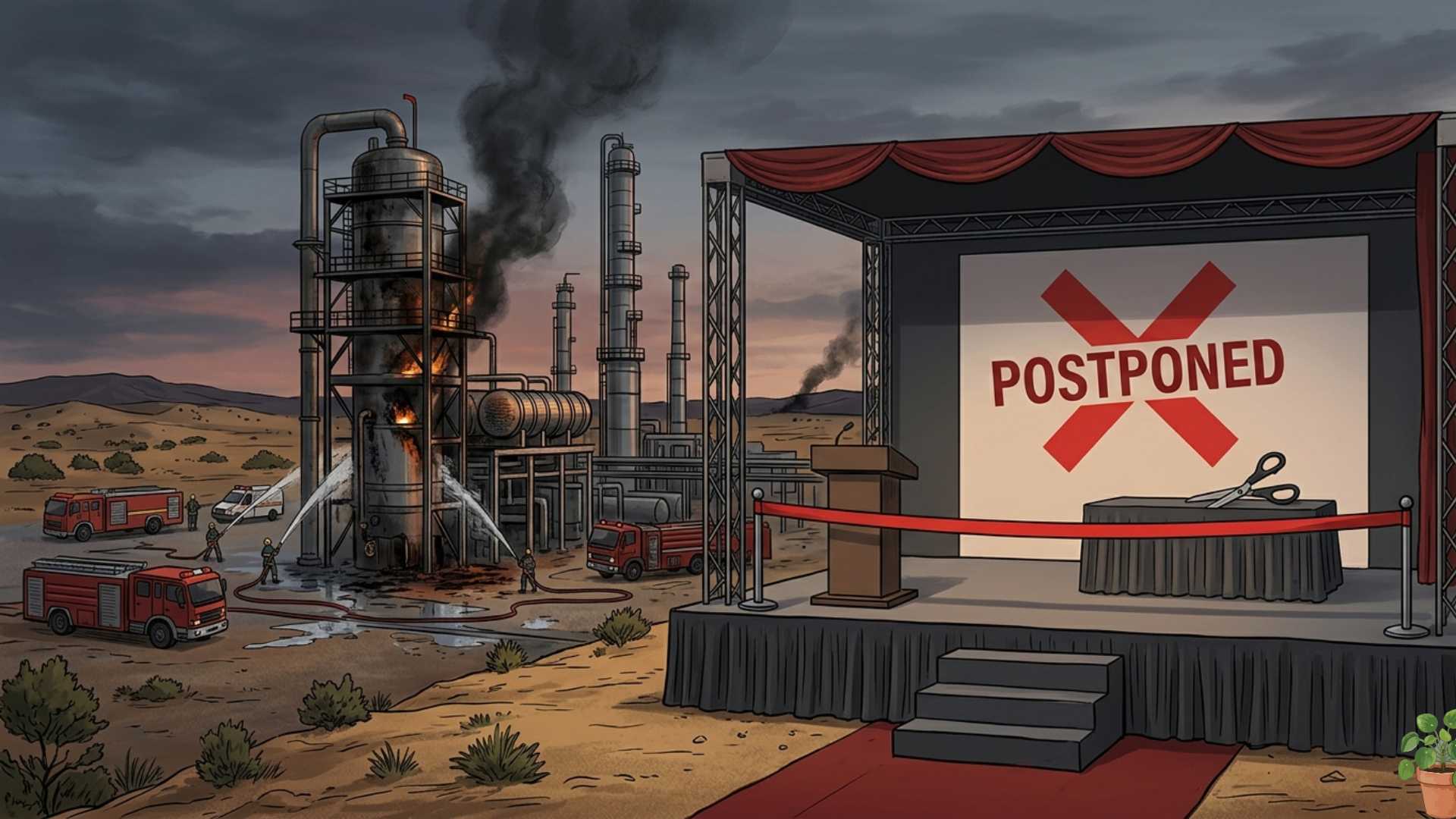
Fire Erupts at Rajasthan Refinery Just Before Inauguration

Introduction
On April 20, 2026, a fire broke out at the HPCL Rajasthan Refinery Limited (HRRL) complex in Balotra, Rajasthan — a day before its scheduled inauguration by the Prime Minister. The fire, localised in the heat exchanger stack of the Crude Distillation Unit (CDU), forced postponement of the inauguration of India's largest greenfield refinery-cum-petrochemical complex. No casualties were reported.
| Key Detail | Figure |
|---|---|
| Project cost | ₹79,459 crore |
| Refinery capacity | 9 MMTPA |
| Petrochemical capacity | 2.4 MMTPA |
| JV structure | HPCL + Govt. of Rajasthan (26% equity) |
| Fire location | Heat exchanger stack, CDU section |
| Prima facie cause | Hydrocarbon leakage via valve/flange |
| Casualties | None reported |
Background & Context
HRRL is a greenfield refinery-cum-petrochemical complex — India's largest single-location refinery project — located in Balotra, Rajasthan. It is a joint venture between HPCL (Hindustan Petroleum Corporation Limited) and the Government of Rajasthan.
The project is significant for three reasons:
- Energy security: Adds 9 MMTPA refining capacity to India's western region, reducing dependence on distant refineries.
- Petrochemical integration: 2.4 MMTPA petrochemical capacity positions Rajasthan as an industrial hub.
- Regional development: Flagship project for Rajasthan's economic transformation — described by both ruling and opposition leaders as "a matter of pride."
Key Concepts
Crude Distillation Unit (CDU) — The first and most critical processing unit in any refinery. Acts as a sorting station: heats raw crude oil and separates it into fractions (LPG, naphtha, kerosene, diesel, fuel oil) based on boiling points. All downstream processing depends on CDU output.
Vacuum Distillation Unit (VDU) — Processes the heavy residue from CDU under vacuum conditions to extract additional valuable fractions. Located adjacent to CDU — both were isolated during the fire.
Heat Exchanger — Equipment that transfers heat between process streams to improve energy efficiency. Hydrocarbon leakage through valves or flanges in heat exchanger circuits is a known ignition risk in refineries — the prima facie cause identified here.
Greenfield Refinery — Built from scratch on new land, as opposed to brownfield (expansion of existing facility). Higher capital cost but allows modern design integration from the ground up.
MMTPA — Million Metric Tonnes Per Annum; standard unit for refinery capacity measurement.
What Happened — Technical Sequence
Hydrocarbon leakage
(valve/flange failure in heat exchanger circuit)
        ↓
Hydrocarbons contact ignition source
        ↓
Fire localised in heat exchanger stack
        ↓
CDU + VDU quickly isolated ✓
All other refinery sections unaffected ✓
No structural damage ✓
No casualties ✓
        ↓
Fire brought under control
Internal + external expert investigation ordered
Governance & Safety Dimensions
Pre-inauguration Safety Protocols The fire occurring one day before PM inauguration raises questions about pre-commissioning safety checks — the final phase before a refinery goes live involves pressurising units with hydrocarbons for the first time, which is inherently the highest-risk phase of operations.
Regulatory Framework for Refinery Safety
| Body/Law | Role |
|---|---|
| PESO (Petroleum & Explosives Safety Organisation) | Licensing + safety inspection of petroleum installations |
| Factories Act, 1948 | Worker safety, hazardous process regulations |
| Environment Protection Act, 1986 | Environmental clearance for refineries |
| OISD (Oil Industry Safety Directorate) | Sets safety standards for oil sector installations |
| PNGRB (Petroleum & Natural Gas Regulatory Board) | Downstream regulation including refinery operations |
Investigation ordered by MoPNG — internal + external expert team. Findings will determine whether this was a pre-commissioning procedural lapse or an equipment design/manufacturing defect.
Significance of HRRL for India
Energy Security
- Adds significant refining capacity in western India — a region currently underserved by domestic refinery infrastructure.
- Reduces crude-to-product transportation costs for Rajasthan and neighbouring states.
Petrochemical Self-Reliance
- 2.4 MMTPA petrochemical capacity supports India's goal of reducing petrochemical imports — aligned with the Petroleum, Chemicals and Petrochemicals Investment Region (PCPIR) policy.
- Feeds into downstream plastic, textile, and chemical industries.
Rajasthan's Industrial Transformation
- Balotra district — historically a textile hub — gains a major industrial anchor.
- Expected to generate significant direct and indirect employment.
Geopolitical Context
- India's refining capacity expansion is a strategic priority given dependence on imported refined products and the global energy transition.
Conclusion
The HRRL fire, while contained without casualties, is a reminder that industrial safety cannot be subordinated to inauguration timelines. Pre-commissioning phases of major refineries — when hydrocarbons are introduced into systems for the first time — carry the highest operational risk and demand the most rigorous safety protocols. The incident also underscores the importance of robust regulatory oversight by PESO and OISD throughout the commissioning process, not just at the point of formal inauguration. HRRL remains a strategically vital project for India's energy security and Rajasthan's economic development — its successful commissioning, when it occurs, must rest on safety, not spectacle.
Attribution
Original content sources and authors


Syllabus classification
How this article maps to GS papers
Main syllabus
GS2Government PoliciesQuick Q&A
What is the role and significance of a Crude Distillation Unit (CDU) in a refinery complex?
Strategic importance: The CDU determines the operational efficiency of the entire refinery. Any disruption in this unit, such as the fire incident at the HRRL refinery, can halt or significantly affect downstream processing units like the Vacuum Distillation Unit (VDU) and petrochemical units. Thus, CDU is often referred to as the “heart of the refinery.”
Industrial relevance: In large integrated complexes like the HPCL Rajasthan Refinery Limited (HRRL), which has a capacity of 9 MMTPA, the CDU ensures optimal utilization of crude and maximization of value-added products. Its safe and efficient functioning is critical not only for economic output but also for safety and environmental management.
Why are industrial safety and risk management critical in refinery-cum-petrochemical complexes?
Economic and social implications: Such incidents can lead to delays in project commissioning, as seen with the postponement of the refinery’s inauguration. Moreover, refineries are capital-intensive projects (₹79,459 crore in this case), and disruptions can have cascading effects on employment, regional development, and energy supply chains.
Regulatory and environmental concerns: Industrial accidents can cause environmental damage and loss of public trust. Therefore, adherence to standard operating procedures (SOPs), regular safety audits, and compliance with environmental norms are crucial. India’s regulatory bodies like the Petroleum and Natural Gas Regulatory Board (PNGRB) play a vital role in ensuring such compliance.
How are fire incidents in refineries typically managed and contained to prevent escalation?
Operational protocols: Emergency shutdown systems (ESD) are activated to cut off fuel supply and reduce pressure in pipelines. Trained personnel and on-site fire brigades respond immediately. The quick isolation of CDU and VDU units in this case reflects adherence to standard emergency protocols.
Post-incident response: After containment, a detailed investigation is conducted to identify the root cause. In this case, both internal and external experts have been tasked with assessing the fire. Lessons learned are used to upgrade safety systems and prevent recurrence, ensuring continuous improvement in industrial safety practices.
What are the likely causes of fire incidents in refinery units, and how can they be mitigated?
Systemic issues: Aging infrastructure, inadequate maintenance, and lapses in safety protocols can exacerbate risks. For instance, failure to detect micro-leaks or delayed maintenance of critical components can lead to catastrophic outcomes.
Mitigation strategies: Preventive measures include regular inspection of pipelines and valves, use of corrosion-resistant materials, and adoption of predictive maintenance technologies like IoT sensors. Additionally, training personnel and conducting mock drills can enhance preparedness. Globally, incidents like the BP Texas refinery explosion (2005) highlight the importance of stringent safety oversight.
Can you provide examples of similar industrial incidents and their broader implications?
Indian context: In India, incidents like the Visakhapatnam HPCL refinery fire (2020) and the ONGC gas blowout in Assam (2020) have highlighted vulnerabilities in industrial safety. These events prompted reviews of safety protocols and emergency response mechanisms.
Lessons learned: Such incidents underscore the need for a proactive safety culture, investment in technology, and strong regulatory oversight. They also demonstrate the socio-economic impact of industrial accidents, including loss of investor confidence and environmental degradation.
Critically analyze the economic and strategic importance of the HPCL Rajasthan Refinery Limited (HRRL) project.
Strategic importance: The refinery reduces dependence on imported petroleum products and strengthens India’s energy security. Its location in Rajasthan also promotes balanced regional development and industrialization in a relatively underdeveloped area.
Challenges and concerns: However, incidents like the recent fire highlight risks associated with such mega-projects. Environmental concerns, high capital costs, and operational risks must be managed effectively. A balanced approach involving economic growth, environmental sustainability, and robust safety mechanisms is essential for long-term success.
As a policymaker, what measures would you suggest to enhance safety and resilience in India’s refinery sector based on this incident?
Technological interventions: Adoption of advanced technologies such as AI-based predictive maintenance, real-time monitoring systems, and automated shutdown mechanisms can significantly reduce risks. Investments in research and development can further improve safety standards.
Capacity building and awareness: Training personnel, conducting emergency drills, and fostering a safety-first culture are essential. Public-private partnerships can be leveraged to share best practices. Additionally, community awareness programs can help mitigate the impact of industrial accidents on nearby populations.
Practice questions
1 question for mains preparation