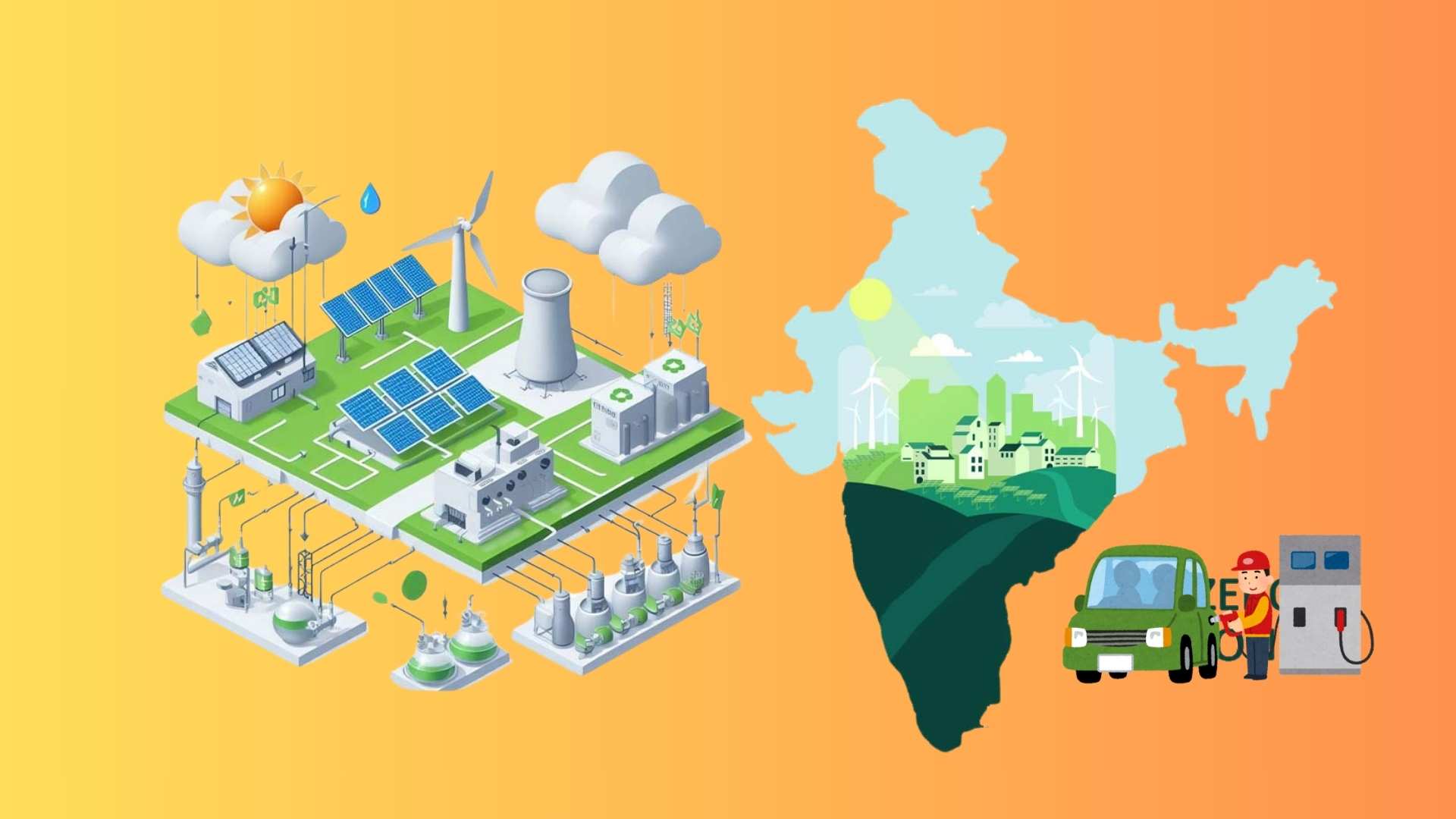
NITI Aayog's Vision for a Development-First Net Zero Future

Understanding India's pathway to economic growth and climate goals for 2070 through strategic reform and electrification.
6 mins read
India’s $30-trillion growth path aligned with net-zero climate transition
Not Started

1. Context: India’s Development Goals and Net-Zero Commitment

India has articulated an ambitious dual objective of becoming a $30 trillion economy by 2047 under the vision of Viksit Bharat, while achieving net-zero greenhouse gas emissions by 2070. According to NITI Aayog, these two goals are not contradictory but can be pursued simultaneously through a carefully sequenced transition.

Through a series of 11 sectoral reports, NITI Aayog has proposed a “development-first” pathway that embeds climate action within India’s growth trajectory rather than treating decarbonisation as a constraint. This approach is particularly significant for a lower-middle-income country with large developmental deficits.

The framework underscores India’s limited historical responsibility for climate change while highlighting its disproportionate vulnerability to climate impacts. Ignoring this balance risks either slowing growth or exacerbating climate-induced economic losses.

The underlying logic is that climate action must be aligned with development priorities to ensure political feasibility and long-term sustainability; separating the two could undermine both growth and climate objectives.

“India has not contributed to the problem, but is one of the countries most affected by it.” — BVR Subrahmanyam, CEO, NITI Aayog


2. Decoupling Economic Growth from Emissions

A central finding of the NITI Aayog analysis is that economic growth and greenhouse-gas emissions can be progressively decoupled. The reports project that India’s GDP could rise 11-fold by 2070, while final energy demand increases only 2.1–2.6 times over 2025 levels, provided efficiency and structural changes are implemented.

This decoupling challenges the traditional assumption that higher growth necessarily leads to proportionally higher emissions. It reframes climate policy as an efficiency and productivity issue rather than a trade-off with prosperity.

Failure to pursue decoupling would lock India into carbon-intensive infrastructure, increasing future transition costs and climate risks.

The logic is that productivity-led growth reduces energy intensity; if ignored, growth would amplify emissions and fiscal burdens from climate damages.


3. Demand-Side Measures as the Transition Anchor

The reports place strong emphasis on demand-side interventions, identifying them as among the most cost-effective tools for achieving net zero. Measures such as energy efficiency, behavioural change, and material circularity are highlighted as having low or even negative marginal abatement costs.

Demand moderation reduces pressure on energy infrastructure, lowers investment requirements, and accelerates emissions reductions without compromising welfare. This is especially relevant for a rapidly urbanising and industrialising economy.

Neglecting demand-side action would shift the entire burden to supply-side expansion, raising costs and increasing systemic stress.

The governance logic is that reducing demand growth eases both fiscal and infrastructural constraints; ignoring it makes the transition capital-intensive and inefficient.


4. “Avoid–Shift–Improve” Framework Across Sectors

NITI Aayog recommends an economy-wide “avoid–shift–improve” framework to operationalise demand-side action. This integrates urban planning, transport, industrial processes, and material use into a coherent low-carbon strategy.

Compact and transit-oriented urban design, public and shared transport, super-efficient appliances, and circular economy practices are presented as enablers of sustainable growth rather than limitations.

If sectoral planning remains fragmented, these synergies would be lost, weakening emissions reduction and development outcomes.

The logic is that systemic coordination multiplies benefits across sectors; isolated interventions deliver suboptimal results.


5. Electrification as the Principal Pathway

Electrification is identified as the primary driver of low-carbon growth. Electricity’s share in final energy demand is projected to rise from about 21% in 2025 to around 60% by 2070 under the net-zero scenario.

This shift will be driven by electric mobility, electric cooking, and electrification of industrial process heat. However, it requires deep reforms in power systems, grid management, and pricing structures.

Without system-level reforms, higher electrification could strain grids and undermine reliability.

The logic is that clean electricity enables economy-wide decarbonisation; if grid reforms lag, electrification benefits will not materialise.


6. Power-Sector and Energy-System Reforms

The report calls for grid modernisation, time-of-day tariffs, flexible operation of coal during transition, and rapid deployment of energy storage. These measures are essential to integrate high shares of renewables while maintaining system stability.

Vice-Chairman Suman Bery cautioned against rigid “mission-based” pushes that could create high-cost domestic lobbies, emphasising the need for competition and market design.

An inflexible, high-cost energy system would undermine both industrial competitiveness and public acceptance of the transition.

The logic is that competitive markets lower transition costs; ignoring this risks inefficiency and rent-seeking.

“Preserving competition and good market design is crucial to avoid a high-cost energy system.” — Suman Bery, Vice-Chairman, NITI Aayog


7. Financing the Net-Zero Transition

Financing is identified as the most binding constraint. Achieving net zero will require cumulative investments of $22.7 trillion by 2070, far exceeding current capital flows.

A financing gap of $6.5 trillion must be bridged, largely through external sources, including concessional finance and grants for technologies not yet commercially viable.

Without adequate finance, the transition risks slowing down or becoming fiscally destabilising.

The logic is that capital availability determines transition speed; ignoring financing gaps delays emissions reduction and growth co-benefits.


8. Domestic Savings, Institutions, and Green Finance

Chief Economic Advisor V. Anantha Nageswaran stressed that most resources must be mobilised domestically through higher household savings, asset financialisation, and sustained employment generation.

To support this, the report recommends creating a National Green Finance Institution, a unified climate-finance taxonomy, and deeper corporate bond markets to crowd in private and foreign capital.

Weak financial institutions would limit India’s ability to absorb and deploy large-scale green investment.

The logic is that institutional capacity anchors financial mobilisation; without it, capital inflows remain fragmented and insufficient.


9. Social and Spatial Dimensions of the Transition

The transition has significant social and regional implications, affecting jobs, livelihoods, and local economies. NITI Aayog highlights the need for district-level transition plans to address uneven impacts.

A coordinating body under the Prime Minister’s Council on Climate Change is proposed to ensure coherence across ministries and levels of government.

Ignoring spatial and social dimensions could lead to resistance, inequality, and implementation failures.

The logic is that inclusive planning sustains legitimacy; neglecting it risks social backlash against climate policy.


Conclusion

NITI Aayog’s development-first net-zero framework positions climate action as an enabler of long-term growth rather than a constraint. By combining demand moderation, electrification, market-based reforms, and innovative finance, India can pursue Viksit Bharat while honouring its climate commitments. The success of this pathway will depend on sustained institutional reform, financial mobilisation, and inclusive implementation.

Quick Q&A

Everything you need to know

A “development-first” net-zero transition, as articulated by NITI Aayog, places India’s economic growth, poverty reduction, and structural transformation at the centre of climate action rather than treating emissions reduction as an overriding constraint. Unlike approaches adopted by many advanced economies—where decarbonisation often follows a consumption-saturated growth path—India’s strategy acknowledges that the country is still industrialising and urbanising. The emphasis is therefore on achieving development outcomes in a low-carbon manner, not postponing development itself.

The reports highlight that India can become a $30 trillion economy by 2047 while still achieving net-zero emissions by 2070 through progressive decoupling of GDP growth from emissions. This decoupling is enabled by energy efficiency, electrification, and circular economy practices. For example, GDP is projected to rise nearly 11-fold by 2070, while final energy demand increases only 2.1–2.6 times compared to 2025 levels—an indicator of structural efficiency gains rather than energy-intensive growth.

For UPSC interviews, this framework is important because it reframes climate action as a development enabler. It challenges the narrative that climate commitments necessarily impose growth sacrifices on developing countries, and instead positions sustainability as a pathway to resilient, inclusive, and competitive economic growth.

NITI Aayog emphasises demand-side measures because they represent the most cost-effective and scalable levers for emissions reduction in a developing economy like India. Demand-side actions—such as energy efficiency, behavioural change, and material circularity—often have low or even negative marginal abatement costs. This means they can reduce emissions while also lowering overall system costs and easing pressure on infrastructure investment.

The report adopts an economy-wide “avoid–shift–improve” framework. This includes avoiding unnecessary energy use through compact urban design, shifting to public and shared transport, and improving efficiency through super-efficient appliances and industrial processes. Concrete examples include higher scrap usage in steel and aluminium, lower clinker ratios in cement, and adoption of energy-efficient cooling and lighting technologies. These measures simultaneously reduce emissions, import dependence, and household energy bills.

From a policy perspective, demand-side measures are particularly relevant for India because they align climate goals with welfare and competitiveness objectives. For UPSC aspirants, this demonstrates how climate policy can be designed as a co-benefit-driven strategy rather than a compliance-driven obligation.

Large-scale electrification is identified as the principal pathway for low-carbon growth because it allows emissions to be reduced across multiple end-use sectors while leveraging cleaner power generation. According to the report, electricity’s share in India’s final energy demand is projected to rise from about 21% in 2025 to nearly 60% by 2070. This transformation is driven by electric mobility, electric cooking, and electrification of industrial process heat.

Electrification enables decarbonisation at scale when paired with an expanding share of renewable energy. For instance, electric vehicles reduce oil dependence and urban air pollution, while electric cooking lowers indoor air pollution and reduces reliance on imported LPG. In industry, electric furnaces and heat pumps can replace fossil-fuel-based thermal processes over time, improving efficiency and controllability.

However, the transition requires deep power-sector reforms, including grid modernisation, time-of-day tariffs, flexible coal operation during the transition, and rapid deployment of storage technologies. For UPSC interviews, this highlights the systemic nature of energy transitions—where technology, market design, and institutional reform must progress together.

NITI Aayog cautions against narrowly designed mission-based energy pushes because they can inadvertently create high-cost domestic lobbies and reduce system flexibility. While targeted missions can accelerate deployment of strategic technologies—such as renewables or nuclear energy—they also risk locking the system into suboptimal cost structures if competition and market signals are weakened. This concern is especially relevant for capital-intensive technologies with long gestation periods.

The report underscores the importance of diversification and competition in energy markets. India’s electricity sector has evolved from a state-dominated system to a more competitive ecosystem after the Electricity Act of 2003 and the rise of private renewable developers. This shift has delivered benefits in terms of cost reductions, innovation, and operational nimbleness. Over-centralised mission approaches could reverse these gains by privileging certain technologies irrespective of evolving costs.

For UPSC analysis, the key takeaway is that energy transitions must balance strategic direction with market discipline. Climate policy should guide outcomes—such as emissions reduction and reliability—while allowing competition to determine the most cost-effective technological pathways.

Financing emerges as the most binding constraint because the scale of investment required for India’s net-zero transition is unprecedented. The report estimates cumulative investment needs of about 22.7trillionby2070,farexceedingcurrentfinancialflows.Evenafteraccountingfordomesticresources,afinancinggapofroughly22.7 trillion by 2070, far exceeding current financial flows. Even after accounting for domestic resources, a financing gap of roughly 6.5 trillion remains, much of which must come from external sources such as concessional finance and grants.

A key challenge is that many net-zero technologies—such as long-duration storage, green hydrogen, and advanced industrial decarbonisation—are not yet commercially viable. This raises risks for private investors and increases the cost of capital. Moreover, India’s financial system has limited depth in long-term corporate bond markets, constraining the mobilisation of patient capital required for infrastructure-heavy transitions.

For UPSC aspirants, this underscores the importance of climate finance as a development issue. India’s net-zero pathway is not merely about technology adoption, but about reshaping domestic and international financial architecture to align long-term capital with sustainability goals.

The proposed National Green Finance Institution (NGFI) is envisaged as an anchor institution to mobilise, de-risk, and channel capital towards India’s net-zero transition. Its primary role would be to structure blended finance, provide guarantees, and crowd in private and foreign investment for projects that are socially desirable but commercially risky. This is particularly relevant for emerging technologies such as green hydrogen, battery storage, and industrial decarbonisation.

The NGFI would also support the development of a unified climate-finance taxonomy, improving transparency and investor confidence. By coordinating with deeper corporate bond markets and multilateral institutions, it can reduce financing costs and improve access to long-term capital. Comparable institutions, such as Germany’s KfW or the UK’s Green Investment Bank, demonstrate how public financial institutions can catalyse large-scale private investment.

For UPSC interviews, this case study highlights how institutional innovation is critical to translating climate ambition into implementation. It reinforces the idea that achieving net zero is as much a financial and governance challenge as it is a technological one.

Attribution

Original content sources and authors

Sign in to track your reading progress

Comments (0)

Please sign in to comment

No comments yet. Be the first to comment!