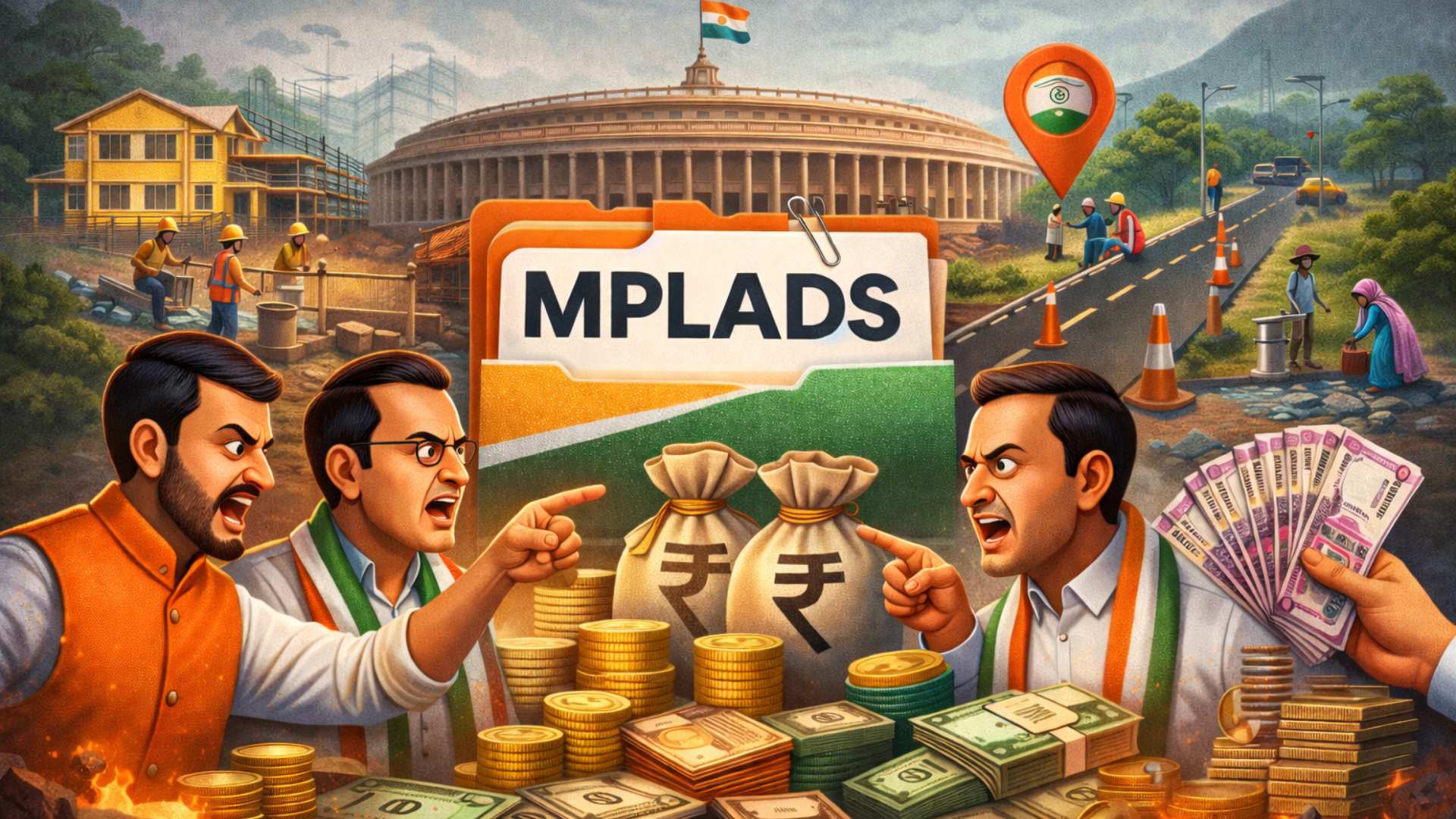
Why MPLADS Funds Should Not Be Scrapped

Despite allegations of misuse, the ongoing debate highlights the crucial role of MPLADS in community development across India.
5 mins read
MPLADS in focus: When used well, local funds translate into real development
Not Started

1. Context: MPLADS Scheme and Its Governance Rationale

The Members of Parliament Local Area Development Scheme (MPLADS) was launched in December 1993 as a Central Sector Scheme, fully funded by the Government of India. It enables MPs to recommend local developmental works focused on creating durable community assets such as roads, school buildings, drinking water facilities, and health infrastructure.

The scheme reflects a governance choice to combine central funding with local political knowledge, allowing MPs to address micro-level development gaps that may be overlooked by larger flagship schemes. Over time, MPLADS has become an important instrument for constituency-level responsiveness and political accountability.

However, MPLADS has also faced periodic criticism on grounds of misuse, politicisation, and overlap with executive functions. Each controversy revives the broader debate on whether legislators should have a role in development expenditure.

If the underlying rationale of MPLADS is misunderstood, reform debates risk shifting from evidence-based assessment to episodic political contestation.

“Democracy is not just about representation, but responsiveness.” — Amartya Sen

The governance logic is that decentralised discretion can complement central planning. Ignoring this balance risks weakening local responsiveness in development delivery.


2. The Recent Controversy: Cross-State Use of MPLADS Funds

The latest controversy emerged when the BJP alleged that three Congress MPs from Rajasthan allocated MPLADS funds for projects in Kaithal district, Haryana, instead of their home constituencies. The allocations involved ₹25 lakh, ₹50 lakh, and ₹45 lakh, respectively.

The BJP argued that such use violated the core objective of MPLADS and raised concerns about cross-State utilisation of public funds, particularly given the alleged political linkage to a Congress leader’s family constituency.

The Congress countered these allegations by citing MPLADS Guidelines (2023), which explicitly allow MPs to recommend works up to ₹50 lakh per financial year outside their constituency or State, and up to ₹1 crore in cases of severe natural calamities.

The dispute highlights the gap between legal permissibility and political perception, underscoring how procedural flexibility can become politically contentious.

The governance lesson is that ambiguity in public finance rules, even when lawful, can erode trust if not transparently communicated.


3. Design Features and Financial Scale of MPLADS

Under MPLADS, each MP can recommend works worth ₹5 crore annually, generally within their constituency. The funds are released by the Centre and implemented through district authorities, maintaining a separation between recommendation and execution.

Statistics:

  • 18th Lok Sabha: ₹5,486 crore allocated; ₹1,453.69 crore spent so far (Live MPLADS Dashboard).
  • 17th Lok Sabha (2019–2024):
    • Allocation: ₹4,837.87 crore
    • Expenditure: ₹3,639.53 crore
    • Works recommended: 96,211
    • Works completed: 41,143
    • Budget utilisation: 75.23%
  • Unspent funds partly reflect disruptions during COVID-19.

Historical data show consistent improvement in utilisation:

  • 16th Lok Sabha (2014–2019): 8.7% funds unspent
  • 15th Lok Sabha (2009–2014): 3.47% unspent
  • 14th Lok Sabha (2004–2009): 0.99% unspent

These figures indicate that systemic underutilisation is not the dominant trend.

The fiscal logic is that utilisation efficiency must be judged over time and context. Ignoring longitudinal data leads to misleading conclusions about scheme performance.


4. Evidence from High-Performing MPs: Utilisation and Transparency

Several MPs have demonstrated effective and transparent use of MPLADS funds, countering the narrative of systemic misuse.

Comparative examples:

  • Sant Balbir Singh Seechewal (Rajya Sabha, Punjab):
    • Utilised ₹9.34 crore out of ₹14.72 crore (>63%)
    • Focused on water scarcity interventions.
  • Iqra Choudhary (Lok Sabha, Kairana):
    • Maintained a fully updated MPLADS profile with geotagged images, enhancing transparency.
  • Tejasvi Surya (Lok Sabha, Bengaluru South):
    • Spent ₹19.36 crore (17th Lok Sabha)
    • Also ranked high in parliamentary questions, indicating legislative engagement.
  • Abhishek Banerjee (Lok Sabha, Diamond Harbour):
    • Completed 173 projects
    • Spent ₹6.13 crore.

These cases show that outcomes depend more on individual capacity and intent than on scheme design.

“Institutions perform as well as the people who run them.” — Douglass North

The governance insight is that performance variation reflects administrative capability. Ignoring best practices prevents institutional learning and replication.


5. Evaluating the Case for Discontinuation

Critics argue that MPLADS blurs the separation of powers by involving legislators in executive functions. However, the scheme limits MPs to recommendatory roles, with execution handled by district administrations.

Empirical data do not support claims of chronic underutilisation or universal misuse. Instead, the evidence suggests variable performance, which is typical of decentralised schemes.

Discontinuing MPLADS may weaken MPs’ ability to address immediate local needs, especially in areas where State capacity is constrained.

From a policy perspective, abolishing a functioning scheme due to isolated misuse risks throwing out institutional capacity along with inefficiencies.


6. Way Forward: Improving Effectiveness Without Dilution

Rather than discontinuation or budget reduction, targeted reforms can improve MPLADS outcomes.

Policy measures:

  • Short capacity-building workshops for MPs on project selection and monitoring.
  • Strengthening digital transparency tools, including mandatory geotagging.
  • Clearer public communication of guideline provisions to reduce political misinterpretation.
  • Sharing best practices from high-performing MPs.

Such measures preserve the scheme’s core objective while addressing legitimate concerns.

“Reform is not about dismantling institutions, but making them work better.” — OECD Governance Principles

The development logic is that incremental reforms yield higher returns than disruptive overhauls. Ignoring capacity gaps perpetuates uneven outcomes.


Conclusion

The MPLADS scheme remains a relevant instrument for constituency-level development and political accountability. While controversies over fund use warrant scrutiny, available evidence does not justify discontinuation. Strengthening transparency, capacity, and communication can ensure that MPLADS continues to support inclusive and responsive governance while aligning with constitutional and fiscal principles.

Quick Q&A

Everything you need to know

MPLADS is a Central Sector Scheme launched in December 1993, fully funded by the Government of India, which allows Members of Parliament to recommend developmental works in their constituencies. Each MP is entitled to recommend works worth up to ₹5 crore annually, primarily aimed at creating durable community assets such as roads, school buildings, drinking water facilities, sanitation infrastructure and public health assets. Importantly, MPs do not execute projects themselves; implementation is carried out by district authorities, preserving the executive’s role.

The core objective of MPLADS is to bridge critical local development gaps that may not receive priority under large, centrally sponsored or state schemes. MPs, as elected representatives, are often best placed to identify grassroots-level needs that affect daily life but fall below the threshold of major policy interventions. MPLADS thus acts as a flexible, demand-driven complement to formal planning mechanisms rather than a substitute for them.

Over time, MPLADS has also acquired a political and accountability dimension. Since projects are tied to MPs’ recommendations, citizens can directly associate local development outcomes with their representatives’ performance. This creates incentives for MPs to focus on visible, impactful works. As the article shows through data across multiple Lok Sabhas, the scheme has generally seen high levels of fund utilisation, suggesting that it addresses a real governance need rather than being merely a discretionary political tool.

The controversy arose because MPLADS is conceptually rooted in constituency-centric development. When MPs allocate funds outside their State or constituency, it raises questions about whether public money is being diverted away from the electorate that elected them. In the Rajasthan-Haryana case, the opposition alleged that such allocations violated the spirit of the scheme and were politically motivated, thus undermining public trust.

However, the issue is not purely legal but also normative. The 2023 MPLADS guidelines explicitly allow MPs to recommend works up to ₹50 lakh outside their constituency or State in a financial year, except during severe natural calamities. This means the allocations were technically permissible. The real concern, therefore, lies in whether such discretion is being exercised in a manner consistent with the scheme’s intent of addressing local developmental deficits.

From a constitutional perspective, MPLADS already walks a fine line between legislative recommendation and executive implementation. Controversies of this nature revive broader debates on accountability, cooperative federalism and ethical use of discretionary funds. They underline the need for transparency and clearer norms rather than outright abolition of the scheme.

Critics of MPLADS argue that it blurs the separation of powers by allowing legislators to influence executive functions, and that funds are often misused or underutilised. Instances of delayed projects, incomplete works and allegations of political favouritism have fuelled this narrative. From a governance theory perspective, such concerns cannot be dismissed outright, as discretionary schemes are inherently vulnerable to rent-seeking.

However, empirical data presented in the article weakens the case for discontinuation. Across the 14th to 17th Lok Sabhas, unspent funds were consistently low—often below 10%—except during the COVID-19 years. This indicates that, systemically, MPLADS funds are largely utilised. Moreover, several MPs have demonstrated best practices, including full utilisation, focus on critical needs like water scarcity, and transparency through geotagged reporting.

A balanced assessment suggests that the problem lies not in the scheme’s design but in capacity and oversight gaps. Instead of abolition, reforms such as better training for MPs, stronger monitoring by district authorities and enhanced public disclosure would preserve the developmental benefits while reducing misuse.

Successful examples demonstrate that MPLADS can be a powerful tool when aligned with local priorities. For instance, Rajya Sabha MP Sant Balbir Singh Seechewal used a majority of his funds to address water scarcity in Punjab’s villages—an area-specific challenge with long-term social benefits. This illustrates how flexible funding can be channelled into environmentally and socially critical sectors.

Similarly, Iqra Choudhary’s maintenance of a fully updated MPLADS profile with geotagged images highlights the role of transparency and citizen oversight. Such practices reduce information asymmetry and strengthen public trust. Other MPs like Tejasvi Surya and Abhishek Banerjee show that high utilisation can coexist with legislative engagement and administrative efficiency.

These cases suggest that MPLADS works best when MPs treat it not as a political entitlement but as a development responsibility. They also show that outcomes depend more on individual capacity and intent than on structural flaws in the scheme itself.

Improving MPLADS effectiveness requires strengthening processes rather than dismantling the scheme. One practical reform suggested in the article is organising short capacity-building workshops for MPs, supported by technical consultants. Such interventions can help MPs identify high-impact projects, navigate administrative procedures and ensure timely completion.

Accountability can be enhanced through digital transparency tools. Expanding the use of geotagged images, real-time dashboards and third-party audits would allow citizens to track project progress and outcomes. This would also deter misuse and reduce political controversies by grounding debates in verifiable data.

Finally, better coordination between MPs, district administrations and local governments can align MPLADS works with broader development plans. This cooperative approach preserves the scheme’s flexibility while ensuring that funds contribute meaningfully to local and regional development goals, reinforcing democratic accountability rather than weakening it.

Attribution

Original content sources and authors

Sign in to track your reading progress

Comments (0)

Please sign in to comment

No comments yet. Be the first to comment!