
The Struggle for Dignity: ASHA and Anganwadi Workers' Protests

Addressing the urgent need for equitable pay and job recognition for ASHA and anganwadi workers in India.
5 mins read
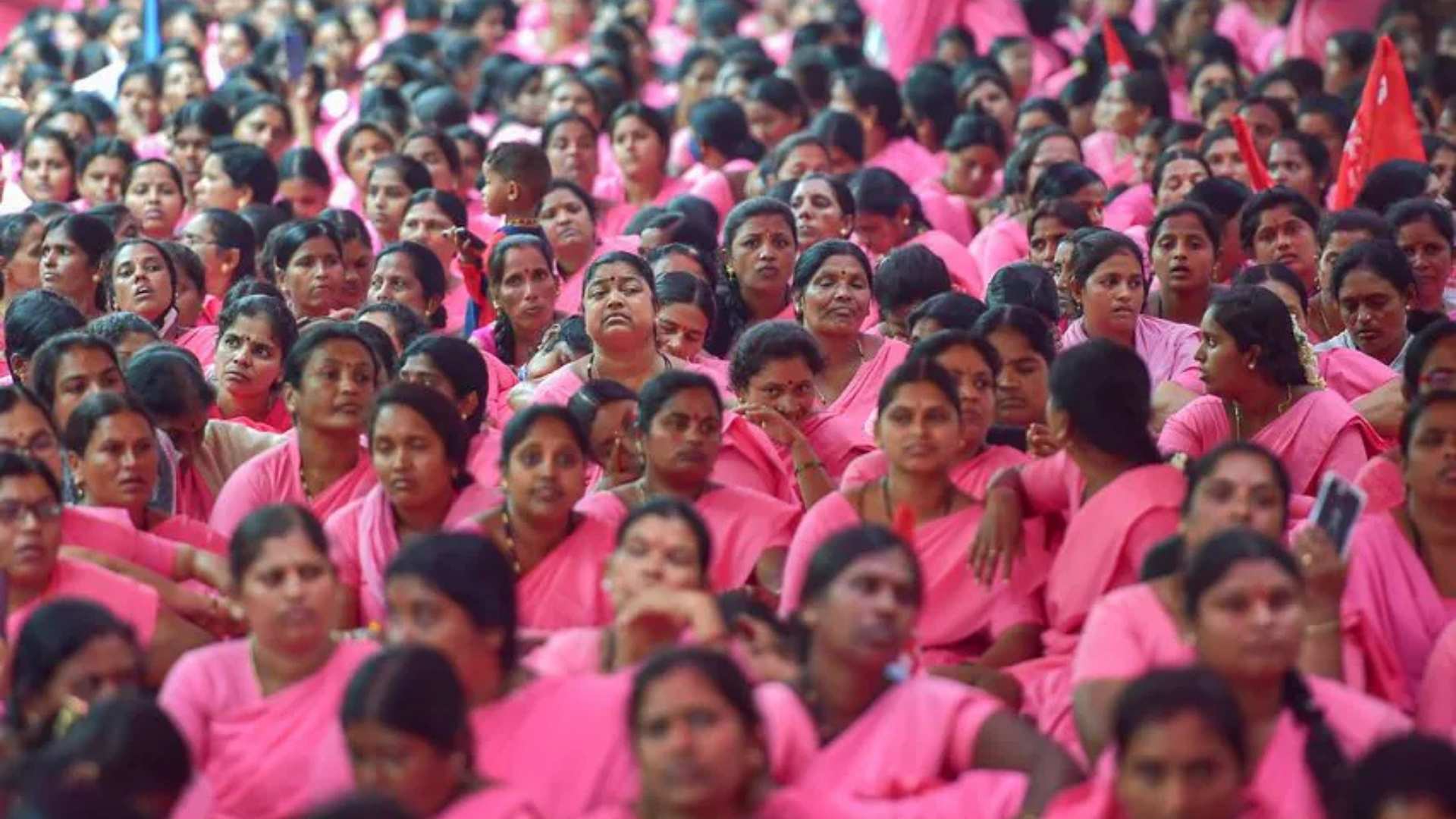
ASHA and anganwadi workers protest in West Bengal, demanding fair wages and recognition for labour that underpins India’s public welfare system.
Not Started

1. Context: Protests by ASHA and Anganwadi Workers

The ongoing protests by ASHA and anganwadi workers in West Bengal demanding a monthly wage of ₹15,000 highlight long-standing structural issues in India’s welfare delivery architecture. These workers are central to flagship programmes such as ICDS, National Health Mission, and nutrition and maternal health interventions.

Despite their indispensable role, they continue to be classified as “volunteers” or “scheme workers” rather than formal employees. This status excludes them from labour law protections, minimum wages, and social security benefits.

The issue is not episodic but rooted in historical policy choices dating back to the inception of ICDS, reflecting a governance model that prioritised scheme expansion over workforce formalisation.

Ignoring this context risks undermining the sustainability and credibility of India’s welfare state.

The governance logic is that welfare delivery depends on labour stability; denial of formal status weakens frontline capacity.

2. Historical Institutionalisation of Informality

The denial of ‘worker’ status to anganwadi workers began under the Indira Gandhi government, when ICDS was launched with a volunteer-based framework. This laid the institutional foundation for bypassing labour laws while expanding social programmes.

As workloads expanded, anganwadi workers formed a national union in 1989, reflecting rising collective mobilisation. However, even during economic liberalisation, the state created the category of “scheme workers” instead of permanent posts.

Judicial reinforcement came through State of Karnataka vs Ameerbi (1996), where anganwadi workers were excluded from government employee status. This occurred even as the Supreme Court expanded the right to food jurisprudence in the early 2000s, increasing reliance on these workers.

This historical trajectory entrenched informality as a policy choice rather than an oversight.

The institutional logic is that informality reduced fiscal liability; persisting with it perpetuates structural exploitation.

3. Extension of the Model to ASHA Workers

The ASHA programme, introduced in the mid-2000s, followed a similar pattern by defining workers as “activists” rather than employees. This semantic framing allowed the state to expand health outreach without corresponding employment obligations.

By the 2010s, consensus emerged among government, employers, and trade unions at the 45th Indian Labour Conference recommending regularisation, minimum wages, and pension and gratuity benefits for ASHA workers.

However, both UPA and NDA governments chose not to implement these recommendations, reinforcing policy continuity across regimes.

Failure to act despite consensus reflects deliberate policy inertia rather than administrative incapacity.

The policy logic is that non-implementation preserved fiscal flexibility; ignoring consensus erodes institutional trust.

4. Fiscal Retrenchment and Centre–State Disparities

In 2015, the NDA government reduced ICDS budget allocations, intensifying financial stress on anganwadi workers. Further, the Centre froze its contribution to honoraria in 2018, transferring fiscal pressure to States.

States, with greater responsibility for hiring and dispute resolution, were compelled to top up payments from their own budgets. This led to wide inter-State disparities, with wealthier or electorally pressured States offering higher pay or additional benefits.

Fiscally constrained States, however, struggled to match these levels, resulting in unequal compensation for similar work across India.

Such disparities undermine the principle of equity in national welfare schemes.

Fiscal dynamics:

  • Centre’s contribution frozen: 2018
  • ICDS budget cut: 2015
  • Result: Uneven State-level top-ups

The federal logic is that decentralisation without fiscal support deepens inequality; ignoring this weakens cooperative federalism.

5. Labour Codes and the Exit from the Social Contract

The denial of formal status to ASHA and anganwadi workers coincides with the lack of guaranteed protections for gig and platform workers under the new labour codes. This signals a broader retreat of the state from its social contract with vulnerable workers.

By prioritising business metrics and fiscal headroom, the state has normalised informality even in publicly funded welfare delivery.

This approach risks hollowing out labour rights while increasing dependence on precarious work arrangements.

Failure to address this trend may erode the legitimacy of labour reforms and welfare governance.

“Economic growth without social justice is fragile and unsustainable.” — International Labour Organization (ILO)

The development logic is that welfare outcomes depend on labour dignity; erosion of rights weakens human development gains.

6. Way Forward: Legal Reclassification and Fiscal Coordination

The article argues for the legal reclassification of ASHA and anganwadi workers as statutory employees under the Code on Social Security. This would guarantee minimum wages, pension, and social security coverage.

Equally important is coordinated fiscal action by the Centre and States to bridge funding gaps and ensure equitable pay across regions.

Institutionalising these protections would align welfare delivery with constitutional values of dignity and equality.

Without reform, protests and service disruptions are likely to persist, affecting beneficiaries most.

Policy measures suggested:

  • Statutory employee status under Code on Social Security
  • Guaranteed minimum wages and pensions
  • Centre–State fiscal burden sharing

The reform logic is that formalisation strengthens welfare delivery; delay entrenches exploitation and instability.

Conclusion

The condition of ASHA and anganwadi workers reflects a deeper governance challenge in balancing fiscal prudence with labour dignity. Recognising these workers as statutory employees and ensuring equitable compensation is essential for sustaining India’s welfare state and upholding the social contract underlying inclusive development.

Quick Q&A

Everything you need to know

Historical Context: The ASHA and anganwadi workers’ struggle has its roots in the denial of 'worker' status under the Integrated Child Development Scheme (ICDS) initiated by the Indira Gandhi government. Despite being central to child and maternal welfare, they were classified as 'scheme workers' or 'volunteers', which excluded them from the benefits of permanent employment and labour protections.

Key Developments:

  • 1989: Formation of a national union advocating for workers’ rights and regularisation.
  • 1996: The Karnataka vs Ameerbi tribunal ruled anganwadi workers are not government employees, limiting legal protections.
  • 2004 onwards: With expansion of rights such as the Right to Food, the demand for permanent jobs became more pronounced, yet successive governments resisted implementation.
  • 2015-2018: Budget cuts and freezing of central contributions further stressed their financial security.

Implication: The historical trajectory shows a persistent structural neglect, where despite growing responsibilities, these workers remain outside the formal social security framework, highlighting a long-standing gap between policy rhetoric and ground reality.

Importance of Regularisation: ASHA and anganwadi workers are the frontline implementers of key welfare schemes such as ICDS, maternal and child health programs, and vaccination drives. Their work directly affects the health, nutrition, and education outcomes of millions of children and women across India.

Consequences of Neglect: Inadequate pay and lack of job security have multiple negative effects:

  • High attrition rates reduce continuity and effectiveness of welfare programs.
  • Demotivation and overwork can compromise the quality of service delivery.
  • Regional disparities emerge as wealthier states can top up salaries, while fiscally constrained states cannot.

Strategic Implications: Proper remuneration ensures equitable delivery of social services, reinforces the social contract between the state and its workers, and strengthens India’s human development indicators. Without addressing these issues, large-scale welfare programs risk inefficiency, inequity, and public dissatisfaction.

Mechanisms for Addressing Issues:

  • Legal Reclassification: Include ASHA and anganwadi workers as statutory employees under the Code on Social Security, guaranteeing minimum wages, pension, and gratuity.
  • Fiscal Support: Bridge the gap between central and state contributions to ensure uniform remuneration across regions, mitigating state-level disparities.
  • Policy Instruments: Introduce performance-linked incentives while standardizing workload norms to prevent exploitation.

State Role: States can tailor additional benefits and dispute resolution mechanisms, leveraging local budgets and electoral accountability. Examples include Kerala and Tamil Nadu, which provide supplementary honoraria and better working conditions compared to poorer states.

Outcome: Institutionalising these protections will reduce fiscal inequities, improve service quality, and ensure that these essential workers can deliver welfare programs sustainably.

Analysis of Government Approach: Historically, both the UPA and NDA governments have deliberately avoided granting permanent employee status to these workers, prioritizing fiscal flexibility over social justice. By creating categories like 'scheme workers' or 'activists', the state effectively bypassed labour laws and the obligations they entail.

Pros and Cons:

  • Pros for the State: Maintains budgetary control, flexibility to scale programs without long-term wage commitments.
  • Cons for Workers: Persistent wage stagnation, lack of pension, vulnerability to economic shocks, and inequity between states.

Implications: This approach undermines the social contract and contributes to structural inequity. While some states have mitigated the impact, the lack of a uniform national policy perpetuates exploitation. The critical lesson is that fiscal discipline should not compromise workers’ rights, especially when they underpin essential welfare programs.

State-level Examples:

  • Kerala: Provides supplementary honoraria and access to state-level pension schemes, resulting in better retention and service quality.
  • Tamil Nadu: Offers additional benefits and structured grievance redressal mechanisms to ensure timely payment.
  • Bihar and Uttar Pradesh: Fiscal constraints mean workers rely primarily on central honoraria, often delayed, leading to protests and high attrition rates.

Analysis: These examples highlight how fiscal capacity and political will affect implementation. States under sustained union pressure or with greater budgetary flexibility tend to provide better conditions.

Implication: A national framework ensuring statutory employment and minimum wages would standardize conditions across states, preventing regional inequities and reinforcing the social contract.

Reasons for Denial:

  • Fiscal Constraints: Regularizing millions of workers would significantly increase government expenditure, reducing flexibility in budget allocation.
  • Political Calculations: Governments may fear setting a precedent for other scheme workers demanding permanent status.
  • Structural Categorization: By classifying them as 'volunteers' or 'scheme workers', the state avoided labour law obligations and pension commitments.

Long-term Impacts: These decisions have perpetuated inequities, weakened morale, and led to frequent protests, which in turn can disrupt welfare delivery. The resistance to regularisation also reflects a broader tension in Indian policymaking between fiscal prudence and social justice.

Way Forward: Addressing this requires political commitment to reclassify these workers legally, bridge fiscal gaps, and institutionalize protections to ensure dignity, fair pay, and consistent service delivery.

Case Study: 2018 Freeze of Central Contributions
In 2018, the Centre froze its contribution to ASHA and anganwadi worker pay, effectively shifting the financial burden to states. This led to:

  • Delayed and irregular payments in fiscally constrained states.
  • Protests and attrition among workers, disrupting critical services such as vaccination and nutrition programs.
  • Greater disparity across states, with wealthier states topping up payments while others struggled to meet obligations.

Lessons for Program Design:
  • Social welfare programs must have predictable and secure financing to maintain continuity.
  • Shared fiscal responsibility between Centre and States is essential to avoid inequities.
  • Worker protections such as minimum wages, pensions, and regularisation must be institutionalized to prevent service disruption.

Conclusion: The 2018 episode demonstrates that financial neglect, even for short periods, undermines both worker morale and program effectiveness. Robust legal and fiscal frameworks are essential for sustainable social welfare delivery.

Attribution

Original content sources and authors

Sign in to track your reading progress

Comments (0)

Please sign in to comment

No comments yet. Be the first to comment!