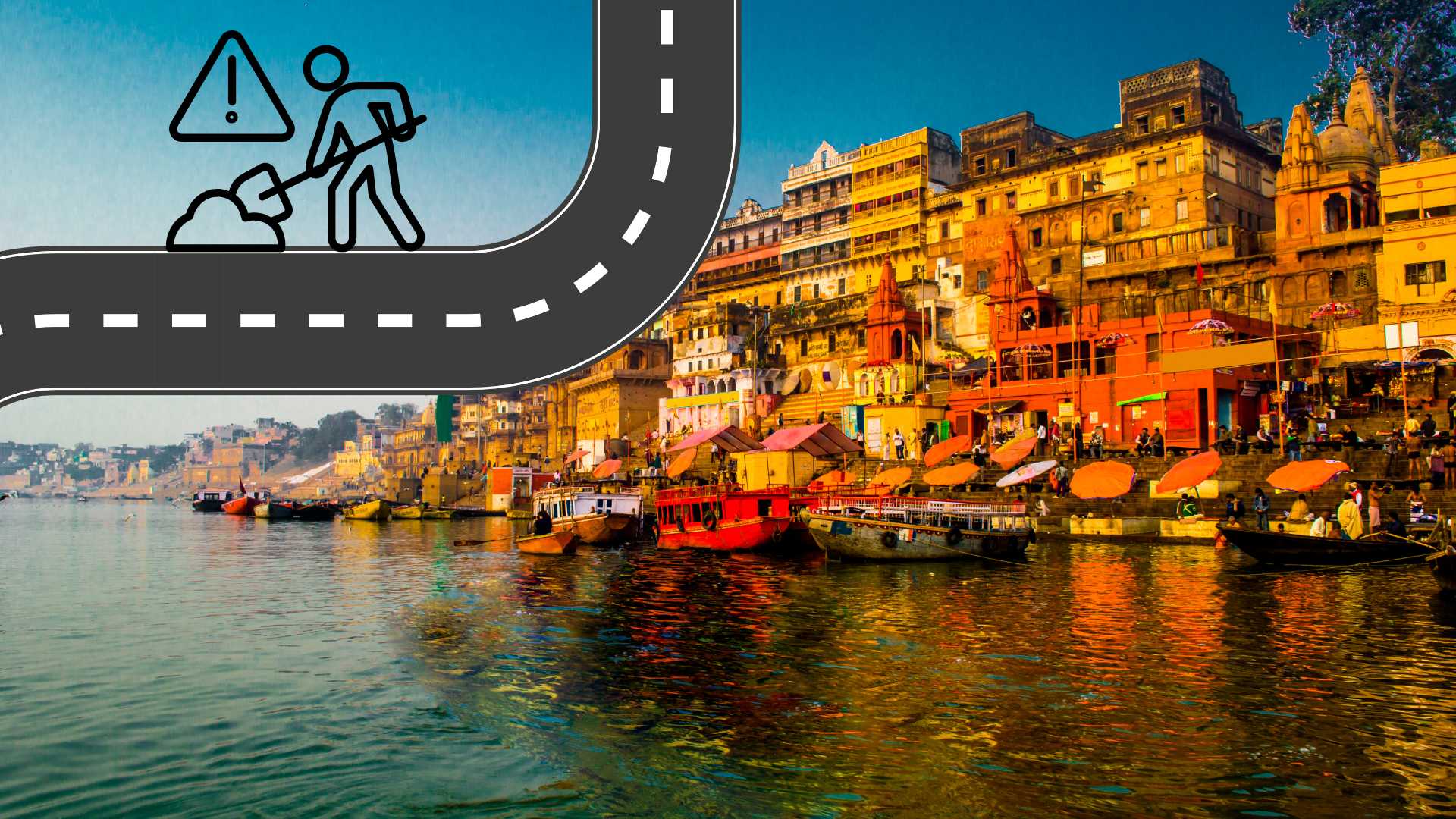
1. Urban Redevelopment in Heritage Cities: Context of the Dal Mandi Project
The Dal Mandi road-widening project in Varanasi is part of the larger Kashi Vishwanath Corridor initiative aimed at improving pilgrim access to the Kashi Vishwanath Temple. The State government approved the project in 2023–24, proposing to widen a 650-metre stretch to create a 17.4-metre-wide road with 3.2-metre footpaths on both sides and underground utilities.
The project involves demolition of 187 buildings and affects over 1,000 shops, which form a dense commercial cluster in a centuries-old market area. The redevelopment cost is estimated at ₹224 crore.
The initiative reflects a broader governance trend in heritage cities: balancing religious tourism, infrastructure modernisation, and urban mobility with preservation of traditional markets and social fabric. Varanasi, one of the world’s oldest living cities, faces acute congestion due to narrow lanes and unplanned growth.
Failure to address infrastructure constraints may hamper emergency access, tourism management, and urban safety. However, redevelopment without adequate socio-economic safeguards risks displacement, livelihood loss, and social unrest.
The governance challenge lies in reconciling infrastructure expansion with constitutional commitments to livelihood security and inclusive development. Ignoring either dimension may produce long-term institutional distrust and social fragmentation.
2. Livelihood Displacement and Economic Vulnerability
Dal Mandi functions as a wholesale and retail hub serving eastern Uttar Pradesh and western Bihar. It deals in groceries, clothing, fabrics, household goods, and handicrafts, catering to both pilgrims and local populations.
Each building houses 5–7 shops, and authorities estimate that over 1,000 shops operate in the affected structures. Many shopkeepers are tenants rather than property owners, creating complications in compensation distribution.
The government has offered compensation at twice the circle rate of ₹44,000 per sq metre, but traders claim market rates are significantly higher. Rental costs in nearby areas exceed ₹20,000 per month for a 100 sq ft shop, making relocation economically unviable for small traders.
Displacement threatens multi-generational family businesses and informal employment networks, including workers and assistants dependent on these shops. For many families, commercial premises also serve as social and cultural anchors.
Key Economic Concerns:
- Loss of direct livelihood for 1,000+ shops
- Indirect unemployment of workers and helpers
- Reduced commercial footfall after relocation
- Inadequate compensation for tenants
Urban redevelopment that does not adequately account for informal tenancy structures and market realities risks converting infrastructure gains into economic distress, undermining inclusive growth objectives.
3. Social Impact Assessment (SIA) and Land Acquisition Process
Under the Right to Fair Compensation and Transparency in Land Acquisition, Rehabilitation and Resettlement Act, 2013 (LARR Act), Social Impact Assessment (SIA) is mandatory for major acquisition projects.
Residents allege that an alternative 200-metre route affecting fewer buildings was suggested during SIA consultations but was not adopted. They argue that the longer alignment was chosen despite greater displacement implications.
Authorities have warned that if compensation negotiations fail, formal land acquisition proceedings would follow. Demolitions began in January, leading to protests and local unrest.
The SIA framework is designed to:
- Mitigate social unrest
- Choose minimally disruptive routes
- Assess livelihood impacts
- Ensure participatory decision-making
If stakeholders perceive the SIA as procedural rather than substantive, public trust in land governance mechanisms weakens. This has broader implications for infrastructure projects nationwide.
Effective SIA implementation is central to balancing development with democratic accountability. If participatory processes are perceived as tokenistic, it may escalate resistance and delay projects.
4. Cultural Heritage and Urban Identity
Dal Mandi is not merely a commercial zone; it represents a historical marketplace embedded in the socio-cultural fabric of Varanasi. Generations of traders have operated in the same lanes, creating interlinked community networks.
Heritage cities like Varanasi exhibit organic urban layouts shaped over centuries. Narrow lanes, mixed-use buildings, and dense habitation patterns are intrinsic to their identity.
Redevelopment aimed at facilitating pilgrim mobility must also consider intangible heritage—traditional markets, social relationships, and local identities. Erasure of such spaces may result in homogenisation and loss of urban character.
However, proponents argue that improved infrastructure enhances tourism potential, economic productivity, and safety standards.
This debate reflects a larger urban policy question: Should heritage cities prioritise conservation of lived spaces, or restructure them to meet modern infrastructural demands?
Urban planning in heritage cities requires a calibrated approach that preserves cultural continuity while ensuring functional efficiency. Ignoring either side can lead to either stagnation or cultural erosion.
5. Political and Communal Dimensions
Some political leaders have alleged “selective targeting,” noting that a majority of affected residents belong to the Muslim community. Protests have also questioned the timing of demolitions during Ramzan.
Such claims introduce a sensitive communal dimension into what is primarily framed as an infrastructure project. Perceived bias in urban redevelopment can deepen identity-based anxieties and polarisation.
Conversely, local authorities and representatives defend the project on grounds of public safety, faulty wiring, congestion, and emergency inaccessibility.
In plural societies, urban interventions in mixed or minority-dominated localities must be handled with procedural transparency and confidence-building measures. Perception management becomes as important as technical planning.
Development projects in socially sensitive zones require enhanced transparency and communication. If identity-based concerns are not addressed institutionally, governance challenges may escalate beyond the project scope.
6. Urban Governance Issues Highlighted
The Dal Mandi episode illustrates structural challenges in Indian urban governance:
- High-density informal markets without formal tenancy records
- Circle rate–market rate disparity
- Weak rehabilitation frameworks for tenants
- Conflict between heritage preservation and infrastructure modernisation
- Political contestation of development projects
It also raises broader constitutional concerns:
- Article 19(1)(g): Right to practice any profession
- Article 21: Right to life, interpreted to include livelihood
- Directive Principles promoting equitable economic development
Effective urban transformation requires integrating planning, compensation, rehabilitation, and stakeholder consultation.
Urban redevelopment that prioritises physical infrastructure without parallel social safeguards may achieve short-term spatial gains but produce long-term governance deficits.
7. Way Forward: Reconciling Development with Inclusion
Balanced urban redevelopment in heritage cities like Varanasi should incorporate:
- Market-linked compensation mechanisms
- Separate rehabilitation packages for tenants
- Dedicated commercial relocation zones
- Phased demolition to minimise disruption
- Transparent public disclosure of SIA findings
- Independent grievance redress mechanisms
Integrating economic rehabilitation into infrastructure planning ensures that development becomes inclusive rather than extractive.
In the long term, heritage-sensitive urban master planning, GIS-based mapping of informal markets, and pre-emptive rehabilitation frameworks can reduce conflict.
Conclusion
The Dal Mandi road-widening project exemplifies the complex intersection of urban infrastructure expansion, livelihood security, cultural heritage, and social harmony.
Sustainable urban governance in heritage cities requires not merely physical transformation but institutional sensitivity, procedural fairness, and inclusive economic planning. Development that strengthens both infrastructure and community resilience will better align with India’s long-term constitutional and socio-economic goals.