
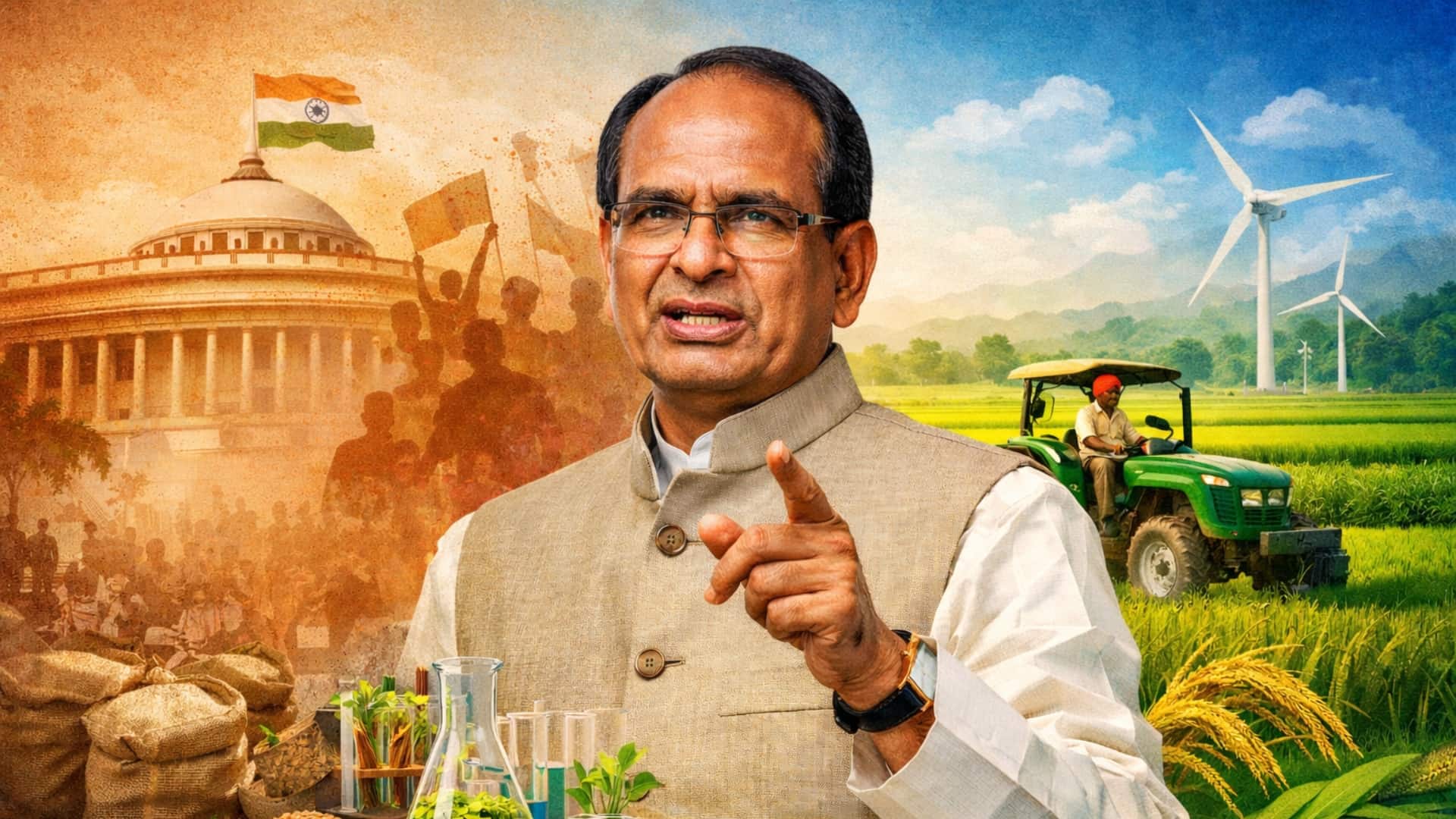
1. Political and Policy Context: Debate over Rural Employment Reform
The Union Agriculture Minister’s remarks come in the context of a sharp political contestation over the Viksit Bharat Guarantee for Rozgar and Ajeevika Mission (Gramin) Bill, positioned as a successor or reformative alternative to MGNREGA. The government frames the Bill as an expansion and correction of past deficiencies, while the Opposition alleges dilution of employment guarantees.
The Minister accused the Opposition of spreading misinformation and disengaging from parliamentary debate, highlighting the absence of the Leader of Opposition during discussions. This reflects broader concerns about the quality of legislative scrutiny and cooperative federalism in social sector reforms.
The discourse signals how flagship welfare programmes become arenas of political legitimacy, where credibility, fiscal commitment, and governance outcomes are contested. If such debates remain polarised rather than evidence-based, policy design risks being driven by rhetoric instead of ground realities.
The governance logic lies in ensuring that large-scale welfare reforms are debated substantively in Parliament; if ignored, institutional trust and policy continuity in rural employment frameworks weaken.
“The Congress has announced an MGNREGA Bachao Sangram. It is actually a ‘save corruption’ campaign.” — Shivraj Singh Chouhan
2. Governance Concerns in MGNREGA: Corruption and Accountability
The Minister argued that MGNREGA had become synonymous with systemic leakages, citing findings from social audits conducted by gram sabhas. These audits reportedly exposed widespread irregularities, indicating gaps in last-mile accountability and monitoring mechanisms.
Issues highlighted include duplication of work, mechanisation in violation of norms, siphoning of funds under routine maintenance activities, and participation of ineligible beneficiaries. Such problems point to weaknesses in decentralised implementation, despite the programme’s rights-based design.
Unchecked governance failures in employment schemes undermine both fiscal prudence and social justice, eroding public confidence in welfare delivery. Over time, this can delegitimise demand-driven programmes meant to protect rural livelihoods.
Key audit-related observations:
- 10.51 lakh complaints flagged through social audits
- Repetition of identical works across locations
- Use of machines instead of manual labour
- 30% workers reported to be above 60 years of age
The development rationale stresses that transparency tools like social audits must translate into corrective action; if ignored, welfare schemes risk becoming fiscally costly without achieving livelihood security.
3. Fiscal Commitment and Comparative Expenditure on Rural Employment
The government positioned the new Bill as fiscally more ambitious and outcome-oriented than MGNREGA. It highlighted significantly higher cumulative allocations under the present government compared to the UPA period, framing this as evidence of sustained commitment to rural employment.
Public expenditure comparisons are used to demonstrate scale and intent, but they also raise questions about efficiency, targeting, and outcome measurement. Higher spending without commensurate governance reforms may not yield proportional developmental gains.
The debate underscores the importance of balancing fiscal expansion with institutional capacity, especially in labour-intensive schemes that directly affect rural consumption and poverty reduction.
Comparative fiscal data:
- Allocation under present government: ₹8.48 lakh crore
- Expenditure during UPA period: just over ₹2 lakh crore
From a policy perspective, sustained funding must be matched with improved delivery systems; otherwise, increased allocations risk diminishing returns and public scepticism.
4. Agricultural Innovation and Climate-Resilient Productivity
Alongside welfare reform discourse, the government unveiled 184 high-yielding and climate-resilient seed varieties, signalling a parallel focus on long-term agricultural productivity. This aligns rural employment with structural transformation in agriculture.
The varieties target climate risks such as drought, salinity, and biotic stress, reflecting adaptation priorities amid climate variability. Enhancing seed quality directly affects yields, cost efficiency, and farm incomes, thereby reducing distress-driven demand for wage employment.
Failure to integrate technological innovation with rural livelihoods could trap agriculture in low productivity cycles, increasing dependence on public employment schemes.
Composition of newly unveiled varieties:
- 122 cereals
- 6 pulses
- 13 oilseeds
- 11 fodder crops
- 6 sugarcane
- 24 cotton (including 22 BT cotton)
- 1 each of jute and tobacco
The development logic connects farm productivity with employment sustainability; if ignored, rural policy remains reactive rather than growth-enabling.
5. Food Security, Institutions, and Seed Ecosystem Strengthening
The Minister highlighted India’s emergence as the world’s largest rice producer, surpassing China, situating seed innovation within national and global food security objectives. Enhanced production strengthens India’s role as a stable food supplier.
Institutional actors like ICAR and the National Seeds Corporation were emphasised for their role in breeding, multiplication, and dissemination. Focus areas such as acid soils, regenerative agriculture, and natural farming reflect evolving sustainability priorities.
Robust seed systems are foundational to agricultural resilience; neglecting institutional coordination can slow technology diffusion and undermine farmer adoption.
Key production and institutional data:
- India’s rice output: 150.18 million tonnes
- China’s rice output: 145.28 million tonnes
- High-yielding varieties approved since 2014: 3,236
- Varieties notified between 1969–2014: 3,969
- National Seeds Corporation turnover: ₹200 crore
Institutional continuity in research and seed delivery ensures food security gains are durable; if overlooked, productivity gains may remain uneven and short-lived.
Conclusion
The article highlights the intersection of welfare reform, governance accountability, and agricultural innovation in India’s rural development strategy. Moving forward, aligning fiscal commitment with institutional reform and climate-resilient productivity will be critical to achieving inclusive and sustainable rural transformation.