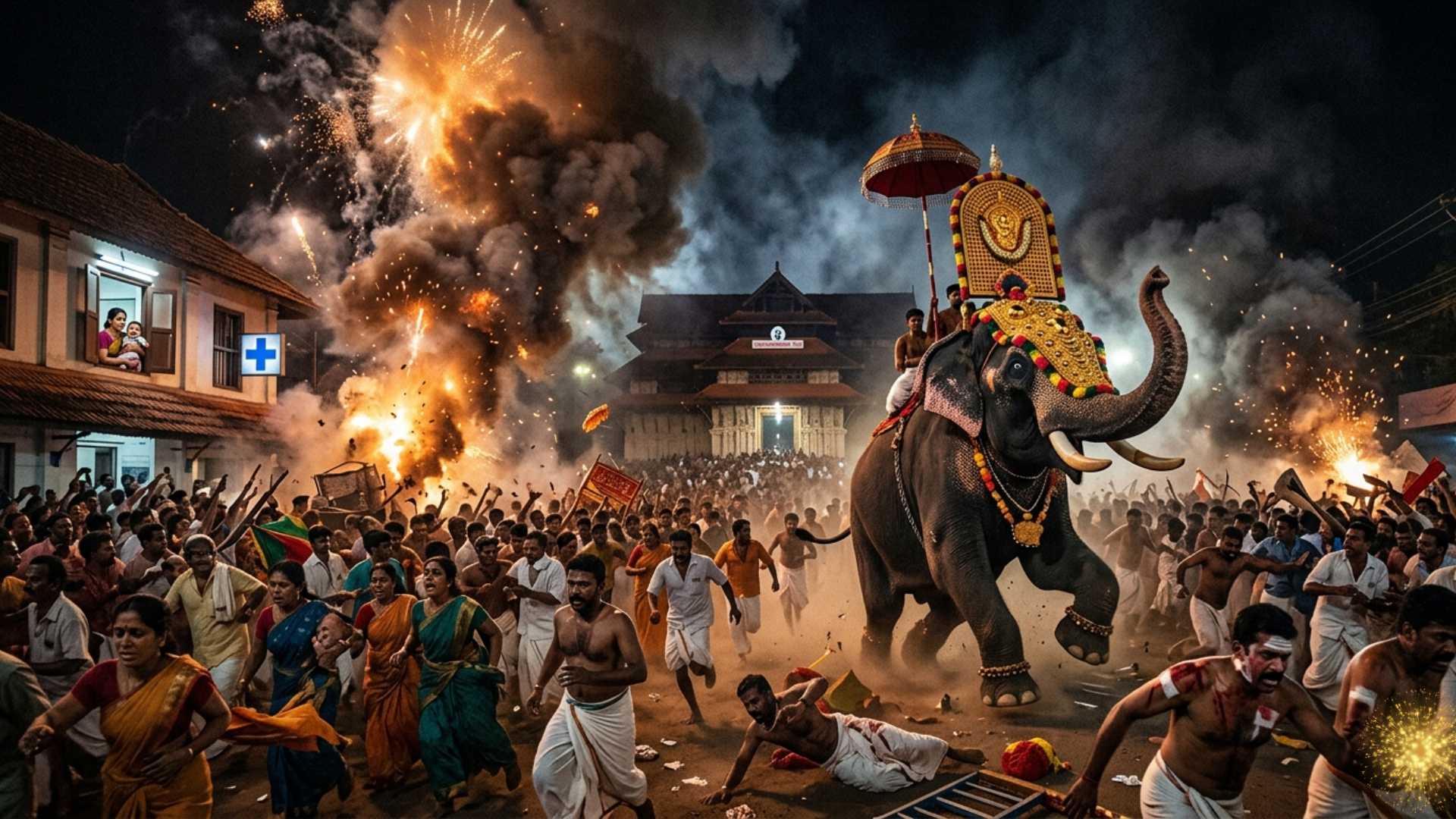
Exploring Safer Fireworks Alternatives for Thrissur Pooram

Introduction
WHO ranks noise pollution as the third most hazardous environmental threat after air and water. India's festival culture — particularly Thrissur Pooram — brings this into sharp focus, with noise levels breaching legal limits and threatening hospitals, wildlife, and infant development. Cold spark technology offers a scientifically viable, governance-ready alternative.
"It is time to go noiseless — cold spark technology is available, but not yet scaled up." — Prof. Rajan Gurukkal, Eminent Social Scientist
Background & Context
- Thrissur Pooram 2025: Noise peaked at 122.4 dB — just under the CPCB legal cap of 125 dB (at 4 metres).
- NANMN limits: Residential zones 45–55 dB; Silence zones (hospitals, schools) 40–50 dB — the 125 dB fireworks cap is nearly 3× the silence zone limit with no spatial buffer mandate.
- Thrissur district hospital is minutes from the fireworks venue — directly in the impact radius.
- April 21, 2025: 13 killed, 40 injured in a fireworks unit blast at Mundathikode, Thrissur.
- Kerala SPCB (RTI): Confirmed noise levels breached ambient safety thresholds.
Key Concepts
Noise Pollution Regulatory Framework
| Standard | Limit |
|---|---|
| CPCB — firecrackers | Max 125 dB at 4m |
| Residential zones (NANMN) | 45–55 dB |
| Silence zones (hospitals, schools) | 40–50 dB |
| WHO classification | 3rd most hazardous environmental threat |
Critical gap: No mandatory spatial buffer between fireworks zones and silence zones in current CPCB norms.
Cold Spark Technology — How It Works
Fuel: Fine alloy powders of titanium and zirconium. A heater activates the powder energy; a fan ejects it into air; the heated powder reacts with oxygen in a rapid exothermic reaction — emitting sparkler-like light with no explosion, no heavy smoke, no burn injuries. Operating temperature: 60–100°C vs. traditional sparklers at ~1,200°C. Already used in TV studios — proven and scalable.
Traditional Fireworks vs. Cold Spark Technology
| Parameter | Traditional | Cold Spark |
|---|---|---|
| Noise | Up to 125+ dB | Near zero |
| Temperature | ~1,200°C | 60–100°C |
| Smoke/PM2.5 | Heavy | Minimal |
| Burn injury risk | High | Very low |
| Visual effect | Standard | Equal or superior |
| Cost | Low | ~₹400/unit; expensive |
| Manufacturing | India + China | Largely China; indigenisation feasible |
Risks & Implications
Hospitals & Vulnerable Populations
- Neonatal ICUs near festival venues face acute noise exposure — linked to infant brain development disruption.
- Many ICU facilities lack soundproof windows — infrastructure gap compounds regulatory gap.
"Elephants get disoriented not just by decibel levels, but also by the structure and frequency of noise." — Manjari Jain, IISER Mohali
Animal welfare: Current regulations measure only decibel levels — frequency and structure of noise, which disorient animals, are entirely absent from CPCB standards.
Industry & Livelihoods: Sivakasi (Tamil Nadu) firecrackers industry is a major employment sector — blanket ban is socially and politically complex; incremental transition is the only viable path.
Supply Chain: Cold spark nano-powders largely imported from China — indigenous titanium/zirconium nano-powder production is scientifically feasible and strategically necessary.
Case Study: Thrissur Pooram
Thrissur Corporation identified as nodal body for transition to noiseless alternatives. Proposed model: begin with large-scale cold spark arrays at Pooram — India's highest-profile pyrotechnic event — and expand statewide. Arrays can be mounted on temporary towers, triggered sequentially, creating the illusion of vertical expansion into the night sky — matching traditional visual grandeur without the hazard.
Way Forward
- Regulatory reform: Mandate spatial buffer zones between fireworks and silence zones; progressively reduce 125 dB cap.
- Technology indigenisation: Domestic production of titanium/zirconium nano-powders to reduce China import dependence.
- Pilot & scale: Test cold spark at Thrissur Pooram + Delhi Diwali as national proof-of-concept.
- Animal welfare standards: Incorporate noise frequency and structure — not just decibels — into CPCB norms.
- Professional training: Shift from artisanal firecracker manufacturing to tech-enabled display management.
Conclusion
Thrissur Pooram exposes a structural tension in Indian governance: cultural rights vs. Article 21 obligations (right to life, clean environment). Cold spark technology proves cultural grandeur and public health are not mutually exclusive — the barrier is institutional, not technological. Scaling proven solutions requires regulatory will, supply chain development, and community buy-in. This sits at the intersection of SDG 3 (Good Health) and SDG 11 (Sustainable Cities) — a model governance challenge.
Attribution
Original content sources and authors


Syllabus classification
How this article maps to GS papers
Main syllabus
GS2Government PoliciesQuick Q&A
What are the environmental and public health concerns associated with high-decibel fireworks in festivals like Thrissur Pooram?
Additionally, noise pollution is ranked by the World Health Organization as the third most hazardous environmental threat, after air and water pollution. Hospitals, particularly those with neonatal intensive care units (NICUs), are highly sensitive to such disturbances. Exposure to high noise levels can disrupt infant brain development and recovery processes in patients. The proximity of fireworks to healthcare facilities in Thrissur underscores the lack of adequate urban planning and regulatory enforcement.
Environmental concerns include:
- Air pollution due to smoke and particulate matter
- Disturbance to animals, leading to incidents like elephants running amok
- Increased risk of fire accidents and injuries
Why is there a growing demand for noiseless or low-noise alternatives to traditional fireworks in India?
Another important factor is the urbanisation and proximity of sensitive zones like hospitals and schools to celebration sites. As highlighted in the article, fireworks conducted near hospitals violate recommended noise standards and can have serious implications for patients, particularly newborns. Furthermore, legal and judicial interventions, such as restrictions imposed by courts on firecracker use during Diwali, reflect a policy shift towards sustainable celebrations.
Key reasons for the shift include:
- Public health concerns, especially in urban areas
- Environmental sustainability and climate considerations
- Animal welfare and ethical considerations
- Rising accident rates in fireworks manufacturing and usage
How does cold spark technology work, and how is it different from traditional fireworks?
Unlike traditional fireworks, which rely on explosive chemical reactions and can reach temperatures of up to 1,200°C, cold spark systems operate at much lower temperatures of 60–100°C. This significantly reduces the risk of burns, fire hazards, and accidental explosions. Additionally, these systems produce minimal smoke and negligible noise, making them suitable for use in urban and sensitive environments.
Key differences include:
- No explosive combustion, hence low noise levels
- Lower operating temperatures, enhancing safety
- Reduced air pollution and smoke emissions
- Programmable and controllable visual effects
Critically analyse the feasibility of replacing traditional fireworks with cold spark technology in India.
However, several challenges hinder its widespread adoption. First, the high cost of cold spark devices—such as ₹400 for a single unit—makes them less accessible to the general public. Second, the technology is currently largely imported, particularly from China, raising concerns about dependency and affordability. Third, there may be cultural resistance, as traditional fireworks are deeply embedded in Indian festivals and social practices.
Key constraints include:
- Economic barriers and affordability issues
- Lack of domestic manufacturing and scaling
- Resistance due to cultural preferences
- Limited awareness and technical expertise
Provide examples of how technology-driven solutions can balance cultural traditions with environmental sustainability in festivals.
Another example is the introduction of green crackers in India, which are designed to emit lower levels of pollutants compared to conventional firecrackers. Similarly, laser light shows and drone-based displays have been used in cities like Delhi and Shanghai as alternatives during major celebrations. These innovations demonstrate how technology can preserve the spirit of celebration while minimising environmental harm.
Key benefits of such solutions include:
- Reduction in air and noise pollution
- Enhanced safety and reduced accident risks
- Customisable and reusable systems
- Alignment with sustainable development goals
As a policymaker, how would you design a transition strategy towards noiseless fireworks in festivals like Thrissur Pooram?
The second component involves promoting domestic manufacturing and cost reduction. Government incentives, such as subsidies and research grants, can encourage Indian firms to produce cold spark devices locally. Public-private partnerships can also play a role in scaling up production and improving affordability. Awareness campaigns highlighting the health and environmental benefits of noiseless alternatives are equally crucial.
Key elements of the strategy include:
- Phased replacement with hybrid models initially
- Financial incentives for indigenous production
- Public awareness and community engagement
- Regulatory measures and monitoring mechanisms
Practice questions
1 question for mains preparation