
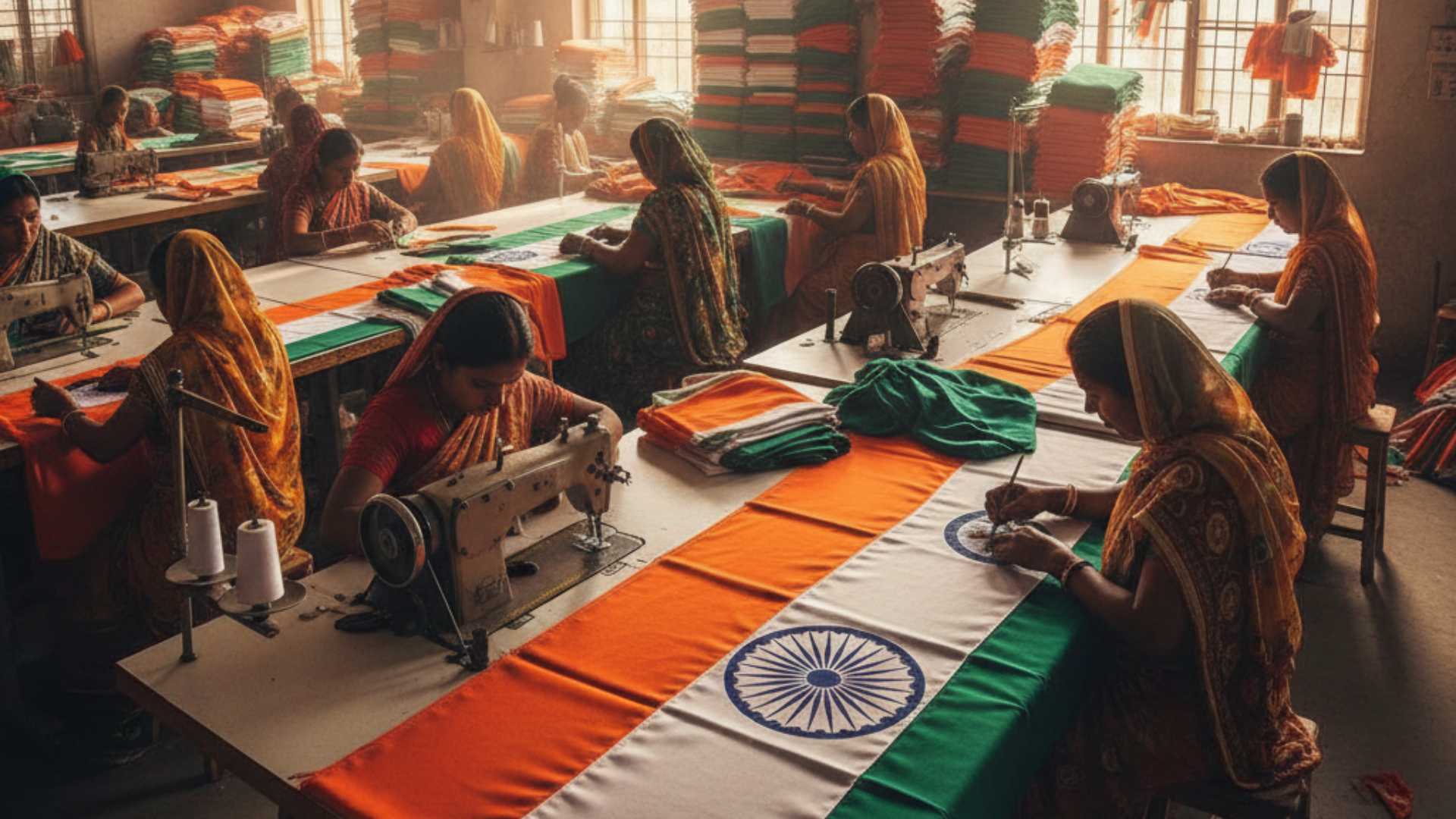
1. Context: Khadi Flag Manufacturing as Livelihood Infrastructure
The national flag manufacturing unit at Bengeri, Hubballi, operated by Karnataka Khadi Gramodyoga Samyukta Sangha (KKGSS), represents a critical livelihood source for women workers, many of whom are widows or from low-income households. For them, flag-making is not symbolic work alone but a means of economic survival, enabling repayment of loans and support for children’s education.
The unit is embedded within a wider khadi ecosystem across North Karnataka, sourcing hand-spun and hand-woven cloth from multiple khadi centres. Consequently, any disruption in flag production directly transmits distress across a decentralised rural production network.
The importance of such units lies in their alignment with inclusive growth, women’s employment, and preservation of traditional industries. If weakened, the policy neglect risks reversing gains in livelihood security and undermining confidence in state-supported cottage industries.
If such livelihood-linked production units are ignored in policy transitions, economic shocks disproportionately affect vulnerable workers, weakening trust in public institutions and employment schemes.
2. Policy Change: Amendment to the Flag Code of India
The distress faced by the Hubballi unit stems primarily from the amendment to Clause 1.2 of Part 1 of the Flag Code of India. This change permitted the use of polyester and machine-made cloth for national flags, relaxing the earlier mandate of exclusive khadi usage.
The amendment was introduced to enable mass availability of flags during the ‘Har Ghar Tiranga’ campaign. While it enhanced short-term outreach, it altered the competitive landscape by allowing cheaper, machine-made flags that outcompete khadi flags on price and scale.
This policy shift illustrates how well-intentioned administrative flexibility can unintentionally undermine traditional, labour-intensive sectors when compensatory safeguards are absent.
When policy prioritises scale and cost without accounting for livelihood externalities, it can weaken decentralised production systems critical for inclusive development.
3. Economic Impact: Declining Sales and Worker Distress
The consequences of the policy change are reflected in sharply declining sales at the BIS-recognised Hubballi unit. After recovering from the pandemic, revenues fell consistently following the amendment.
Sales performance:
- ₹3.94 crore (2022–23) after post-pandemic recovery
- ₹1.71 crore (2023–24) following Flag Code amendment
- ₹1.21 crore (2024–25)
- ₹65.51 lakh (till December, current fiscal)
Reduced orders have translated into falling incomes, with workers’ monthly earnings halving in some cases, even as loan repayment obligations persist. The pressure has forced management to consider workforce rationalisation and redeployment to other khadi units.
Such contraction highlights the vulnerability of informal and semi-formal workers to policy-induced market changes, especially when alternative employment is limited.
Ignoring demand-side shocks in traditional industries can convert policy reform into a livelihood crisis, with long-term social and economic costs.
4. Governance and Institutional Concerns
Despite repeated representations, the Centre has not responded to memoranda seeking reconsideration of the amendment. This absence of institutional feedback has intensified uncertainty for workers and management alike.
The situation raises broader governance questions about stakeholder consultation, policy impact assessment, and centre–state responsiveness. Khadi institutions operate at the intersection of cultural symbolism, rural employment, and small-scale industry promotion, requiring nuanced policy calibration.
Failure to address these concerns risks marginalising khadi institutions, despite their historical role in employment generation and national identity.
Effective governance requires not only policy formulation but continuous feedback loops; without them, implementation gaps widen and institutional legitimacy erodes.
5. Civil Society Response and Adaptive Measures
In response to declining sales, a group of citizens, in collaboration with KKGSS, has launched the ‘Fly Khadi Tricolour, Buy Khadi Tricolour’ initiative. The campaign seeks to promote khadi flags through social media outreach, e-commerce platforms, and heritage-based branding of flag manufacturing centres.
These efforts reflect adaptive strategies from non-state actors to sustain employment and preserve traditional industries in the absence of immediate policy correction. However, such initiatives have limited scale compared to nationwide procurement and regulatory frameworks.
Their emergence underscores the role of civil society in cushioning policy shocks, though they cannot substitute for structural policy support.
Civil society initiatives can mitigate distress temporarily, but sustainable outcomes depend on coherent policy alignment with livelihood objectives.
Conclusion
The Hubballi khadi flag unit case illustrates how regulatory changes, when detached from livelihood considerations, can destabilise traditional industries and women’s employment. A balanced approach that integrates national symbolism, market access, and inclusive growth is essential to ensure that policy reforms strengthen rather than weaken grassroots production systems.
