1. Context: Judicial Observations on Freebies and Fiscal Responsibility
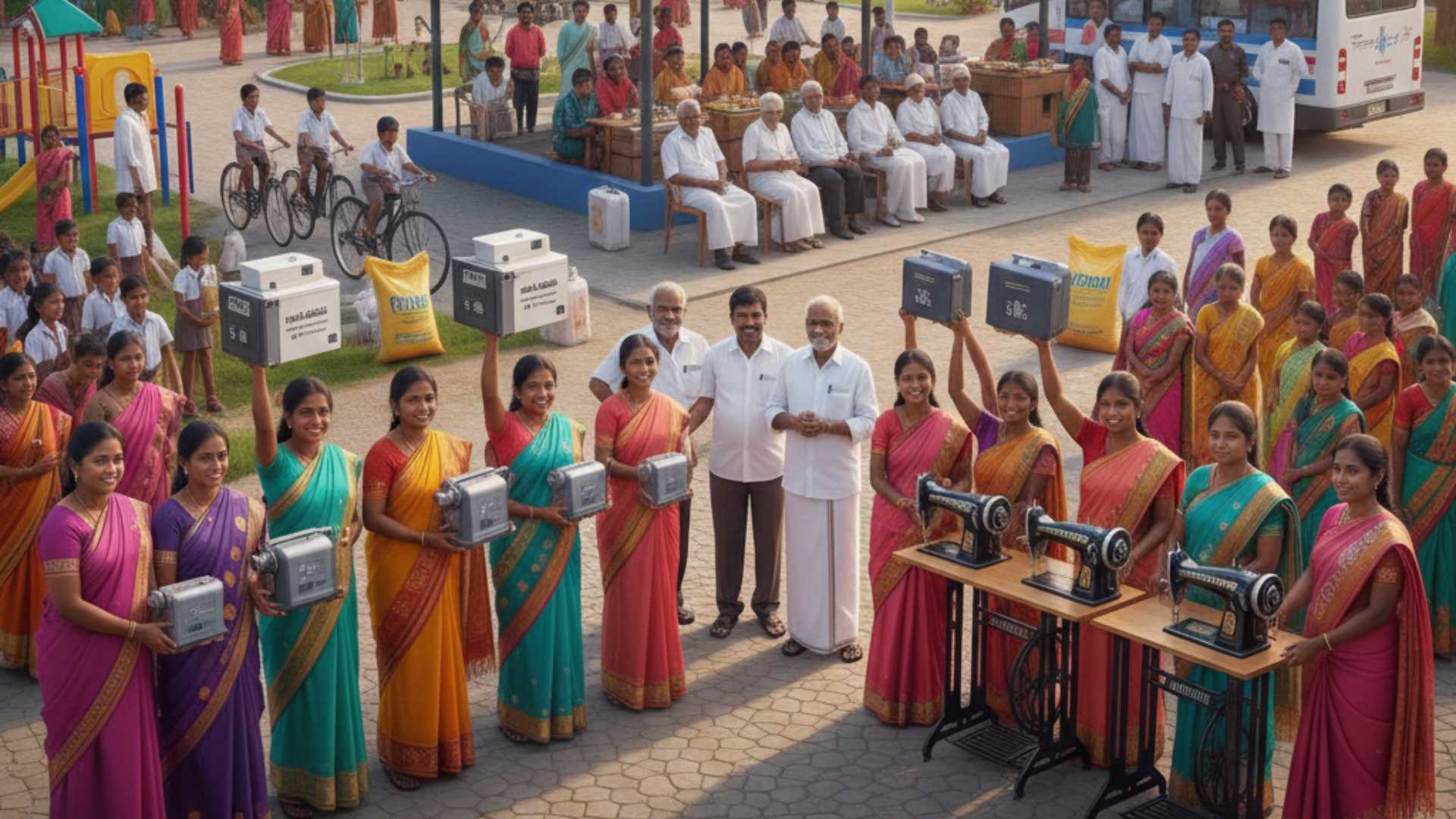
The Supreme Court, while hearing a petition filed by the Tamil Nadu Power Distribution Corporation Limited (TNPDCL), expressed concern over State governments distributing “largesse” without distinguishing between the affluent and the genuinely needy. The Court questioned whether such policies amount to electoral appeasement without regard for fiscal sustainability.
Chief Justice of India Surya Kant observed that even deficit-running States continue to announce welfare schemes, raising concerns about prioritisation of expenditure. The Court underlined the obligation of States to invest in core public goods such as infrastructure, healthcare, and education rather than short-term material giveaways.
However, the Bench clarified that it does not intend to cross constitutional limits by deciding the purpose or wisdom of welfare schemes, which falls within the domain of elected governments. The judicial concern was primarily about fiscal prudence and effective targeting.
"Why should State governments... have so much statesmanship? We know what is happening in States when elections come up." — CJI Surya Kant
The underlying governance issue is balancing democratic welfare commitments with fiscal responsibility. If unchecked, indiscriminate populism can erode public finances and crowd out essential developmental spending.
GS Linkages:
- GS II: Separation of powers, role of judiciary, welfare state
- GS III: Fiscal deficit, public expenditure management
- Essay: Welfare vs Populism
2. Issue: Targeting of Welfare vs Indiscriminate Freebies
The Court distinguished between legitimate welfare and irrational largesse. It acknowledged that education and basic services for disadvantaged sections are constitutional obligations, especially under Article 21 and Directive Principles. However, the Bench questioned why affluent sections often benefit first from subsidies or freebies.
The Court stressed the need for a tested mechanism to ensure that assistance reaches those who genuinely require a “helping hand”. Improper targeting not only leads to leakages but also distorts distributive justice.
It highlighted that short-sighted distribution of largesse ultimately harms poorer sections whose children depend on quality schools, healthcare, and long-term public investments.
The core logic is that welfare must be redistributive and equity-oriented. If benefits are not targeted, scarce public resources are diluted, undermining both social justice and economic efficiency.
Governance Concerns:
- Lack of beneficiary differentiation
- Election-time scheme announcements
- Absence of institutional targeting mechanisms
- Opportunity cost of public funds
GS Linkages:
- GS II: Welfare schemes and vulnerable sections
- GS III: Public finance and subsidy rationalisation
- Prelims: Directive Principles, fiscal deficit concepts
3. Fiscal Stress and the Electricity Sector Case
The observations arose in the context of TNPDCL’s challenge to Rule 23 of the Electricity (Amendment) Act, 2024. The petition argued that the electricity sector in Tamil Nadu faces a widening revenue-expenditure gap.
Key financial concerns highlighted:
- Annual revenue-expenditure gap in Tamil Nadu electricity sector: ₹50,000 crore (approx.)
- Rule 23 mandates only a 3% gap between approved annual revenue requirement and tariff revenue.
- Carrying costs to be liquidated in three equal yearly installments.
- Late payment surcharge governed by Electricity (Late Payment Surcharge and Related Matters) Rules, 2022.
TNPDCL argued that implementing Rule 23 could result in an “exponential tariff shock” and impose an unsustainable burden on the State exchequer, possibly shifting costs to consumers.
The Court questioned why affluent consumers could not pay market-based tariffs, thereby reducing subsidy burdens and enabling financial sustainability.
The electricity sector illustrates the structural problem: cross-subsidies and politically motivated tariff decisions can weaken utilities, increase fiscal liabilities, and reduce investment capacity.
GS Linkages:
- GS III: Power sector reforms, fiscal consolidation
- Economy: Tariff rationalisation, subsidy management
- Prelims: Electricity regulatory framework
4. Constitutional Dimensions: Welfare State vs Fiscal Prudence
India is constitutionally envisioned as a welfare state. Articles 38 and 39 (DPSPs) mandate the State to reduce inequalities and ensure equitable distribution of resources. However, fiscal prudence is equally embedded in governance norms, including Fiscal Responsibility legislation at Union and State levels.
The Court maintained institutional restraint by clarifying that policy wisdom lies within the executive domain. Yet, it raised legitimate questions about deficit financing of populist schemes and their long-term sustainability.
The suggestion that a portion (e.g., 25% of annual revenue collection) could be dedicated entirely to development highlights the need for predictable capital allocation toward infrastructure.
The tension lies between political responsiveness and macroeconomic stability. Ignoring fiscal sustainability can reduce future welfare capacity and compromise intergenerational equity.
GS Linkages:
- GS II: Federalism, role of judiciary
- GS III: Fiscal Responsibility and Budget Management (FRBM)
- Essay: Intergenerational equity, sustainable development
5. Developmental Implications of Indiscriminate Largesse
The Court warned that irrational distribution ultimately affects the poor, as fiscal space gets diverted from structural development.
If public funds are excessively used for short-term material transfers:
- Capital expenditure on roads, irrigation, hospitals, and schools may decline.
- Human capital development suffers.
- State debt levels may increase.
- Tariff hikes or future tax burdens may become unavoidable.
Consequently, developmental multipliers reduce, and the capacity to generate sustainable employment weakens.
Public finance has a trade-off structure: every rupee spent on non-merit subsidies is a rupee not invested in productivity-enhancing infrastructure. Long-term growth and welfare thus depend on prioritisation.
GS Linkages:
- GS III: Capital vs Revenue expenditure
- GS I/III: Human capital and development
- Essay: Growth vs Redistribution
6. Way Forward: Balancing Welfare and Fiscal Sustainability
The issue calls for institutional rather than rhetorical solutions. The Court emphasised the need for mechanisms that ensure welfare reaches the intended beneficiaries without distorting fiscal health.
Policy Measures:
- Targeted subsidy delivery through data-driven identification
- Periodic review of welfare schemes for outcome effectiveness
- Transparent fiscal disclosures on funding sources
- Rationalisation of cross-subsidies in sectors like electricity
- Strengthening State-level FRBM compliance
Such reforms would preserve both social justice objectives and macroeconomic stability.
The long-term legitimacy of welfare policies depends on credibility, targeting, and fiscal sustainability. Balanced governance ensures that present commitments do not erode future developmental capacity.
Conclusion
The Supreme Court’s observations highlight a critical governance dilemma: reconciling welfare commitments with fiscal discipline in a competitive electoral democracy. While policy choices remain within the executive domain, sustainable public finance is indispensable for long-term social justice.
A calibrated approach—prioritising targeted welfare, infrastructure investment, and fiscal transparency—can ensure that the welfare state strengthens rather than undermines developmental capacity.