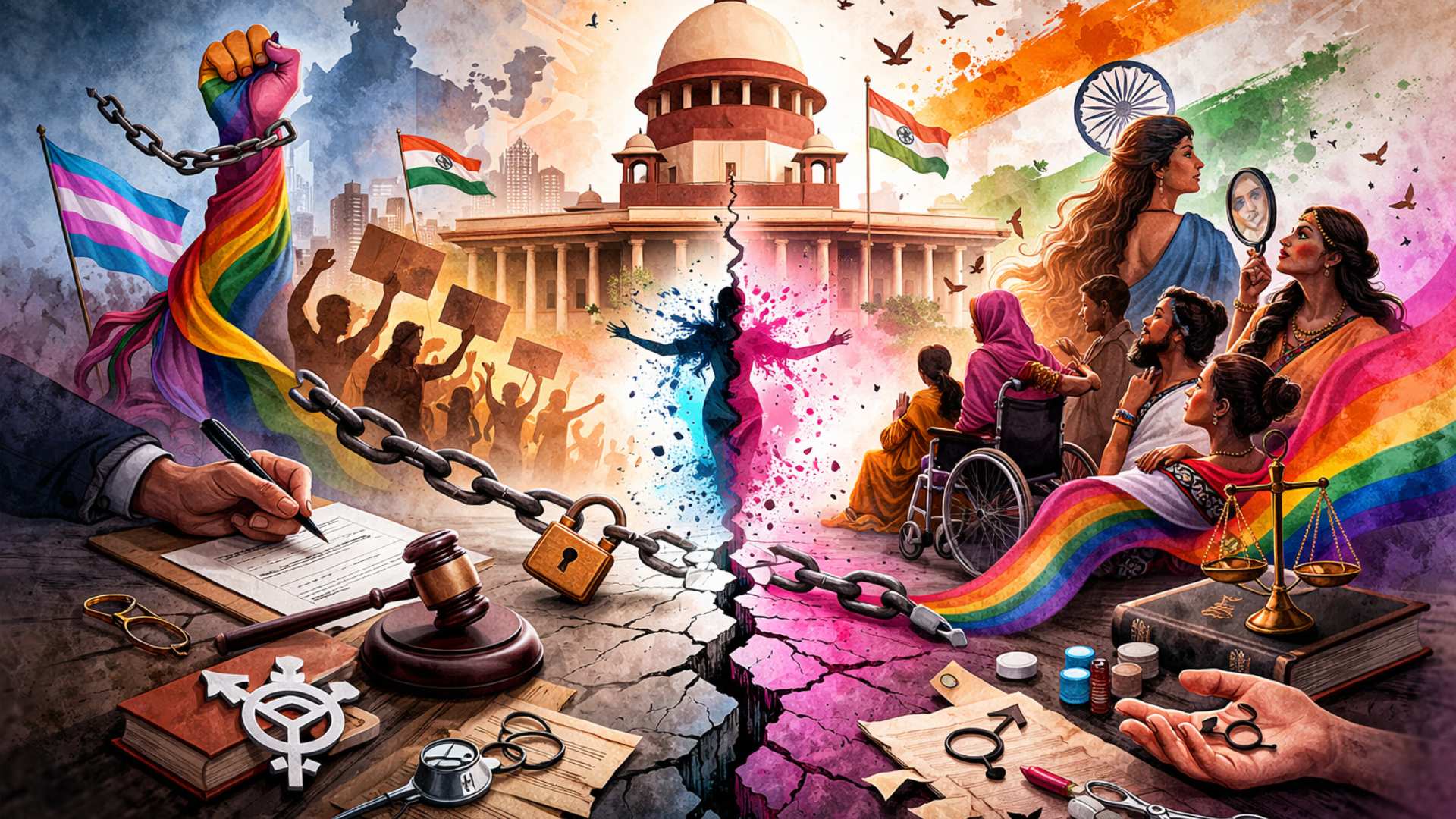
Proposed Changes to the Transgender Persons (Protection of Rights) Act, 2019

Examining the government's amendments to the Act, implications for transgender rights, and the Supreme Court's landmark judgement on gender identity.
S
Surya
3 mins read
Transgender rights debate over self identity

Introduction

The recognition of transgender rights in India marked a major constitutional milestone with the NALSA judgment (2014), which upheld self-identification of gender as a fundamental right under Article 21. According to the 2011 Census, India has over 4.8 lakh transgender persons, though actual numbers are likely higher. The proposed Transgender Amendment Bill, 2026 has sparked debate for potentially reversing this rights-based framework.


1. Background and Context

  • NALSA v. Union of India (2014):

    • Recognised third gender
    • Affirmed right to self-perceived gender identity
  • Transgender Persons Act, 2019:

    • Provided legal recognition and protection
    • Prohibited discrimination
  • Need for Amendment (Govt view):

    • Address “ambiguity” in definition
    • Improve implementation and targeting of benefits

2. Key Changes Proposed

Aspect2019 ActAmendment Bill, 2026
Gender IdentityRight to self-perceived identityRemoved
DefinitionBroad, inclusiveNarrow, biology & socio-cultural basis
CertificationDM issues certificateBased on medical board recommendation
SRS RequirementOptionalMandatory for revised gender certificate
Intersex DefinitionIncludedProposed to be removed
OffencesLimitedExpanded with stricter penalties

3. Key Provisions Explained

(a) Removal of Self-Identification

  • Omission of Section 4(2): → No explicit right to self-perceived gender identity

Significance:

  • Departure from NALSA principle of autonomy

(b) Redefined “Transgender Person”

  • Focus on:

    • Biological variations (intersex, congenital conditions)
    • Socio-cultural identities (hijra, kinner, etc.)
  • Excludes:

    • Self-perceived identities
    • Sexual orientation-based identities

(c) Medicalisation of Identity

  • Creation of “Authority” (Medical Board)

  • Certification dependent on:

    • Medical verification
    • Administrative approval

(d) Regulation of Gender Transition

  • Mandatory re-certification post-SRS
  • Reporting requirements for hospitals

(e) Strengthened Penal Provisions

  • Expanded offences:

    • Violence, abuse, exploitation
  • Punishments:

    • Up to life imprisonment + ₹5 lakh fine

(a) Violation of Fundamental Rights

  • Article 21 (Right to Life & Liberty):

    • Includes dignity, autonomy
  • Article 14 (Equality):

    • Discriminatory classification concerns

(b) Conflict with NALSA Judgment

Supreme Court Observation:

“Self-determination of gender is an integral part of personal autonomy.”

  • Amendment contradicts:

    • Self-identification principle
    • Non-requirement of medical procedures

(c) Medical vs Rights-Based Approach

ApproachFeaturesConcerns
Rights-based (NALSA)Self-identificationInclusive
Medical-based (Amendment)Certification, biologyExclusionary

5. Concerns and Criticism

(a) Exclusionary Definition

  • May exclude:

    • Gender-fluid individuals
    • Non-binary identities

(b) Increased Bureaucratic Control

  • Dependence on:

    • Medical boards
    • District Magistrates

(c) Community Concerns

  • Lack of consultation

  • Fear of:

    • Loss of identity recognition
    • Fragmentation within community

(d) Ethical and Human Rights Issues

  • Mandatory medicalisation violates:

    • Bodily autonomy
    • Informed consent principles

6. Government’s Justification

  • Existing definition:

    • “Vague and unworkable”
  • Need to:

    • Identify “genuine beneficiaries”
    • Align with other laws
  • Focus on:

    • Biological vulnerability rather than identity

7. International Perspective

  • Global trend:

    • Move towards self-identification laws

    • Examples:

      • Argentina, Ireland, Malta

UN Position:

Legal gender recognition should not require medical procedures.


8. Implications

(a) Social

  • Increased marginalisation
  • Identity-related conflicts

  • Potential for:

    • Judicial review
    • Constitutional challenges

(c) Governance

  • Tension between:

    • Welfare targeting
    • Rights protection

9. Way Forward

  • Align law with NALSA principles

  • Ensure community consultation

  • Balance:

    • Welfare delivery
    • Fundamental rights
  • Move towards:

    • Inclusive and rights-based framework

Conclusion

The Transgender Amendment Bill, 2026 reflects a shift from a rights-based to a regulatory approach in gender recognition. While the intent to streamline implementation is notable, the dilution of self-identification raises serious constitutional and ethical concerns. A balanced approach rooted in dignity, autonomy, and inclusivity is essential to uphold the spirit of the Constitution.

Quick Q&A

Everything you need to know

The Transgender Persons (Protection of Rights) Amendment Bill, 2026 proposes significant changes to the 2019 Act, particularly in the areas of definition, certification, and rights recognition. The most controversial change is the removal of the right to self-perceived gender identity, which was earlier guaranteed under Section 4(2) of the Act.

Key changes include:

  • Redefinition of transgender identity: Narrowing it to include socio-cultural identities (hijra, kinner, etc.), intersex persons, and certain biological conditions.
  • Medicalisation of identity: Introduction of a medical board (‘authority’) whose recommendation is required for certification.
  • Certification process: District Magistrate to rely on medical verification before issuing identity certificates.
  • Mandatory reporting: Medical institutions must report sex-reassignment surgeries (SRS).
  • Expanded penal provisions: Stricter punishments for offences against transgender persons.

Additionally, the Bill mandates applying for a revised certificate after SRS and limits recognition based on the new definition.

In essence, the amendments shift the framework from a rights-based and self-identification model to a more state-controlled and medically regulated system, raising important constitutional and ethical questions.

The removal of the right to self-perceived gender identity has triggered strong reactions because it directly contradicts the principles established in the landmark NALSA v. Union of India (2014) judgment. The Supreme Court had explicitly recognised self-identification of gender as a fundamental right under Article 21, linking it to dignity, autonomy, and personal liberty.

The concerns arise due to:

  • Violation of constitutional rights: It undermines the right to privacy and personal autonomy.
  • Medicalisation of identity: Requiring medical validation reduces identity to biological criteria.
  • Exclusionary definition: Many gender-diverse individuals may no longer qualify as ‘transgender’.
  • Social stigma: Increased scrutiny may reinforce discrimination.

For example, a transgender person who does not wish to undergo surgery or medical intervention may face challenges in obtaining legal recognition under the new framework.

Thus, critics argue that the amendment represents a shift from a progressive, rights-based approach to a restrictive framework, potentially reversing gains made in transgender rights over the past decade.

The NALSA judgment (2014) is a landmark ruling that fundamentally reshaped India’s legal understanding of gender identity and transgender rights. The Supreme Court recognised transgender persons as a ‘third gender’ and affirmed their right to self-identify their gender without requiring medical intervention.

Key principles established include:

  • Self-identification: Gender identity is based on an individual’s intrinsic sense of self.
  • Distinction between sex and gender: Biological sex and gender identity are अलग concepts.
  • Fundamental rights: Rights under Articles 14, 15, 19, and 21 apply equally to transgender persons.
  • No forced medical procedures: Legal recognition cannot depend on surgery or hormonal therapy.

The judgment emphasised that dignity, autonomy, and freedom of expression are central to gender identity. It also directed the government to take affirmative actions such as reservations and welfare measures.

Therefore, NALSA serves as the constitutional foundation for transgender rights in India, and any deviation from its principles—such as limiting self-identification—raises serious legal and ethical concerns.

The government’s rationale for introducing a more ‘precise’ definition of transgender persons is based on concerns about administrative clarity and targeted welfare delivery. It argues that the earlier definition was too broad, making it difficult to identify beneficiaries and implement legal provisions effectively.

Merits of this approach include:

  • Administrative efficiency: Clear definitions can help in policy targeting.
  • Prevention of misuse: Ensures benefits reach genuinely marginalised groups.
  • Legal consistency: Aligns with other statutory frameworks.

However, there are significant criticisms:
  • Exclusionary nature: It may exclude many gender-diverse individuals.
  • Contradiction with NALSA: Undermines self-identification as a fundamental right.
  • Over-medicalisation: Reduces identity to biological or surgical criteria.
  • Lack of consultation: Community stakeholders were reportedly not involved.

For instance, activists argue that limiting recognition to socio-cultural categories like ‘hijra’ ignores evolving identities such as non-binary or genderqueer persons.

Thus, while administrative clarity is important, it must be balanced with constitutional rights and inclusivity to avoid marginalising vulnerable groups further.

Redefining transgender identity in a restrictive manner can have far-reaching social and legal consequences. By narrowing the definition, the law risks excluding individuals who do not conform to specific biological or socio-cultural criteria.

Potential consequences include:

  • Legal exclusion: Individuals may lose access to legal recognition and welfare schemes.
  • Community fragmentation: Divisions may arise over who qualifies as ‘transgender’.
  • Increased discrimination: Lack of recognition can lead to social marginalisation.
  • Judicial challenges: The law may face constitutional scrutiny for violating fundamental rights.

For example, a non-binary individual who identifies outside traditional categories may not be recognised under the new definition, affecting access to rights and protections.

Additionally, such changes may undermine India’s international commitments to human rights and equality.

Therefore, restrictive definitions risk reversing progress in social inclusion and legal recognition, making it essential to adopt a more inclusive and rights-based approach.

Balancing administrative clarity with constitutional rights requires a nuanced and inclusive approach that respects both governance needs and individual freedoms. As a policymaker, the objective should be to ensure effective implementation without compromising fundamental rights.

Key strategies would include:

  • Retaining self-identification: Uphold the NALSA principle as the foundation.
  • Optional verification mechanisms: Introduce safeguards only in cases of fraud, not as a default requirement.
  • Inclusive definitions: Recognise diverse gender identities beyond traditional categories.
  • Community consultation: Involve transgender representatives in policymaking.

For example, countries like Argentina allow self-identification without medical requirements, providing a model for rights-based legislation.

Additionally, administrative efficiency can be improved through digital certification systems and awareness programmes rather than restrictive definitions.

In conclusion, a rights-based, participatory, and flexible framework is essential to ensure that governance objectives are met without undermining the dignity and autonomy of transgender persons.

Attribution

Original content sources and authors

Sign in to track your reading progress

Comments (0)

Please sign in to comment

No comments yet. Be the first to comment!