Tribal Long Marches in Maharashtra: Forest Rights, Governance Gaps, and Developmental Implications
1. Context: Tribal Mobilisation and Democratic Expression
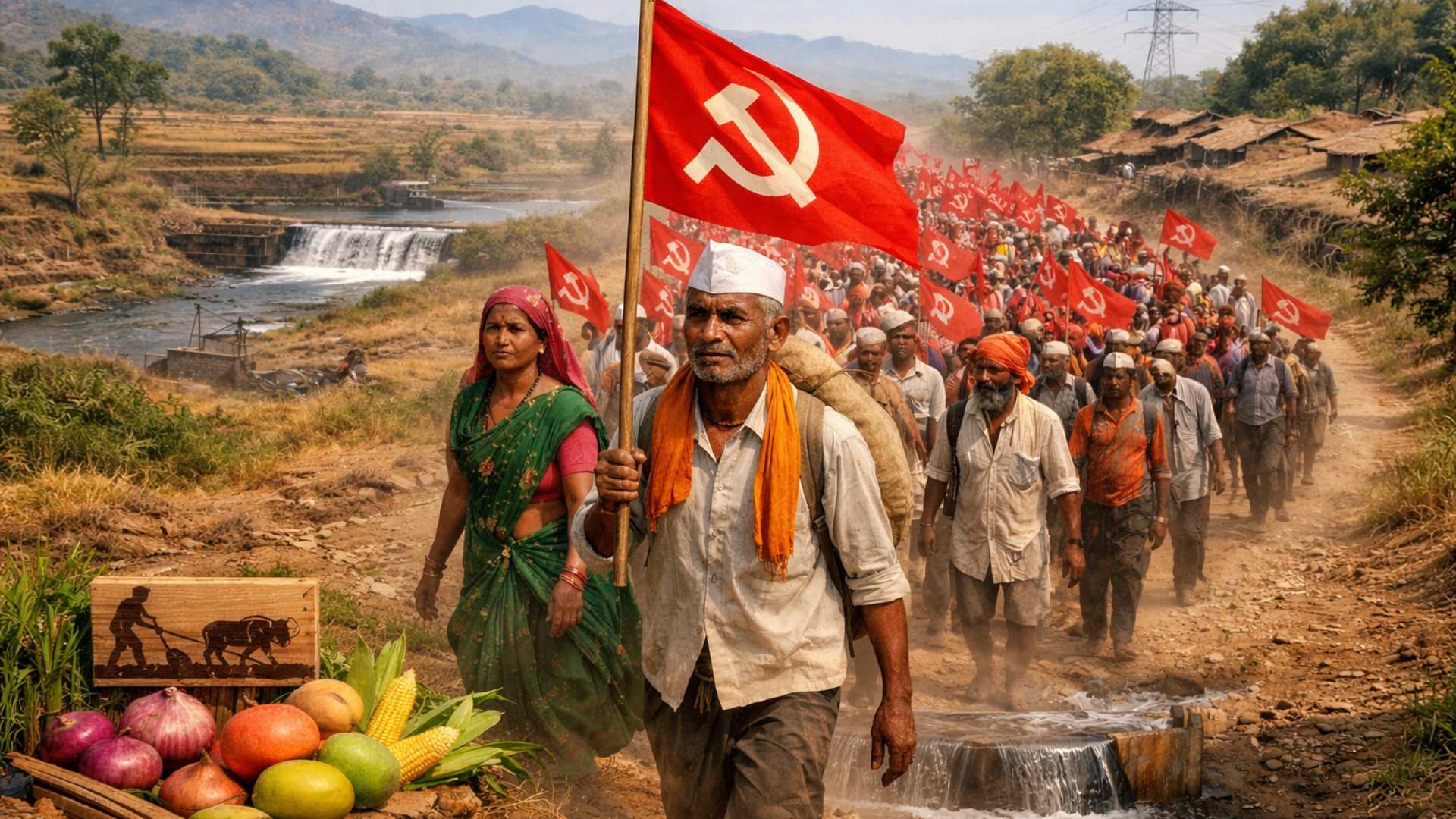
Recent long marches by tribal farmers from Palghar and Nashik districts of Maharashtra reflect persistent structural grievances related to land rights, livelihoods, and governance. Organised by the All India Kisan Sabha and CPI(M), these marches underline the continued relevance of collective mobilisation as a democratic mechanism for marginalised communities.
The marches occurred in districts with a dominant tribal population, highlighting region-specific governance failures rather than isolated discontent. While immediate administrative demands in Palghar were partially addressed, policy-level concerns triggered continued mobilisation from Nashik, indicating unresolved systemic issues.
Such movements point to gaps between legislative intent and on-ground implementation, especially in tribal welfare laws. If these governance gaps persist, they risk eroding trust in institutions and weakening democratic accountability at the grassroots level.
Mass mobilisation by tribals signals not policy resistance, but policy non-fulfilment; ignoring such expressions risks deepening alienation and governance legitimacy deficits.
2. Core Demand: Implementation of the Forest Rights Act, 2006
The central demand of the protests is the effective implementation of the Forest Rights Act (FRA), 2006, particularly the recognition of individual forest land rights for land cultivated by tribals over generations. Protesters argue that procedural shortcomings have diluted the spirit of the Act.
Tribal groups contend that land titles are often issued in formats that list village-level ownership, with individual names merely appended, thereby preventing access to government schemes, institutional credit, and crop insurance. This defeats the FRA’s objective of providing legally enforceable tenure security.
High rejection rates of claims and allocation of land far smaller than what is actually cultivated have further intensified grievances. If tenure security remains uncertain, tribals remain excluded from formal development processes despite statutory protection.
Legal recognition without enforceable individual titles converts rights into symbolic entitlements, undermining both welfare delivery and rural development.
Evidence:
- Claims disposed in Maharashtra: 3,80,966
- Titles distributed: 2,08,335
- Claims rejected: 1,72,631
- Rejection rate: ~45%
- Pending claims: 28,190
“There is a constant ideological tension between conservation versus forest rights.” — Madhav Gadgil, The India Forum
3. Irrigation, Agriculture, and Livelihood Constraints
Beyond land rights, tribals have demanded small dams and river-linking projects to address chronic irrigation deficits. They argue that arresting west-flowing rivers and diverting water to east-flowing regions can enable multi-cropping and reduce livelihood vulnerability.
Currently, most tribal farmers cultivate only one seasonal paddy crop, making incomes highly unstable. Improved irrigation could facilitate diversification into crops such as corn, soybean, onion, millets, fruits, and horticulture, improving resilience and income security.
They have also demanded Minimum Support Price (MSP) coverage for non-paddy crops, reflecting a push to integrate tribal agriculture into mainstream market and price-support mechanisms. Without such support, diversification may remain economically unviable.
Livelihood security in tribal areas depends not merely on land ownership, but on water access and market integration; ignoring these linkages perpetuates subsistence farming.
4. Employment and Local Self-Governance under PESA, 1996
Another major demand concerns pending recruitments under the Panchayats (Extension to Scheduled Areas) Act, 1996 (PESA). The Act aims to empower tribal communities through self-governance and local control over resources and institutions.
Tribal youth have highlighted delays in recruitment processes, which limit employment opportunities and weaken the operationalisation of PESA. Inadequate staffing in local institutions dilutes decentralisation and undermines participatory governance.
Failure to implement PESA in letter and spirit risks converting constitutional decentralisation into a procedural formality, weakening tribal agency and local accountability.
Decentralisation without functional empowerment reduces self-governance to symbolism, weakening democratic inclusion in Scheduled Areas.
“Real democracy means power at the grassroots.” — B.R. Ambedkar
5. Education, Electricity, and Human Development Gaps
The protests also raised concerns regarding vacant teacher posts, inadequate staffing in Zilla Parishad schools, and limited educational opportunities for tribal children. Persistent shortages affect learning outcomes and intergenerational mobility.
Additionally, the demand for 24-hour electricity supply reflects the link between basic infrastructure and human development. Electricity access influences education, irrigation, storage, and small enterprises.
If foundational services such as education and power remain deficient, gains from land rights and livelihood interventions may not translate into sustainable human development.
Human development deficits can neutralise economic rights; governance failures in basic services compound marginalisation.
6. Governance Challenges: Claim Rejections and Administrative Interpretation
Government data indicates that over 45% of FRA claims have been rejected, revealing significant administrative filtering. Authorities have acknowledged discrepancies, citing issues such as digitisation-induced errors and differing interpretations of the Act.
The State government has initiated dialogue with protest leaders and expressed willingness to resolve issues. However, incremental implementation without institutional clarity risks prolonging disputes.
Experts argue that misinterpretation of FRA provisions stems from a conservation-centric administrative mindset that resists human presence in forests, contrary to the Act’s participatory conservation framework.
When administrative interpretation overrides legislative intent, welfare laws lose transformative capacity and become sources of conflict.
“Forest dwellers must be seen as partners in conservation, not obstacles.” — Madhav Gadgil
Conclusion
The tribal long marches in Maharashtra highlight enduring governance gaps in land rights, decentralisation, and service delivery. Effective implementation of the Forest Rights Act and PESA, coupled with irrigation support, market access, and human development investments, is essential to translate constitutional and statutory promises into lived realities. Addressing these issues institutionally can strengthen democratic inclusion, reduce conflict, and promote sustainable development in Scheduled Areas.